Student Loan Consolidation Cost: The Three Charges Priced in Dollars (2026)
Federal consolidation has no fee, yet it can cost thousands: a rate round-up, capitalized interest and a longer term, each priced in dollars from official examples.
Interest capitalization is what happens when unpaid interest on a student loan is added to the principal balance. From that point on, interest is charged on the larger balance, so the borrower pays interest on interest. It is one of the least visible costs in student lending, because nothing is billed on the day it happens: the balance simply steps up and every later payment is calculated from the higher figure.
Articles under this tag look at when capitalization is triggered and what it costs in dollars. On federal loans the most common trigger for borrowers reading this site is consolidation. When loans are combined into a Direct Consolidation Loan, any interest that is outstanding on the old loans becomes part of the new principal. Federal Student Aid publishes a worked example in which $3,890 of unpaid interest on a $27,000 loan lifts the 20-year repayment total from $46,425 to $53,113. We use that example as the baseline and show how the cost changes with balance and term.
The practical lesson repeated across these articles is simple. Capitalization only applies to interest that is unpaid at the moment of the trigger, so asking the servicer for the accrued interest figure and paying it before a consolidation removes the cost entirely. Where capitalization cannot be avoided, the articles here show how to estimate it in advance, so the decision is made with the real number in view rather than a surprise on the first statement.
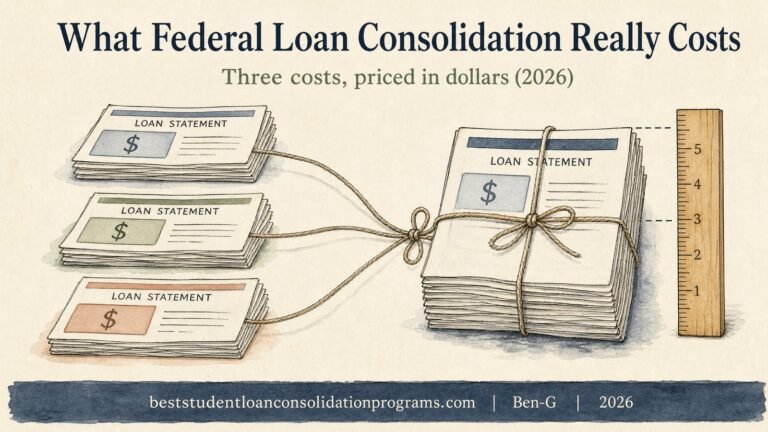
Federal consolidation has no fee, yet it can cost thousands: a rate round-up, capitalized interest and a longer term, each priced in dollars from official examples.