Student Loan Refinancing

Student loan refinancing replaces one or more existing student loans, federal or private, with a single new private loan from a bank, credit union or online lender. The new loan carries a new interest rate, a new term and a new lender, and the old loans are paid off and closed. Refinancing is the only way to lower the interest rate on a student loan, because federal consolidation only averages existing rates. It is also the step that permanently removes federal loans from the federal system: income-driven repayment, Public Service Loan Forgiveness, deferment, forbearance and the new Repayment Assistance Plan (RAP) are all gone once a federal loan is refinanced privately.

This category holds data-driven articles for U.S. borrowers deciding whether a refinance is worth it, who actually gets approved, what it costs in rate and what it does to a credit score. Every figure on these pages is tied to a named primary source: lender investor presentations and SEC filings, marketplace rate tables, Federal Reserve Bank of New York household-credit reports, FICO and VantageScore research notes, and the lenders’ own eligibility pages.

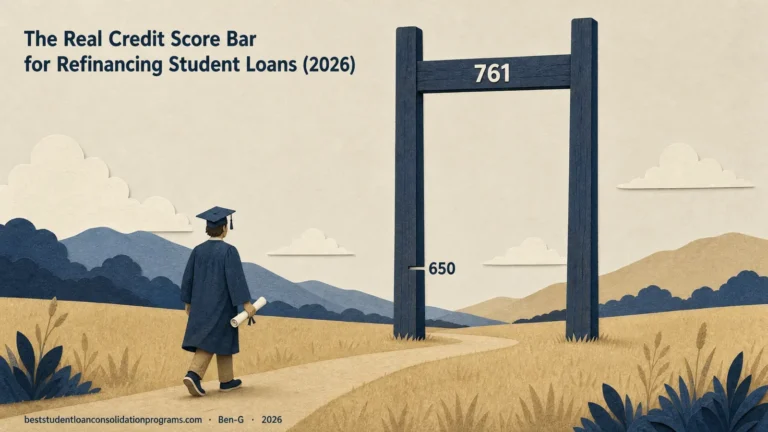
Who gets approved. Lenders publish a minimum credit score, usually somewhere between 650 and 720, but the minimum is a filter rather than a forecast. The only major lender that discloses the profile of borrowers it actually approves is SoFi, whose student loan book carried a weighted-average FICO score of 761 and a weighted-average income of $154,000 in the third quarter of 2026, according to its investor presentation. That is more than a hundred points above the lowest published floor in the market and about seventy points above the average millennial score of 689 reported by Experian. ELFI is the one lender that prints its full rule set on its own page: a 680 score, $35,000 in income and 36 months of credit history. SoFi and Laurel Road publish no minimum at all. Borrowers who apply with a cosigner were roughly 1.5 times as likely to be approved on the Credible marketplace over the past year.

What it costs in rate. Credible’s prequalified-borrower data for September 2026 shows the price of each credit band on a ten-year fixed refinance: 5.87% at 780 and above, 6.53% at 720 to 779, 7.16% at 680 to 719, and 9.47% at 640 to 679. The step below 680 is the cliff where a refinance stops beating the fixed rate most federal borrowers already hold.

What it does to your credit. A refinance application adds one hard inquiry, which FICO says costs most people fewer than five points and stops counting after twelve months; new credit as a whole is only 10% of a FICO Score. Closing the old installment accounts and opening one new one shifts the average age of accounts, which is why some borrowers see a temporary dip. By contrast, the delinquency a refinance may help avoid is expensive: when missed federal payments returned to credit reports in 2025, the New York Fed counted 2.2 million newly delinquent borrowers whose scores fell by more than a hundred points, and FICO’s 2026 Credit Insights put the average drop for consumers with a recent student loan delinquency at 38 points.

Who should not refinance. Anyone pursuing PSLF, anyone who needs an income-driven plan, anyone whose income is unstable, and anyone whose score sits below the 680 cliff will usually be better served by the federal options covered in our Federal Loan Consolidation category. Private refinancing suits borrowers with stable six-figure incomes, scores in the mid-700s and loans whose rates are above today’s market.

How these pages are built. Each article in this category starts from a question borrowers keep asking in forums without getting a sourced answer, checks that no comprehensive answer already exists, and then assembles the numbers from primary documents. Every statistic links to the document it came from, each page lists its methodology and the degraded steps in its research, and figures that cannot be traced to a primary source are labelled as such. The pages are updated when the underlying reports are, and the date of the last update is shown on each article.