Does refinancing student loans hurt your credit? Only slightly and only for a year, while the missed payment a refinance can prevent costs far more, as the numbers below show.
KEY TAKEAWAYS
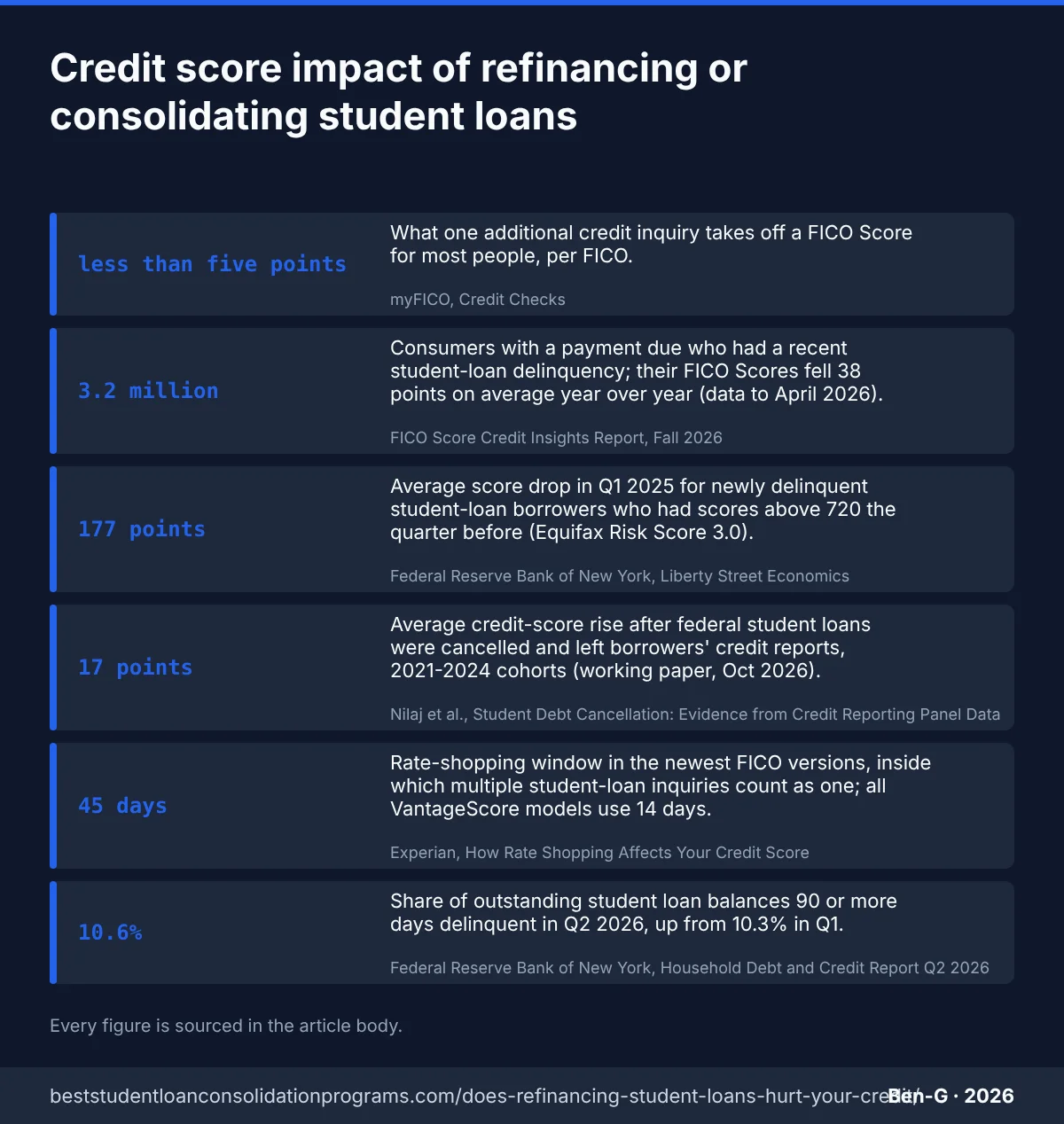
- → less than five points What one additional credit inquiry takes off a FICO Score for most people, per FICO. (myFICO, Credit Checks, 2026)
- → 3.2 million Consumers with a payment due who had a recent student-loan delinquency; their FICO Scores fell 38 points on average year over year (data to April 2026). (FICO Score Credit Insights Report, Fall 2026, 2026)
- → 177 points Average score drop in Q1 2025 for newly delinquent student-loan borrowers who had scores above 720 the quarter before (Equifax Risk Score 3.0). (Federal Reserve Bank of New York, Liberty Street Economics, 2025)
- → 17 points Average credit-score rise after federal student loans were cancelled and left borrowers' credit reports, 2021-2024 cohorts (working paper, Oct 2026). (Nilaj et al., Student Debt Cancellation: Evidence from Credit Reporting Panel Data, 2026)
- → 45 days Rate-shopping window in the newest FICO versions, inside which multiple student-loan inquiries count as one; all VantageScore models use 14 days. (Experian, How Rate Shopping Affects Your Credit Score, 2026)
- → 10.6% Share of outstanding student loan balances 90 or more days delinquent in Q2 2026, up from 10.3% in Q1. (Federal Reserve Bank of New York, Household Debt and Credit Report Q2 2026, 2026)
Does refinancing student loans hurt your credit? Every refinance lender has a page saying the application will cost you “a few points.” None of them puts that number next to the one that matters. In the year to April 2026, 3.2 million consumers with a payment due had a recent student-loan delinquency, and their FICO Scores fell 38 points on average (FICO Score Credit Insights Report, Fall 2026 (Business Wire release), 2026). The refinance application that borrowers hesitate over adds one hard inquiry, which FICO itself says takes less than five points off most people’s scores (myFICO, Credit Checks, 2026). Those two figures have never been printed on the same axis, which is why so many borrowers protect a score from a five-point dent while leaving it exposed to a thirty-eight-point hole.
This page lays the refinance cost out driver by driver: the inquiry, the new account, the closed loans, and the rate-shopping windows that decide whether three applications count as one or three. It then puts that cost beside what the 2025 return of delinquency reporting actually did to scores, using FICO’s, the New York Fed’s, TransUnion’s and VantageScore’s own measurements, and beside the one study that measured what happens when student loans leave a credit report entirely. One honest caveat sits over the refinance half: no bureau publishes a panel measurement of refinance borrowers’ scores at one, three and six months. What exists are the model rules and the measured events around them, and that is what you will find below.
1 How Many Points Does a Refinance Application Cost? Fewer Than 5, Weighted at 10%
One hard inquiry costs most people less than five points on a FICO Score, inquiries and new credit together carry a 10% weight, and the inquiry stops affecting the score after a year (myFICO, Credit Checks, 2026). The rate check that precedes the application is a soft credit pull at SoFi and most lenders, which does not touch the score at all (SoFi, Student Loan Refinancing, 2026).
| METRIC | VALUE | SOURCE |
|---|---|---|
| Score impact of one additional hard inquiry, most people | less than five points | myFICO, Credit Checks |
| Weight of inquiries and new credit in a FICO Score | 10% | myFICO, Credit Checks |
| How long one inquiry affects a FICO Score | a year | myFICO, Credit Checks |
| Weight of payment history (the delinquency factor) | 35% | Experian, Will Paying Off a Loan Improve Credit? |
| Weight of length of credit history (the new-account factor) | 15% | myFICO, Length of Credit History |
| SoFi rate check: type of credit pull | soft credit pull | SoFi, Student Loan Refinancing |
| Bankruptcy risk with six or more inquiries | up to eight times | myFICO, Credit Checks |
| Practitioner estimate of the whole refinance | fewer than 5 points (commonly cited; no primary source traceable) | Tate Law, Does Refinancing Student Loans Hurt Your Credit? |
The arithmetic is not subtle. Payment history is 35% of the score and length of credit history 15% (Experian, Will Paying Off a Loan Improve Credit?, 2024); inquiries share a 10% slice with every other form of new credit. A single refinance inquiry therefore moves a small fraction of a small factor, and FICO caps the typical effect at less than five points. The one place the number grows is volume: FICO’s own research finds people with six or more inquiries up to eight times more likely to declare bankruptcy than people with none (myFICO, Credit Checks, 2026), which is why the model treats a cluster of applications outside a shopping window as a risk signal rather than a rounding error.
The second driver is the new account itself. Opening it lowers the average age of your accounts, and the length-of-history factor weighs 15% (myFICO, Length of Credit History, 2026). On a file with a decade of cards and an auto loan, one new tradeline barely moves the average; on a file whose only accounts are the student loans being replaced, it can. That is the honest reason two borrowers refinancing the same balance report different dips, and it is the part no lender’s FAQ quantifies. The practitioner estimate that the whole event costs fewer than 5 points (Tate Law, Does Refinancing Student Loans Hurt Your Credit?, 2026) is consistent with the model rules, but it is an estimate, and this page labels it as one rather than dressing it up as a measurement.
2 How Many Lenders Can You Apply To Without Extra Damage? 45 Days on New FICO, 14 on VantageScore
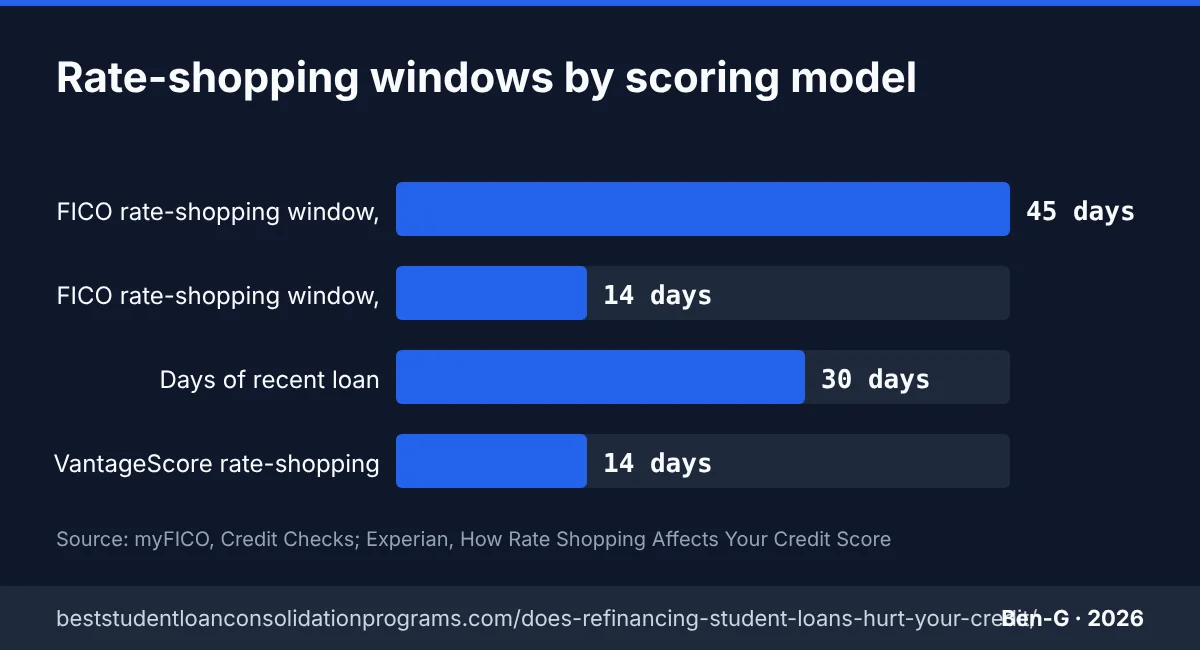
The newest FICO versions bundle student-loan inquiries made inside a 45-day window into one; older FICO versions use 14-day (myFICO, Credit Checks, 2026). Every VantageScore model uses a 14-day window (Experian, How Rate Shopping Affects Your Credit Score, 2026). FICO also ignores loan inquiries from the past 30 days when it scores you, and an inquiry stays on the report for two years.
| METRIC | VALUE | SOURCE |
|---|---|---|
| FICO rate-shopping window, newest versions | 45-day | myFICO, Credit Checks |
| FICO rate-shopping window, older versions | 14-day | myFICO, Credit Checks |
| Recent loan inquiries FICO ignores when scoring | 30 days | myFICO, Credit Checks |
| VantageScore rate-shopping window, all models | 14-day | Experian, How Rate Shopping Affects Your Credit Score |
| How long a hard inquiry stays on the report | two years | myFICO, Credit Checks |
| How long it affects a FICO Score | a year | myFICO, Credit Checks |
The practical rule falls out of the smaller number. A borrower who applies to three lenders inside 14-day is scored as if one inquiry happened, whichever model the next lender pulls; a borrower who spreads the same three applications over two months collects three. The 45-day window on the newest FICO versions is generous, but you do not get to choose which version a lender uses, and older versions still in circulation use 14-day (myFICO, Credit Checks, 2026). The 30 days grace period is a separate mechanism: FICO ignores loan inquiries that young when it computes the score, so a second lender pulling your file a week after the first sees your pre-application number.
The timeline on the other side is just as fixed. The inquiry sits on the report for two years but counts toward the score for a year (myFICO, Credit Checks, 2026). There is no measured recovery curve for refinance borrowers, and this page will not invent one; what the rules say is that whatever the inquiry cost, it is gone from the calculation after twelve months, and the new account’s age effect fades as the account ages. The event that does not fade on that schedule is the one in the next two sections.
3 Does Refinancing Student Loans Hurt Your Credit When the Old Loans Close? The Only Measurement Says +17 Points
A closed account in good standing stays on the report for 10 years (American Express Credit Intel, 2026) and its payment history keeps counting positively for 10 years (Experian, Will Paying Off a Loan Improve Credit?, 2024). The only panel study of student loans actually leaving credit reports found scores rose 17.4 points on average after cancellation, 15.5 after adjusting for prior drift (Nilaj et al., working paper (Oct 26, 2026), 2026).
| METRIC | VALUE | SOURCE |
|---|---|---|
| Closed account in good standing stays on the report | 10 years | American Express Credit Intel |
| Paid-loan payment history keeps counting | 10 years | Experian, Will Paying Off a Loan Improve Credit? |
| New delinquency stays on the report | seven years | Federal Reserve Bank of New York, Liberty Street Economics (March 2025) |
| Average score rise after student debt cancellation | 17.4 | Nilaj et al., working paper (Oct 26, 2026) |
| Same, adjusted for prior drift | 15.5 | Nilaj et al., working paper (Oct 26, 2026) |
| Range of the gain across cancellation cohorts | 12 to 22 | Nilaj et al., working paper (Oct 26, 2026) |
| Rise in share scoring 700 or above | 7.1 pp | Nilaj et al., working paper (Oct 26, 2026) |
| Rise in homeownership rate, four years on | 1.2 pp | Nilaj et al., working paper (Oct 26, 2026) |
The fear that paying off or closing a loan hurts you has a real mechanism behind it and a wrong conclusion in front of it. Experian is explicit that a payoff can lower a score briefly if the loan was your only installment account, because credit mix is (Experian, Will Paying Off a Loan Improve Credit?, 2024) a scored factor; it is equally explicit that the closed account’s history keeps counting for 10 years. A refinance does not even trigger the mix effect, because the old installment loans are replaced by a new one. What remains is the age effect from the previous section, and nothing else.
The strongest evidence on the direction of the net effect comes from the opposite extreme. Nilaj and co-authors tracked fifteen quarterly cohorts of borrowers whose federal loans were cancelled between 2021 and 2024 in a two-percent national credit panel, and found scores rose 17.4 points from a pre-cancellation mean of 701, with every cohort gaining between 12 to 22 points and the share of borrowers at 700 or above rising 7.1 pp (Nilaj et al., working paper (Oct 26, 2026), 2026). Cancellation removes the balance as well as the account, so it is not a refinance; but if closing student loan tradelines carried a meaningful penalty, it would show up here as a drag on that gain, and it does not. The paper is a working paper, dated October 2026 and not yet peer-reviewed, and the homeownership effect of 1.2 pp it reports (Nilaj et al., working paper (Oct 26, 2026), 2026) is the kind of downstream result that will get it read. For a borrower weighing a consolidation or refinance, the takeaway is narrow and useful: the closing of the old loans is not where the risk lives.
4 What Actually Costs Triple Digits? A 90-Day Delinquency: 38 Points on Average, 177 for Prime Borrowers
FICO measured an average 38-point drop for the 3.2 million consumers with a recent student-loan delinquency, against gains of 6 points for consistent payers and 16 for borrowers with no recent delinquency (FICO Score Credit Insights Report, Fall 2026, 2026). The New York Fed found newly delinquent borrowers lost 74, 140 and 177 points by prior score band in Q1 2025 (Federal Reserve Bank of New York, Liberty Street Economics (May 2025), 2025).
| METRIC | VALUE | SOURCE |
|---|---|---|
| Average FICO change, recent student-loan delinquency (year to April 2026) | 38 points lost | FICO Score Credit Insights Report, Fall 2026 |
| Average FICO change, consistent payers | 6 points gained | FICO Score Credit Insights Report, Fall 2026 |
| Average FICO change, no recent delinquency | 16 points gained | FICO Score Credit Insights Report, Fall 2026 |
| Newly delinquent, prior score below 620, Q1 2025 | 74 points lost | Federal Reserve Bank of New York, Liberty Street Economics (May 2025) |
| Newly delinquent, prior score 620-719, Q1 2025 | 140 points lost | Federal Reserve Bank of New York, Liberty Street Economics (May 2025) |
| Newly delinquent, prior score above 720, Q1 2025 | 177 points lost | Federal Reserve Bank of New York, Liberty Street Economics (May 2025) |
| Newly delinquent borrowers who lost more than 100 points | 2.2 million | Federal Reserve Bank of New York, Liberty Street Economics (May 2025) |
| Historical drop, prior score 760+, 2016-2019 | 171 points lost | Federal Reserve Bank of New York, Liberty Street Economics (March 2025) |
| Borrowers who defaulted after the on-ramp, Jan-Feb 2025 | 63 points lost | TransUnion, May 2025 Student Loan Update |
| VantageScore projected maximum decline for missed payments | 129 points lost | VantageScore (Feb 27, 2025) |
The delinquency numbers are the reason this page exists. When servicers resumed reporting missed payments in early 2025 after the pandemic pause and the year-long on-ramp, the New York Fed’s consumer credit panel caught the hit in a single quarter: 2.2 million newly delinquent borrowers dropped more than 100 points, and more than a million dropped at least 150 (Federal Reserve Bank of New York, Liberty Street Economics (May 2025), 2025). The damage ran inversely to the starting score, which is the cruelest feature of the payment-history factor: a borrower under 620 lost 74 points on average, one between 620 and 719 lost 140, and one above 720 lost 177. The Fed’s own back-test on 2016-2019 data had predicted exactly this shape, with super-prime borrowers losing 171 points on a new 90-day delinquency (Federal Reserve Bank of New York, Liberty Street Economics (March 2025), 2019).
The other measurements line up. TransUnion put the average decline at 63 points for borrowers who went into default in the first two months of 2025 (TransUnion, May 2025 Student Loan Update, 2025); VantageScore had projected drops of up to 129 points for borrowers who kept missing payments, and gains of up to eight for those who resumed on time (VantageScore (Feb 27, 2025), 2025). FICO’s fall 2026 report then measured the full year: 38 points lost on average by delinquent borrowers, while everyone who simply kept paying gained 6 (FICO Score Credit Insights Report, Fall 2026, 2026). Set beside the refinance cost of less than five points, the comparison is not close, and the asymmetry extends to duration. The inquiry stops counting after a year; the delinquency stays on the report for seven years (Federal Reserve Bank of New York, Liberty Street Economics (March 2025), 2025). A refinance or consolidation that gets a borrower a payment they can make is, on these numbers, the cheapest credit-score decision in the whole student-loan system.
5 Where Do Student-Loan Borrowers Stand in 2026? A 714 Average, 10.6% of Balances 90 Days Late
The average U.S. FICO Score held at 714 in the year to April 2026 (FICO Score Credit Insights Report, Fall 2026, 2026) and the average VantageScore 4.0 at 701 (VantageScore CreditGauge, June 24 2026, 2026), while 10.6% of the $1.65 trillion in outstanding student loan balances was 90 or more days delinquent in Q2 2026 (Federal Reserve Bank of New York, Household Debt and Credit Report Q2 2026, 2026). Among 24.2 million Credit Karma members with student loans, 9.7% had a loan 90 days past due and averaged a 549 score, against 677 for members fully current (Credit Karma, 2026 Student Loan Debt Report, 2026).
| METRIC | VALUE | SOURCE |
|---|---|---|
| Average U.S. FICO Score, data to April 2026 | 714 | FICO Score Credit Insights Report, Fall 2026 |
| Share of consumers with FICO Scores of 750 or higher | 48.1% | FICO Score Credit Insights Report, Spring 2026 (Business Wire) |
| Average VantageScore 4.0, May 2026 | 701 | VantageScore CreditGauge, June 24 2026 |
| Outstanding student loan debt, Q2 2026 | $1.65 trillion | Federal Reserve Bank of New York, Household Debt and Credit Report Q2 2026 |
| Student loan balances 90+ days delinquent, Q2 2026 | 10.6% | Federal Reserve Bank of New York, Household Debt and Credit Report Q2 2026 |
| Credit Karma members with a student loan 90+ days past due | 9.7% | Credit Karma, 2026 Student Loan Debt Report |
| Average VantageScore 3.0, members with a delinquent student loan | 549 | Credit Karma, 2026 Student Loan Debt Report |
| Average VantageScore 3.0, members fully current | 677 | Credit Karma, 2026 Student Loan Debt Report |
| Share 90+ days past due, members scoring 599 or below | 22.7% | Credit Karma, 2026 Student Loan Debt Report |
| Federal borrowers 90+ days past due, Feb 2025 (vs 11.5% in Feb 2020) | 20.5% | TransUnion, May 2025 Student Loan Update |
| Prime-tier federal borrowers 90+ days past due, Feb 2025 | 7.5% | TransUnion, May 2025 Student Loan Update |
The backdrop makes the delinquency figures structural rather than a one-quarter shock. Nearly two years after reporting resumed, 10.6% of student loan balances were seriously delinquent in Q2 2026 and still rising (Federal Reserve Bank of New York, Household Debt and Credit Report Q2 2026, 2026), and Credit Karma’s cut of TransUnion files as of September 30, 2026 shows the same picture at the member level: 9.7% with a loan 90 days late, and a 128-point spread in average score between those members and the ones fully current (Credit Karma, 2026 Student Loan Debt Report, 2026). The exposure is concentrated where it does most damage. 22.7% of members scoring 599 or below are 90 days late on a student loan, against 0.9% of members at 720 and above, so the borrowers with the least score to lose are the ones losing it.
The national averages hide this. The average FICO Score sat at 714, 48.1% of consumers scored 750 or higher (FICO Score Credit Insights Report, Spring 2026 (Business Wire), 2026), and the VantageScore average held at 701, all essentially flat, because the delinquent minority is small enough to disappear into a population mean. TransUnion’s February 2025 reading already showed the shift inside the federal portfolio: 20.5% of borrowers with a payment due were 90 days late, up from 11.5% in February 2020, and the prime tier’s rate had gone from 1.3% to 7.5% (TransUnion, May 2025 Student Loan Update, 2025). Those are the borrowers for whom a refinance is both available and, on this page’s numbers, worth far more than the five points it costs to apply.
Explore every figure in this article
Methodology
Sources. myFICO’s guidance on credit inquiries; FICO’s Fall 2026 Credit Insights release; the Federal Reserve Bank of New York’s Liberty Street Economics analysis and Q2 2026 Household Debt and Credit report; VantageScore and Experian research; the Credit Karma 2026 report; and a working paper by Nilaj et al. (October 2026) on scores after student loans left credit reports.
How the figures were checked. Every number was compared against the page or document it comes from in early November 2026. Figures inside PDFs (the New York Fed report and the working paper) were confirmed by opening the document itself.
Limitations. No primary source measures how many months a score takes to recover after a refinance, so recovery timing is described from the scoring rules (an inquiry counts for twelve months) rather than from measured data. The Nilaj et al. paper is a working paper, not yet peer reviewed. One law-firm estimate of the overall effect is marked as secondary and disputed.
Frequently Asked Questions
How many points does refinancing student loans drop your credit score?
The application adds one hard inquiry, and FICO says one additional inquiry takes less than five points off most people's scores. Inquiries make up 10% of a FICO Score and stop counting after a year. Practitioners put the whole refinance at fewer than five points; nobody has published a measured panel figure. (myFICO, Credit Checks, 2026)
Does checking refinance rates hurt your credit?
Not at the quote stage. SoFi's disclosure, typical of the market, says the rate check is a soft credit pull that will not affect your credit score; a hard pull happens only if you continue to a full application. Compare offers on soft pulls first, then apply. (SoFi, Student Loan Refinancing, 2026)
How long do I have to apply to several lenders without extra damage?
The newest FICO versions treat student-loan inquiries made within 45 days as one; older FICO versions and every VantageScore model use 14 days. Keep all hard applications inside 14 days and both models see a single inquiry. FICO also ignores loan inquiries from the past 30 days when scoring. (Experian, How Rate Shopping Affects Your Credit Score, 2026)
Will closing my old student loans lower my score?
A closed account in good standing stays on your report for up to 10 years and its payment history keeps counting. The only panel study of student loans actually leaving credit reports found scores rose 17 points on average after cancellation, so the net effect of paid-off loans is not negative. (Nilaj et al., working paper (Oct 26, 2026), 2026)
How much does a missed student loan payment hurt compared with refinancing?
FICO reports that 3.2 million consumers with a recent student-loan delinquency lost 38 points on average in the year to April 2026. The New York Fed found newly delinquent borrowers who had scores above 720 lost 177 points on average in early 2025. A refinance inquiry costs fewer than five. (FICO Score Credit Insights Report, Fall 2026, 2026)
How long does a student loan delinquency stay on my credit report?
Seven years, according to the New York Fed's March 2025 analysis of the delinquencies returning to credit reports. A hard inquiry, by contrast, stays on the report for two years and affects FICO Scores for one. (Federal Reserve Bank of New York, Liberty Street Economics (March 2025), 2025)
Does federal Direct Consolidation affect credit the same way as private refinancing?
The mechanics on the report are the same: a new installment account appears and the old loans close in good standing. Length of credit history is 15% of a FICO Score and the new account lowers the average age, which matters most on thin files. Federal consolidation, however, does not require a credit check for Direct Consolidation Loans, so the inquiry component is absent. (myFICO, Length of Credit History, 2026)
Sources & References
- FICO Score Credit Insights Report, Fall 2026. “FICO Score Credit Insights Report: Average FICO Score Holds Steady at 714 as Consumers Show Resilience.” finviz.com/news/385222/fico-score-credit-insights-report-average-fico-score-hold. Accessed 2026-11-07.
- myFICO, Credit Checks. “Credit Checks: What are credit inquiries and how do they affect your FICO Score?.” myfico.com/crediteducation/CreditChecks.aspx. Accessed 2026-11-07.
- myFICO, Length of Credit History. “Length of Credit History.” myfico.com/credit-education/credit-scores/length-of-credit-history. Accessed 2026-11-07.
- Experian, Will Paying Off a Loan Improve Credit?. “Will Paying Off a Loan Improve Credit?.” experian.com/blogs/ask-experian/will-paying-off-a-loan-improve-credit/. Accessed 2026-11-07.
- Experian, How Rate Shopping Affects Your Credit Score. “How Rate Shopping Affects Your Credit Score.” experian.com/blogs/ask-experian/how-does-rate-shopping-affect-credit-score. Accessed 2026-11-07.
- American Express Credit Intel. “How Long Do Closed Accounts Stay on Your Credit Report?.” americanexpress.com/en-us/credit-cards/credit-intel/how-long-do-closed-accounts-. Accessed 2026-11-07.
- SoFi, Student Loan Refinancing. “Student Loan Refinancing.” sofi.com/refinance-student-loan/. Accessed 2026-11-07.
- Tate Law, Does Refinancing Student Loans Hurt Your Credit?. “Does Student Loan Refinance Hurt Your Credit Score?.” tateesq.com/learn/does-refinancing-student-loans-hurt-your-credit. Accessed 2026-11-07.
- Federal Reserve Bank of New York, Liberty Street Economics (May 2025). “Student Loan Delinquencies Are Back, and Credit Scores Take a Tumble.” libertystreeteconomics.newyorkfed.org/2025/05/student-loan-delinquencies-are-bac. Accessed 2026-11-07.
- Federal Reserve Bank of New York, Liberty Street Economics (March 2025). “Credit Score Impacts from Past Due Student Loan Payments.” libertystreeteconomics.newyorkfed.org/2025/03/credit-score-impacts-from-past-due. Accessed 2026-11-07.
- Federal Reserve Bank of New York, Household Debt and Credit Report Q2 2026. “Quarterly Report on Household Debt and Credit, 2026:Q2.” newyorkfed.org/medialibrary/interactives/householdcredit/data/pdf/hhdc_2026q2.pd. Accessed 2026-11-07.
- TransUnion, May 2025 Student Loan Update. “May 2025 Student Loan Update.” newsroom.transunion.com/may-2025-student-loan-update/. Accessed 2026-11-07.
- VantageScore (Feb 27, 2025). “VantageScore Analysis Finds Benefits for Borrowers Who Resume Student Loan Payments, While Many Will See Lower Credit Scores.” vantagescore.com/vantagescore-analysis-finds-benefits-for-borrowers-who-resume-s. Accessed 2026-11-07.
- VantageScore CreditGauge, June 24 2026. “VantageScore CreditGauge May 2026: Lending Activity Picks Up as Borrowers Adapt to Higher Rates.” vantagescore.com/resources/knowledge-center/press_releases/vantagescore-creditga. Accessed 2026-11-07.
- Credit Karma, 2026 Student Loan Debt Report. “2026 Credit Karma Student Loan Debt Report.” creditkarma.com/insights/i/student-loan-debt-report. Accessed 2026-11-07.
- Nilaj et al., working paper (Oct 26, 2026). “Student Debt Cancellation: Evidence from Credit Reporting Panel Data.” marshallsteinbaum.org/wp-content/uploads/2026/10/Nilaj-et-al-2026-Effect-of-Stud. Accessed 2026-11-07.
- FICO Score Credit Insights Report, Spring 2026 (Business Wire). “FICO Score Credit Insights Report: Average FICO Score Dips to 714.” businesswire.com/news/home/20260324459421/en/. Accessed 2026-11-07.
Last updated:
This article is general information for U.S. student loan borrowers, not financial or legal advice. Confirm details with your loan servicer or studentaid.gov before acting. See our editorial policy and disclaimer.