Author: Ben-G

  • PSLF Payment Count After Consolidation: How Many Payments You Actually Keep (2026)

    PSLF Payment Count After Consolidation: How Many Payments You Actually Keep (2026)

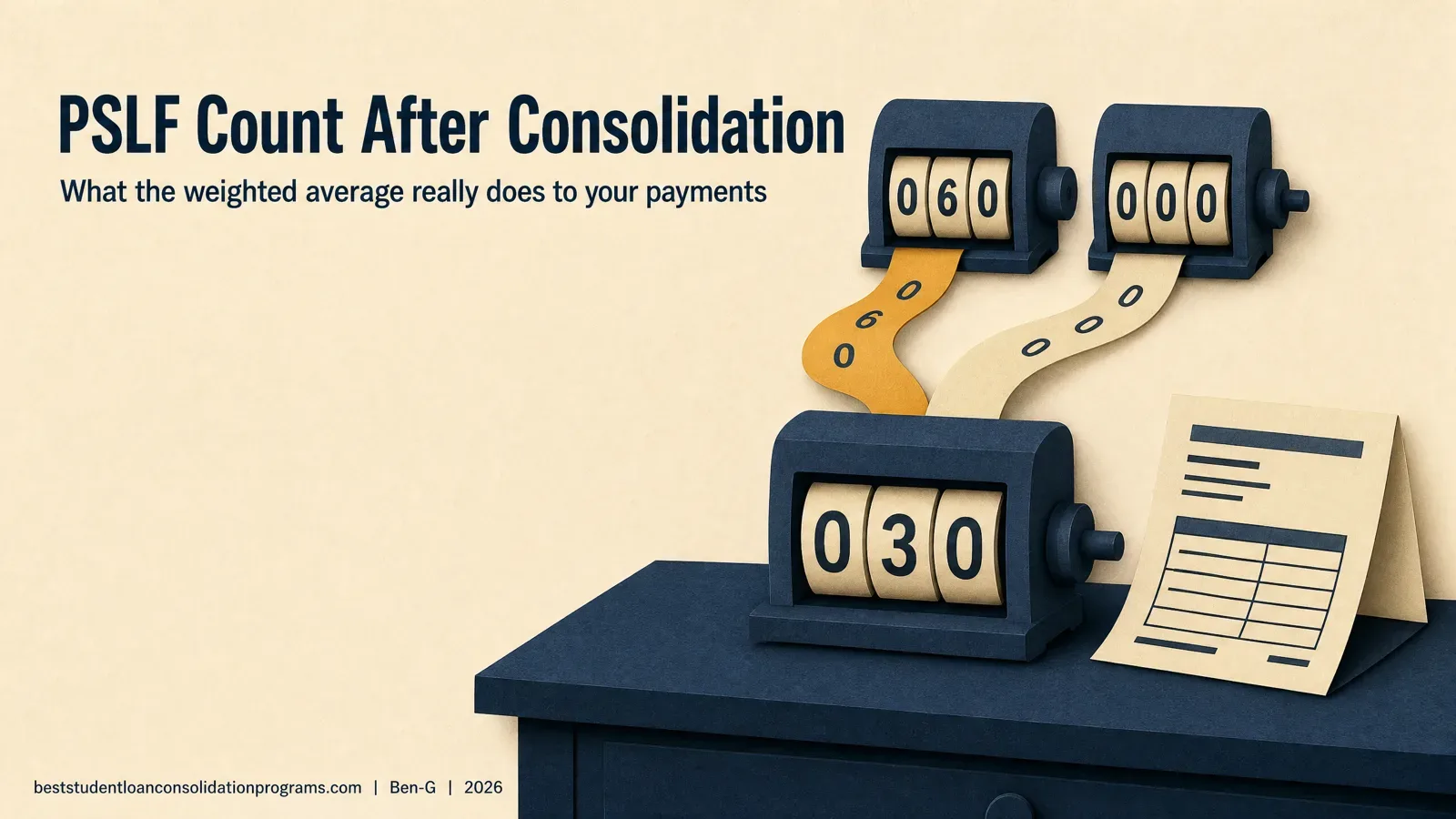
    Your PSLF payment count after consolidation is not reset to zero, but it is averaged across every loan you combine, and that average can cost you years of progress.

    30
    Federal Student Aid's own example: a $30,000 Direct Loan with 60 qualifying payments, consolidated with a $30,000 Direct Loan that has none, is credited 30 qualifying payments on the new consolidation loan.
    Source: Federal Student Aid (studentaid.gov) (2026)

    KEY TAKEAWAYS

    Your PSLF payment count after consolidation no longer resets to zero, but consolidating does something most borrowers only discover after the fact: it blends every Direct Loan’s count into one balance-weighted number. Federal Student Aid’s own illustration shows how sharp the blend can be. A borrower with sixty qualifying payments on one loan, consolidating it with an equal-sized loan that has none, is credited 30 payments on the new loan (Federal Student Aid (studentaid.gov), 2026). Half the progress is still there; half of it has been averaged away.

    That is the rule. What has been missing is the arithmetic for the loan mixes people actually hold, and the three other costs that a consolidation completed on or after July 1, 2026 now carries: the plans the new loan is allowed to use, the forgiveness clock that no longer travels with it, and the Buyback months that fall out of reach. This page works through all of it from the regulation itself, the Department’s court-ordered reporting, and the attorneys and calculators borrowers rely on. Every number links to where it came from, and the rows marked as our calculation say so.

    The short version: if every Direct Loan you consolidate carries the same count, you lose nothing. If one seasoned loan is blended with a larger loan that has little credit, the loss can be most of what you earned, and since July 2026 the decision cannot be undone by switching back to an older plan. The pages at Best Student Loan Consolidation Programs exist to make that trade visible before you sign.

    1 How Much of Your PSLF Payment Count After Consolidation Do You Keep? Six Worked Loan Mixes

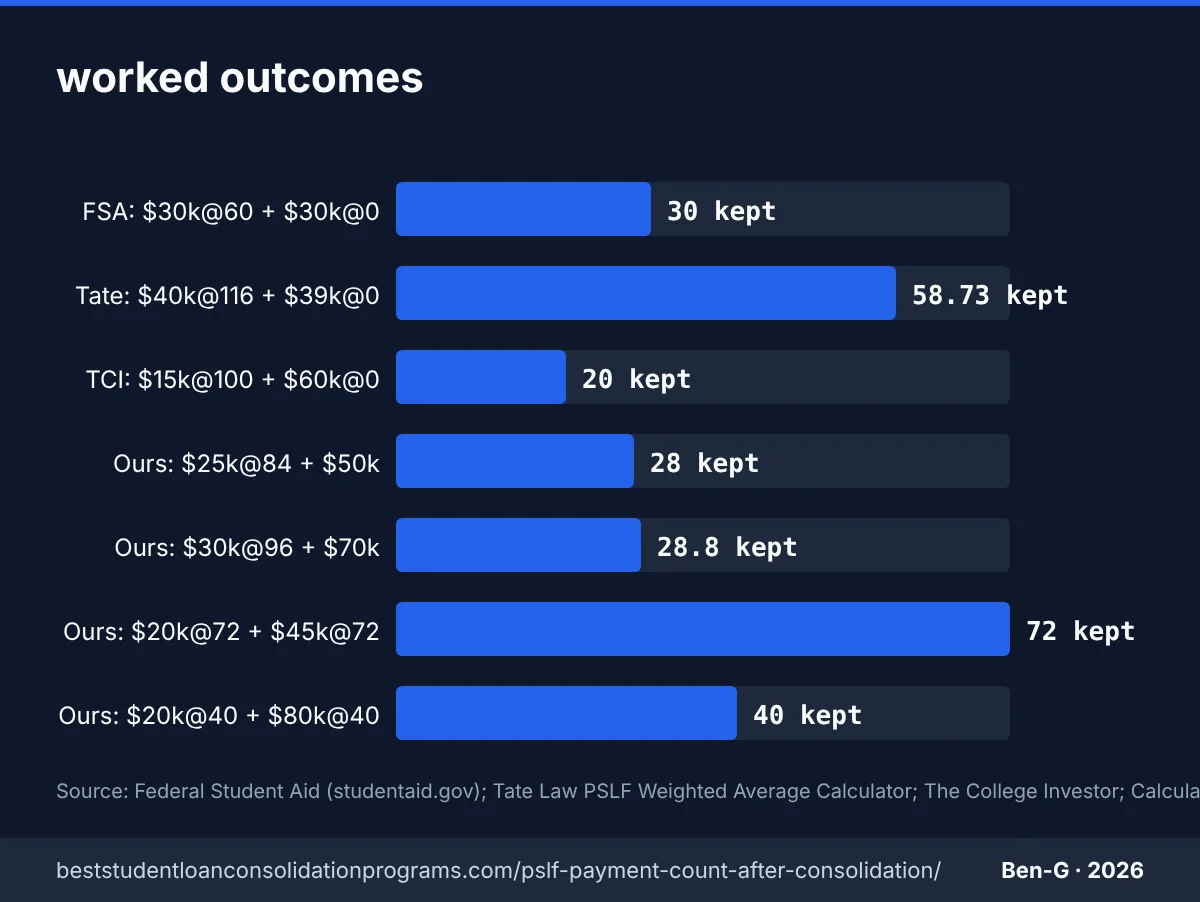
    The formula is simple: multiply each Direct Loan’s balance by its qualifying-payment count, add the products, divide by the total balance. FSA’s example yields 30; The College Investor’s yields 20; Tate Law’s calculator yields 58.73. Equal counts keep everything; a large zero-count loan erases most of it. (Federal Student Aid (studentaid.gov), 2026)

    LOAN MIXPAYMENTS CREDITED AFTER CONSOLIDATIONSOURCE
    FSA example: $30,000 at 60 payments + $30,000 at 030Federal Student Aid (studentaid.gov)
    College Investor example: $15,000 at 100 + $60,000 at 020The College Investor
    Tate Law example: $40,000 at 116 + $39,000 at 0 (unrounded)58.73Tate Law PSLF Weighted Average Calculator
    Our calculation: $25,000 Direct at 84 + $50,000 FFEL at 028Calculated from 34 CFR 685.219(c)(3) formula
    Our calculation: $30,000 Direct at 96 + $70,000 Parent PLUS at 0 (unrounded)28.8Calculated from 34 CFR 685.219(c)(3) formula
    Our calculation: $20,000 at 72 + $45,000 at 7272Calculated from 34 CFR 685.219(c)(3) formula
    Our calculation: $20,000 at 40 + $80,000 at 4040Calculated from 34 CFR 685.219(c)(3) formula
    58.73
    Tate Law’s calculator makes the alternative explicit: keep the seasoned loan out of the consolidation and it stays at its full count; include it and the whole balance blends down.
    Tate Law PSLF Weighted Average Calculator, 2026

    Qualifying payments kept after consolidation, by loan mix

    FSA: $30k@60 + $30k@0
    30
    TCI: $15k@100 + $60k@0
    20
    Tate: $40k@116 + $39k@0
    58.73
    Ours: $25k@84 + $50k FFEL@0
    28
    Ours: $20k@72 + $45k@72
    72
    Ours: $20k@40 + $80k@40
    40

    Read the table from the bottom up and the pattern is obvious. The two rows where every loan carries the same count, 72 and 40, lose nothing, and the balances do not matter at all. The damage appears only when counts differ, and it scales with the share of the total balance held by the loan with the lower count. In The College Investor’s example the seasoned loan is a fifth of the total, so four fifths of its hundred payments disappear and 20 remain (The College Investor, 2026). In FSA’s example the two loans are equal, so exactly half survives.

    The two rows we calculated ourselves are the ones borrowers ask about most on r/PSLF and r/StudentLoans: a Direct Loan with years of credit sitting next to an older FFEL loan, or a Parent PLUS loan that has never been in a qualifying plan. The regulation is explicit that only payments on the Direct Loans being consolidated enter the average, and that Direct PLUS Loans made to parents are included in the blend (Federal Register, 91 FR 23769 (34 CFR 685.219(c)(3)), 2026). FSA’s FAQ adds the other half of the sentence: other loan types will not be considered (Federal Student Aid (studentaid.gov), 2026). So a FFEL balance contributes its full weight to the denominator and nothing to the numerator, which is why the Direct-plus-FFEL row falls from eighty-four to 28.

    One number in the table deserves its own caveat. Tate Law shows 58.73 unrounded because the PSLF regulation does not say how the Department rounds (Tate Law PSLF Weighted Average Calculator, 2026). The IDR-forgiveness paragraph, by contrast, rounds its weighted average up to the nearest whole month (Federal Register, 91 FR 23769 (final rule, May 1, 2026), 2026). Until FSA publishes its PSLF rounding, treat a fractional result as a floor, not a promise. The calculator further down this page uses the same unrounded arithmetic so you can test your own mix.

    2 What Exactly Does 34 CFR 685.219(c)(3) Say, and Since When?

    The May 2026 final rule republishes the PSLF consolidation paragraph unchanged in substance: the new loan is credited the weighted average of qualifying payments made on the Direct Loans it repaid, parent PLUS included. The weighted average replaced the waiver-era highest-count treatment, which ended with the June 30, 2024 consolidation deadline. (Federal Register, 91 FR 23769 (34 CFR 685.219(c)(3)), 2026)

    RULE ELEMENTWHAT IT SAYSSOURCE
    PSLF credit on a Direct Consolidation Loanweighted averageFederal Register, 91 FR 23769 (34 CFR 685.219(c)(3))
    Which payments enter the averageDirect Loan payments only; other loan types will not be consideredFederal Student Aid (studentaid.gov)
    Rounding, PSLF paragraphRegulation does not specify how ED roundsTate Law PSLF Weighted Average Calculator
    Rounding, IBR-forgiveness paragraphrounded up to the nearest whole monthFederal Register, 91 FR 23769 (final rule, May 1, 2026)
    Weighted average became the permanent defaultSept. 1, 2024The College Investor (updated Feb. 1, 2026)
    Last day to apply for the highest-count account adjustmentJune 30, 2024NASFAA (May 16, 2024)
    Borrowers forgiven under the limited waiver that preceded it758,800The College Investor (updated Feb. 1, 2026)
    June 30, 2024
    The last day to apply for the highest-count account adjustment. Consolidations applied for after it are credited the weighted average instead.
    NASFAA (May 16, 2024), 2024

    The rule has changed three times in five years, which explains why so much advice on forums is simply out of date. Before the limited waiver, consolidation reset the count to zero. During the waiver and the one-time account adjustment that followed, the Department applied the credit of the most-seasoned loan to the whole consolidation; The College Investor reports 758,800 borrowers forgiven under the waiver alone (The College Investor (updated Feb. 1, 2026), 2023). That generous treatment closed with the June 30, 2024 application deadline (NASFAA (May 16, 2024), 2024), and The College Investor dates the weighted average as the permanent default from Sept. 1, 2024 (The College Investor (updated Feb. 1, 2026), 2024). The Department’s own FAQ page on this point is a JavaScript application our tools could not read, so that start date is attributed to secondary reporting rather than to FSA directly.

    What the regulation does not do is distinguish between a consolidation you chose and one you were steered into. Several of the Reddit threads behind this article describe borrowers who consolidated in 2018 or 2020 on a servicer’s advice and later had restored credit questioned. The paragraph that governs their count today is the one in the table, and the Department has confirmed in litigation that some earlier waiver-era credits were deliberately rolled back, which is the subject of the final section.

    3 What Changed on July 1, 2026 for a New Consolidation Loan?

    A Direct Consolidation Loan made on or after July 1, 2026 may be repaid only under the Tiered Standard repayment plan, or the Repayment Assistance Plan. The Tiered Standard plan is not a PSLF-qualifying repayment plan, so PSLF credit on the new loan comes only from RAP, whose forgiveness threshold is 360 payments. ICR-plan payments stop counting after June 30, 2028. (Federal Register, 91 FR 23769 (34 CFR 685.220(h)(2)), 2026)

    POST-CUTOVER ELEMENTRULESOURCE
    Plans available on a consolidation loan made on/after July 1, 2026Tiered Standard repayment plan, or the Repayment Assistance PlanFederal Register, 91 FR 23769 (34 CFR 685.220(h)(2))
    Tiered Standard plan and PSLFnot a PSLF-qualifying repayment planFederal Register, 91 FR 23769 (final rule preamble)
    Last date an ICR-plan payment counts for PSLFJune 30, 2028Federal Register, 91 FR 23769 (final rule preamble)
    RAP forgiveness threshold360 qualifying monthly payments over at least 30 yearsFederal Register, 91 FR 23769 (34 CFR 685.209(k)(8))
    IDR-forgiveness credit on a post-cutover consolidationgenerally does not carry prior IDR-forgiveness creditTate Law PSLF Weighted Average Calculator (Nov. 6, 2026)
    Final rule effective dateJuly 1, 2026Federal Register (May 1, 2026)
    June 30, 2028
    After this date no payment made under ICR, PAYE or SAVE counts toward PSLF; a consolidation loan made on or after July 1, 2026 never had those plans at all.
    Federal Register, 91 FR 23769 (final rule preamble), 2026

    This is the part the weighted-average calculators do not show, and it changes the answer for anyone consolidating now. The PSLF count still blends exactly as before; the regulation’s consolidation paragraph was republished in the same final rule. But the loan receiving that blended count is a new loan, and under the amended statute a new consolidation loan has two plans available: Tiered Standard repayment plan, or the Repayment Assistance Plan (Federal Register, 91 FR 23769 (34 CFR 685.220(h)(2)), 2026). Since the Tiered Standard plan is not a PSLF-qualifying repayment plan (Federal Register, 91 FR 23769 (final rule preamble), 2026), a borrower who consolidates and wants PSLF credit has one path, RAP, and must stay on it.

    Two further clocks are affected. First, payments made under the older income-contingent plans count for PSLF only if made on or before June 30, 2028 (Federal Register, 91 FR 23769 (final rule preamble), 2026), so even borrowers who did not consolidate face a plan change within two years. Second, the IDR-forgiveness credit that the IBR paragraph preserves through its own rounded-up weighted average lives in a plan the new loan cannot use; Tate Law’s reading is that a consolidation completed on or after the cutover generally does not carry prior IDR-forgiveness credit (Tate Law PSLF Weighted Average Calculator (Nov. 6, 2026), 2026). RAP’s own forgiveness requires 360 qualifying monthly payments over at least thirty years (Federal Register, 91 FR 23769 (34 CFR 685.209(k)(8)), 2026). For a borrower close to IDR forgiveness that is a different trade than the PSLF arithmetic alone suggests, and it is why The College Investor has been telling readers not to consolidate without understanding the plan consequences first.

    The practical reading is that the weighted average is now the smaller of the two costs. A borrower whose Direct Loans all carry similar counts keeps their PSLF progress intact but still surrenders IBR, PAYE and ICR on the new loan. Whether that is acceptable depends on income, on how many of the 360 RAP payments would ever be needed, and on whether the consolidation was required at all. For FFEL and Perkins holders it usually is required, because those loans cannot qualify for PSLF unconsolidated; for Direct-only borrowers, the question is what consolidation buys that an employment certification does not.

    4 How Far Back Can PSLF Buyback Reach After You Consolidate?

    Only to the new loan’s first disbursement. Buyback applies to months on the consolidation loan itself, requires 120 months of certified qualifying employment first, and under the 2026 rule months spent in RAP are not eligible for reconsideration credit. A consolidation therefore fixes the earliest month you can ever buy back. (Tate Law (updated Oct. 23, 2026), 2026)

    BUYBACK RULEVALUESOURCE
    Which months a consolidation borrower can buy backMonths on the consolidation loan itself onlyTate Law (updated Oct. 23, 2026)
    Qualifying employment required before applying120 monthsTate Law (updated Oct. 23, 2026)
    Deferment or forbearance months while enrolled in RAPnot eligible for reconsideration creditFederal Register, 91 FR 23769 (final rule preamble)

    Buyback is the remedy most borrowers reach for when the weighted average leaves them short of one hundred twenty, and it is weaker after a consolidation than before one. Tate Law’s guide states the limit directly: you can only buy back months on the consolidation loan itself, and nothing before that loan’s first disbursement (Tate Law (updated Oct. 23, 2026), 2026). The forbearance or deferment months on the underlying loans, including SAVE forbearance months that pre-date the consolidation, are not on the new loan and cannot be converted. The program also does nothing for employment: it requires 120 months of certified qualifying employment and converts non-payment months into payment months only (Tate Law (updated Oct. 23, 2026), 2026).

    The 2026 final rule narrows the remedy once more for the plan a new consolidation loan must use. In its response to commenters the Department confirms that months in the Repayment Assistance Plan are not eligible for reconsideration credit, reasoning that the statute counts only on-time RAP payments and a borrower in deferment or forbearance has not made one (Federal Register, 91 FR 23769 (final rule preamble), 2026). Put the two rules together and a borrower who consolidates after July 2026 and later pauses payments on RAP has months that can be bought back from neither side of the consolidation date. That is the blind spot in most guides: the weighted average is a one-time loss, but the Buyback ceiling is permanent.

    5 How Big Is the Buyback Backlog, and What Is the Lawsuit About?

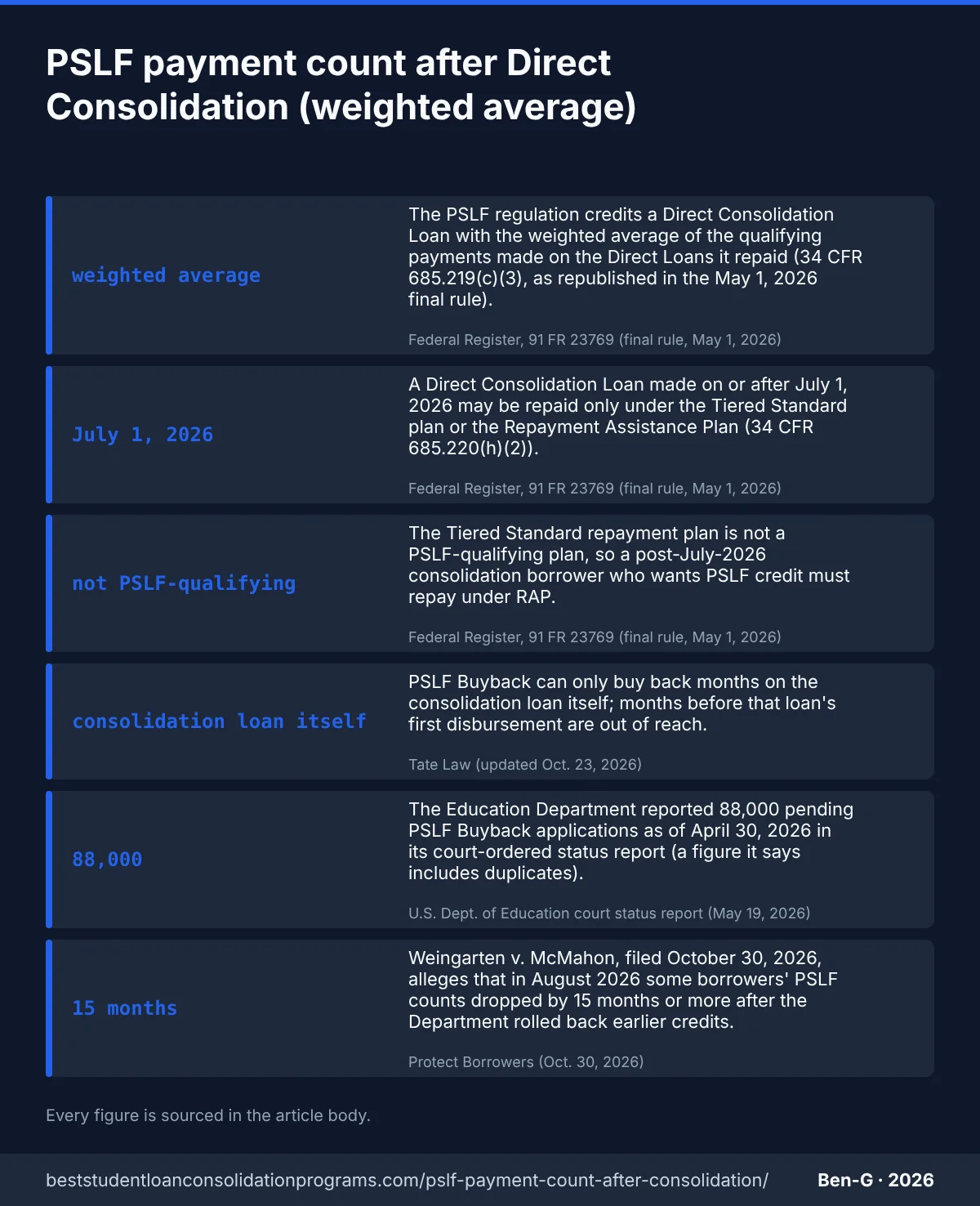
    The Department’s court-ordered report counted 88,000 pending Buyback applications on April 30, 2026, with 6,600 approvals and 11,500 PSLF discharges processed that month. Protect Borrowers says the queue stood at 49,000 a year earlier. Weingarten v. McMahon, filed October 30, 2026, alleges counts dropped by 15 months or more. (U.S. Department of Education status report (ECF 65, May 19, 2026), 2026)

    METRICVALUESOURCE
    Pending Buyback applications, April 30, 2026 (includes duplicates)88,000U.S. Department of Education status report (ECF 65, May 19, 2026)
    Buyback applications approved, April 20266,600U.S. Department of Education status report (ECF 65, May 19, 2026)
    PSLF discharges processed, April 202611,500U.S. Department of Education status report (ECF 65, May 19, 2026)
    Pending Buyback applications, April 202549,000Protect Borrowers (Oct. 30, 2026)
    Pending Buyback applications reported to The Washington Post, October 202682,000Tate Law citing The Washington Post (Oct. 2026)
    PSLF count reductions alleged for August 202615 months or moreProtect Borrowers (Oct. 30, 2026)
    15 months
    Weingarten v. McMahon was filed October 30, 2026 in the U.S. District Court for the District of Columbia as a nationwide class action by AFT president Randi Weingarten and two public-service borrowers.
    Protect Borrowers (Oct. 30, 2026), 2026

    The numbers in this section come from the Department’s own filings in an earlier suit over income-driven repayment processing. Its May 2026 status report lists 88,000 Buyback applications pending at the end of April, a figure it says includes roughly eighteen to nineteen thousand duplicates, alongside 6,600 approvals and 11,500 PSLF discharges in the month (U.S. Department of Education status report (ECF 65, May 19, 2026), 2026). At that approval pace the stated queue is roughly a year deep, and the Department has published no processing-time estimate. Tate Law reports a figure of 82,000 pending given to The Washington Post in October (Tate Law citing The Washington Post (Oct. 2026), 2026), while Protect Borrowers puts the April backlog at nearly ninety thousand, up from 49,000 twelve months before (Protect Borrowers (Oct. 30, 2026), 2025).

    The lawsuit matters to the consolidation question for a specific reason. Protect Borrowers’ release says that in August 2026 some borrowers saw their PSLF counts fall by 15 months or more, and that the Department acknowledged some earlier waiver and account-adjustment credits were purposely rolled back (Protect Borrowers (Oct. 30, 2026), 2026). Many of those credits were awarded on consolidation loans under the highest-count treatment that preceded the weighted average. A borrower deciding whether to consolidate today is therefore not only choosing between a blended count and an intact one; they are choosing which number they will have to defend if their tracker changes. A review of the past month of borrower discussion found the r/PSLF threads of October 2026 dominated by exactly that: trackers frozen since June, counts revised without explanation, and Buyback requests pending since the spring of 2025.

    None of this changes the arithmetic in the first table, which is set by regulation and will produce the same blended count whoever administers it. It does change the advice. Certify employment before consolidating so the pre-consolidation count is on record, download the payment history from the servicer, and run the mix through the calculator below with the real balances. If the blended count is close to the unblended one, the plan consequences of the July 2026 cutover are the larger cost; if it is not, the seasoned loan may be better left alone.
    Key statistics: PSLF Payment Count After Consolidation (2026)
    Key statistics at a glance | Source: see numbered sources below

    PSLF Weighted-Average Calculator: Test Your Own Loan Mix
    Enter each Direct Loan’s current balance and its qualifying-payment count. FFEL, Perkins or other non-Direct loans you plan to include: enter the balance with a count of zero. The result is unrounded, because the PSLF regulation does not publish a rounding rule.

    LoanBalance ($)Qualifying payments
    Loan 1
    Loan 2
    Loan 3
    Loan 4

    Formula: sum of (balance x payments) divided by total balance, per 34 CFR 685.219(c)(3). This is arithmetic, not a Department determination; your servicer’s count governs.

    Comparison chart: PSLF Payment Count After Consolidation (2026)
    Comparison | Source: see numbered sources below

    Methodology

    Sources. The Department of Education’s final rule published at 91 FR 23769 (May 1, 2026), the PSLF regulation at 34 CFR 685.219, Federal Student Aid’s pages on studentaid.gov, the Department’s court status reports in AFT v. Department of Education, and explanations from The College Investor, Tate Law, NASFAA and the Student Borrower Protection Center.

    How the figures were checked. Every rule and number was compared against its source in early November 2026; figures in court PDFs and the Federal Register were confirmed in the documents themselves. The worked loan mixes apply the official weighted-average formula to example balances; the one scenario we built ourselves is labelled as our calculation.

    Limitations. The regulation does not say how a fractional count is rounded, so results are shown unrounded. The September 1, 2024 start of the weighted-average rule is cited from The College Investor; confirm it on studentaid.gov. Your servicer’s count is the one that governs, and the calculator is arithmetic, not a Department determination.

    Frequently Asked Questions

    Does consolidating reset my PSLF payment count to zero?

    Not for Direct Loans. Under 34 CFR 685.219(c)(3) the new Direct Consolidation Loan is credited with the weighted average of the qualifying payments on the Direct Loans it repaid. In Federal Student Aid's example, 60 payments on a $30,000 loan blended with a $30,000 loan at zero become 30. Payments on FFEL or Perkins loans are not Direct Loan payments and add nothing to the average. (Federal Student Aid (studentaid.gov), 2026)

    When does consolidation cost me no PSLF payments at all?

    When every Direct Loan going into the consolidation carries the same count. A $20,000 loan at 72 payments and a $45,000 loan at 72 payments average to 72, whatever the balances. The loss comes only from mixing a seasoned loan with a loan that has fewer payments, and it scales with that loan's share of the total balance. (Calculated from 34 CFR 685.219(c)(3), 2026)

    What changed for consolidations on or after July 1, 2026?

    The loan itself is new, and under 34 CFR 685.220(h)(2) a Direct Consolidation Loan made on or after July 1, 2026 may be repaid only under the Tiered Standard plan or the Repayment Assistance Plan. IBR, ICR, PAYE and SAVE are off the table for that loan, and only RAP payments on it can count toward PSLF because the Tiered Standard plan is not PSLF-qualifying. (Federal Register, 91 FR 23769, 2026)

    Can I buy back months from before my consolidation?

    No. PSLF Buyback can only buy back months on the consolidation loan itself, reaching no further back than the new loan's first disbursement, and it requires 120 months of certified qualifying employment first. Months spent in deferment or forbearance while enrolled in RAP are also not eligible for reconsideration credit under the 2026 final rule. (Tate Law (updated Oct. 23, 2026), 2026)

    How is the weighted average rounded?

    For PSLF, the regulation does not say. Tate Law's calculator shows an unrounded 58.73 for a $40,000 loan at 116 payments blended with a $39,000 loan at zero and notes that ED publishes no rounding rule. The separate IBR-forgiveness paragraph (34 CFR 685.209(k)(4)(vi)(B)) does round the weighted average up to the nearest whole month. (Tate Law PSLF Weighted Average Calculator, 2026)

    How big is the PSLF Buyback backlog right now?

    The Department's court-ordered status report put pending Buyback applications at 88,000 on April 30, 2026, a figure it said included roughly 18,000-19,000 duplicates, with 6,600 approvals processed that month. Protect Borrowers' October 30, 2026 lawsuit release says the backlog had grown from 49,000 a year earlier, and Tate Law reports about 82,000 pending as of October 2026. (U.S. Department of Education status report (ECF 65, May 19, 2026), 2026)

    Why are borrowers suing over PSLF counts?

    Weingarten v. McMahon, filed October 30, 2026 in the U.S. District Court for the District of Columbia, alleges that in August 2026 some borrowers saw PSLF counts drop by 15 months or more after earlier waiver and account-adjustment credits were rolled back, that recent qualifying payments were withheld, and that Buyback applications were left pending without communication. (Protect Borrowers (Oct. 30, 2026), 2026)

    Sources & References

    1. Federal Student Aid. “SAVE Plan Borrowers: FAQs About Choosing a Different Repayment Plan.” studentaid.gov/articles/save/. Accessed 2026-11-07.
    2. Federal Register. “Reimagining and Improving Student Education — Federal Student Loan Program Final Regulations, 91 FR 23769.” govinfo.gov/content/pkg/FR-2026-05-01/html/2026-08556.htm. Accessed 2026-11-07.
    3. Federal Register. “Reimagining and Improving Student Education — Final Regulations (document page).” federalregister.gov/documents/2026/05/01/2026-08556/reimagining-and-improving-st. Accessed 2026-11-07.
    4. Tate Law. “PSLF Weighted Average Payment Count Calculator.” tateesq.com/calculator/pslf-weighted-average-payment-count. Accessed 2026-11-07.
    5. Tate Law. “PSLF Buyback Program: How It Works and How to Apply.” tateesq.com/learn/pslf-buyback. Accessed 2026-11-07.
    6. The College Investor. “PSLF Weighted Average Rule Explained.” thecollegeinvestor.com/65178/pslf-weighted-average-rule/. Accessed 2026-11-07.
    7. U.S. Department of Education. “Status Report, American Federation of Teachers v. U.S. Department of Education, No. 1:25-cv-802 (D.D.C.), ECF 65.” storage.courtlistener.com/recap/gov.uscourts.dcd.278527/gov.uscourts.dcd.278527.. Accessed 2026-11-07.
    8. Protect Borrowers. “Weingarten v. McMahon: Major Class Action Lawsuit Launched.” protectborrowers.org/weingarten-v-mcmahon/. Accessed 2026-11-07.
    9. NASFAA. “Biden Administration Extends Loan Consolidation Deadline to Get Credit for Loan Forgiveness.” nasfaa.org/news-item/33682/Biden_Administration_Extends_Loan_Consolidation_Deadl. Accessed 2026-11-07.

    Last updated:

    This article is general information for U.S. student loan borrowers, not financial or legal advice. Confirm details with your loan servicer or studentaid.gov before acting. See our editorial policy and disclaimer.
  • Credit Score to Refinance Student Loans: The Real Approval Bar vs. the Published Minimum (2026)

    Credit Score to Refinance Student Loans: The Real Approval Bar vs. the Published Minimum (2026)

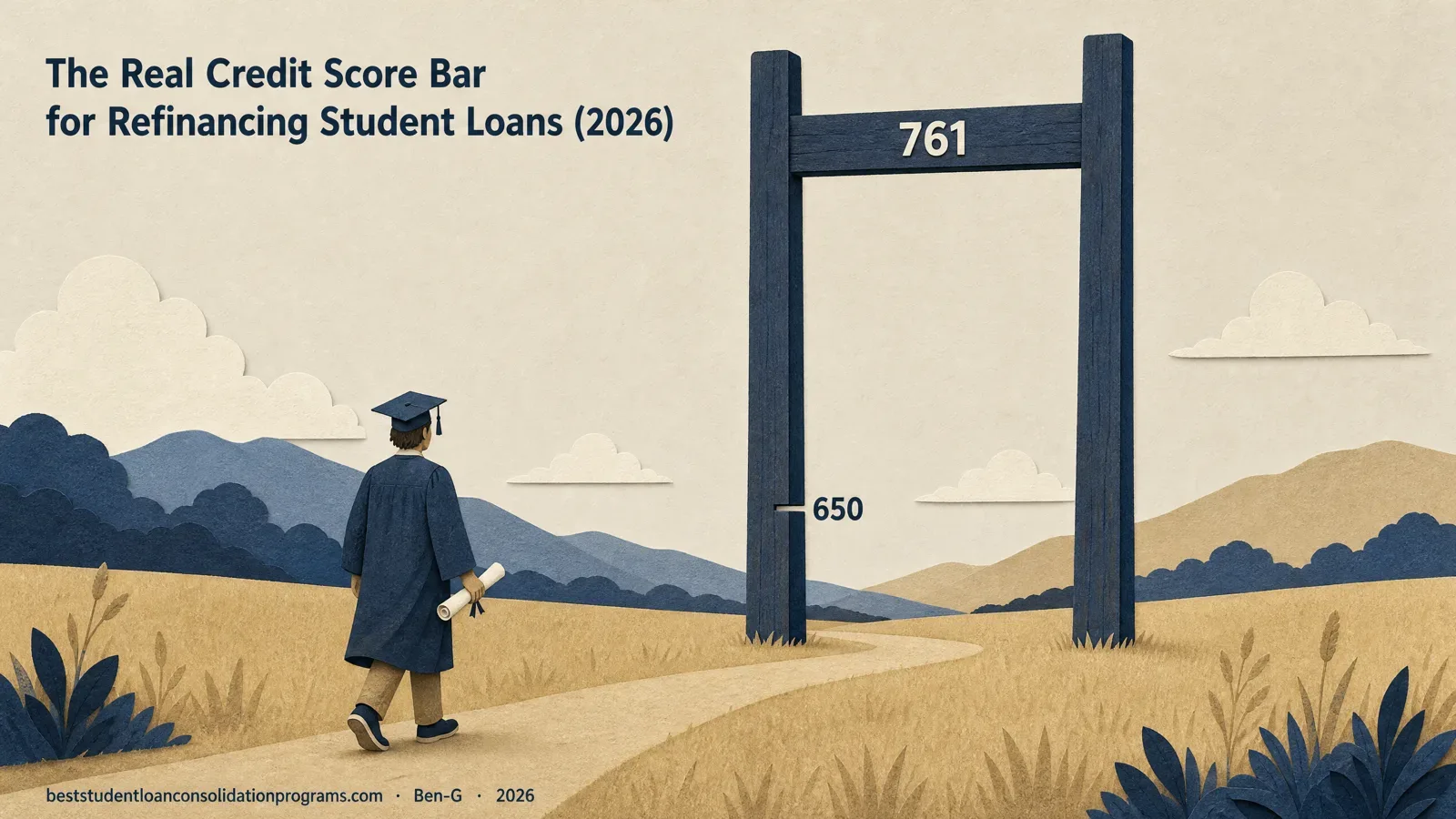
    What credit score to refinance student loans do lenders actually approve? The published minimum and the approved average are two different numbers, and this page sources both.

    761
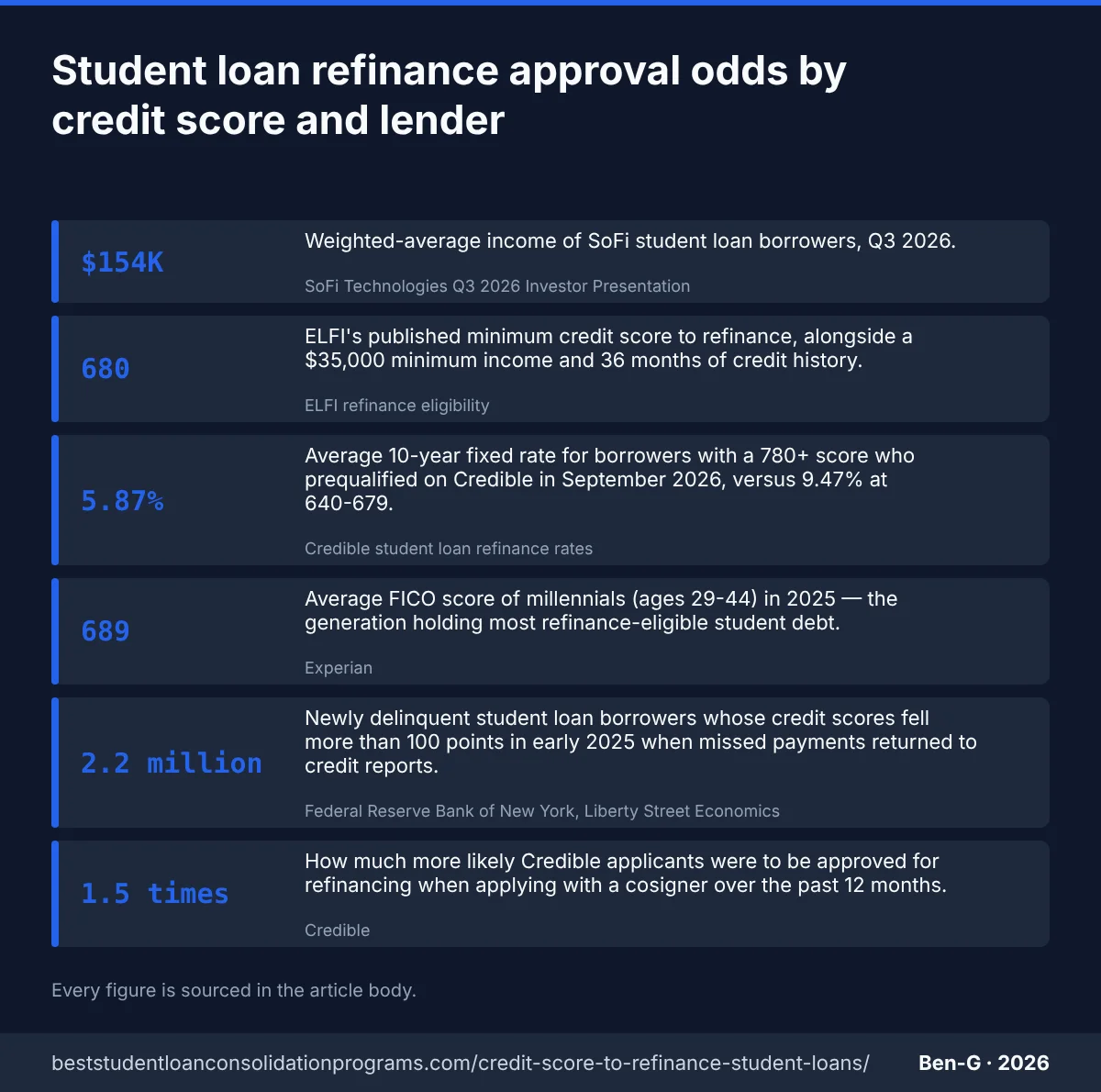
    SoFi's student loan borrowers carried a weighted-average FICO score of 761 and a weighted-average income of $154,000 in Q3 2026 — the only approved-borrower profile any major refinance lender discloses.
    Source: SoFi Technologies Q3 2026 Investor Presentation (2026)

    KEY TAKEAWAYS

    Ask any lender what credit score to refinance student loans it requires and you get the lowest number it will accept. None of them tells you the score at which it actually says yes. That silence is the gap this page fills. The only major lender that discloses who it approves is SoFi, and its student loan borrowers carried a weighted-average FICO of 761 with a weighted-average income of $154K in the third quarter of this year (SoFi Technologies Q3 2026 Investor Presentation, 2026). The published minimums, meanwhile, cluster between 650 (commonly cited; no primary source traceable) and 720. The distance between those two numbers is the whole story of approval odds, and it is larger than any lender’s marketing page admits.

    This matters more now than it did two years ago. When missed federal payments returned to credit reports in early 2025, the New York Fed counted 2.2 million newly delinquent borrowers whose scores fell by more than a hundred points (Federal Reserve Bank of New York, Liberty Street Economics, 2025), and by mid-2026 more than a tenth of all student loan balances were seriously delinquent. A large share of the people searching for a refinance today are doing so from a score that no longer clears any lender’s floor. Below, each data section pairs a published minimum with the evidence of where approvals really land, so you can judge your odds before you spend a hard inquiry.

    A note on what this page can and cannot do: it reports disclosed figures only. Lenders do not publish approval rates by credit band, and the securitization reports that carry pool-level FICO and income data sit behind rating-agency paywalls. Where a number is an aggregator’s restatement of a lender’s rule rather than the lender’s own page, the source column says so.

    1 What Does an Approved Refinance Borrower Actually Look Like? A 761 FICO and $154K Income

    SoFi, the largest refinance originator to disclose a borrower profile, reported a weighted-average FICO of 761 and weighted-average income of $154K for its student loan book in the third quarter of this year, on $2.9 billion of originations, with charge-offs at 63 basis points (SoFi Technologies Q3 2026 Investor Presentation, 2026).

    METRICVALUESOURCE
    SoFi student loans, weighted-average FICO, Q3 2026761SoFi Technologies Q3 2026 Investor Presentation
    SoFi student loans, weighted-average income, Q3 2026$154KSoFi Technologies Q3 2026 Investor Presentation
    SoFi student loans, weighted-average FICO, Q4 2025765SoFi Technologies Q4 2025 Investor Presentation
    SoFi student loans, weighted-average income, Q4 2025$149KSoFi Technologies Q4 2025 Investor Presentation
    SoFi personal loans, weighted-average FICO, Q3 2026 (comparison)743SoFi Technologies Q3 2026 Investor Presentation
    SoFi student loan originations, Q3 2026$2.9 billionSoFi Technologies Q3 2026 earnings release (SEC 8-K)
    SoFi student loan annualized charge-off rate, Q3 202663 basis pointsSoFi Technologies Q3 2026 earnings release (SEC 8-K)
    SoFi average student loan balance, Q3 2026$44,113SoFi Technologies Q3 2026 earnings release (SEC 8-K)
    761
    The weighted-average FICO of SoFi’s approved student loan borrowers, against an industry floor most aggregators put in the mid-600s.
    SoFi Technologies Q3 2026 Investor Presentation, 2026

    Two things stand out in SoFi’s disclosure. First, the approved student loan book is more creditworthy than the company’s own personal loan book: 761 against 743 on FICO, on almost identical income. Refinancing is underwritten as a prime product, and the growth is coming from the prime end. Originations of $2.9 billion in a single quarter were the highest in the company’s history, and the charge-off rate of 63 basis points is what a book built around a 760 average produces. The borrowers being added are not lowering the bar; they are raising it.

    Second, the profile is stable. A year earlier the same table showed 765 and $149K (SoFi Technologies Q4 2025 Investor Presentation, 2025). Rates moved, volume doubled, and the typical approved borrower barely changed. That is the strongest evidence this page has that the approved profile is a policy, not an accident of who applied. For a borrower reading the lender’s eligibility page, which lists no minimum score at all (SoFi eligibility requirements, 2026), the useful number is not the floor but the center of gravity: a score in the mid-700s and income well into six figures. If you are comparing programs on our student loan consolidation guide, treat this profile as the benchmark every undisclosed lender is likely pricing against.

    2 What Credit Score to Refinance Student Loans Does Each Lender Publish?

    Published minimums run from 650 at Earnest to 720 at Brazos, with ELFI at 680 plus a $35,000 income floor (ELFI refinance eligibility, 2026). SoFi and Laurel Road publish no minimum at all; the typical base lenders require is about 670, per Experian (CNBC Select, 2026).

    LENDERPUBLISHED MINIMUMSOURCE
    ELFI (plus minimum income below)680ELFI refinance eligibility
    ELFI minimum income$35,000ELFI refinance eligibility
    Earnest (aggregators disagree: see note)650NerdWallet, Earnest vs. SoFi (updated Oct 15, 2026)
    LendKey680Credible lender table (updated Nov 6, 2026)
    MEFA670Credible lender table (updated Nov 6, 2026)
    EdvestinU700Credible lender table (updated Nov 6, 2026)
    Splash Financial (soft minimum)700educationdata.org lender comparison (updated Oct 7, 2026)
    Brazos (without cosigner)720Credible lender table (updated Nov 6, 2026)
    SoFinone disclosedSoFi eligibility requirements
    Laurel Road (KeyBank)none disclosedKeyBank / Laurel Road student loan refinancing
    Typical base requirement (Experian, via CNBC)670CNBC Select
    Credible marketplace fixed APR range, Nov 20263.95% to 11.99%Credible student loan refinance rates
    ELFI lowest fixed APR, late Oct 20264.49%ELFI refinance eligibility
    680
    ELFI is the one lender in this table whose minimum score, minimum income and credit-history requirement all come straight from its own eligibility page rather than an aggregator.
    ELFI refinance eligibility, 2026

    The table splits into three groups. ELFI is the transparent case: a 680 score, $35,000 in income, three years of credit history and a bachelor’s degree, all printed on its own page. The credit-union and state-agency lenders (LendKey, MEFA, EdvestinU, Brazos) publish floors that aggregators can restate, though the restatements drift: Credible lists Earnest at a different figure than NerdWallet does, which is why Earnest’s 650 is flagged as contested here. Then there are the two largest brands, SoFi and Laurel Road, which publish nothing. SoFi’s page says eligibility rests on financial history, credit score and monthly income versus expenses (SoFi eligibility requirements, 2026); KeyBank’s says credit profile, monthly income and monthly debt payments (KeyBank / Laurel Road student loan refinancing, 2026).

    Read together with the previous section, the pattern is uncomfortable but clear. The lender with no published minimum has the most selective disclosed book. A borrower at 670, which Experian describes as the usual base, is roughly ninety points below where SoFi’s approvals cluster. Whether a score at the floor converts to an approval depends on the variables none of these pages quantify: income, debt-to-income, degree and employment. The minimum is the price of admission to underwriting, not a probability of leaving with a loan.

    3 How Much Does Each Credit Band Cost in Rate? From 5.87% to 9.68%

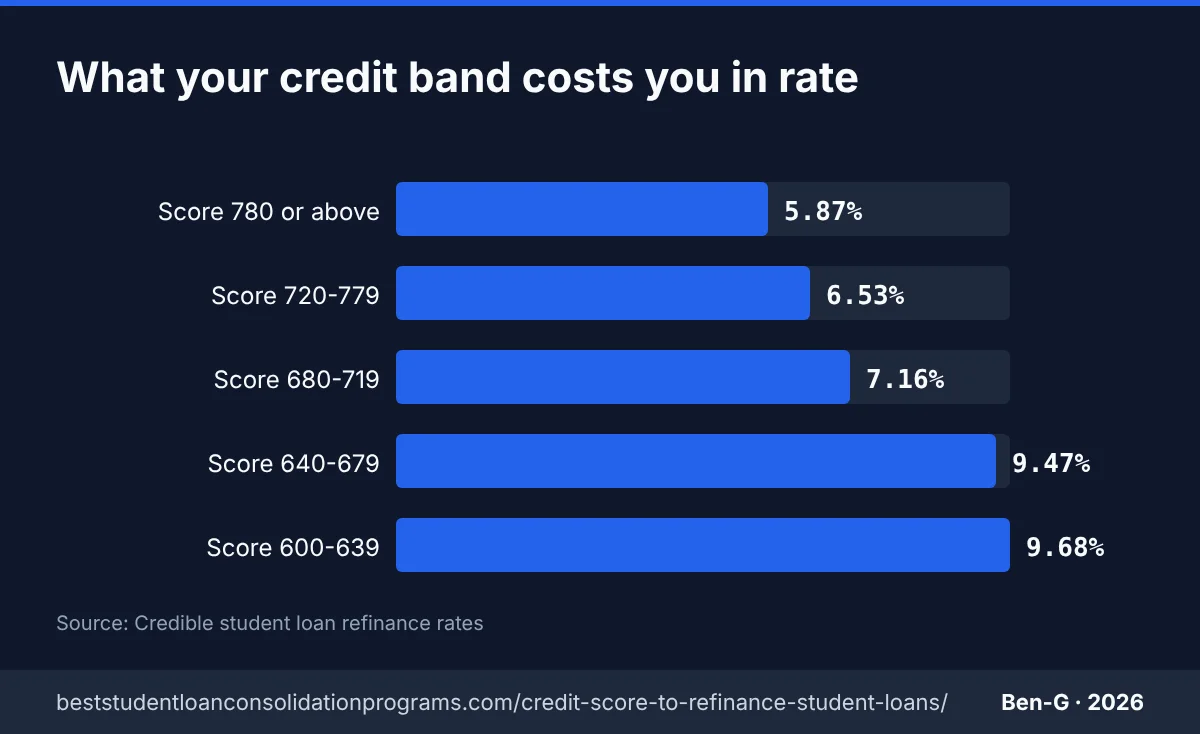
    Borrowers who prequalified on Credible in September averaged 5.87% on ten-year fixed loans with a score of 780 or above, 6.53% at 720-779, 7.16% at 680-719, and 9.47% at 640-679 (Credible student loan refinance rates, 2026). The largest single step is the drop below 680, worth more than two percentage points.

    CREDIT BAND (10-YEAR FIXED, CREDIBLE PREQUALIFIED, SEPT 2026)AVERAGE RATESOURCE
    780 or above5.87%Credible student loan refinance rates
    720 to 7796.53%Credible student loan refinance rates
    680 to 7197.16%Credible student loan refinance rates
    640 to 6799.47%Credible student loan refinance rates
    600 to 6399.68%Credible student loan refinance rates

    Average 10-year fixed refinance rate by credit band (Credible, September 2026)

    Score 780 or above
    5.87%
    Score 720-779
    6.53%
    Score 680-719
    7.16%
    Score 640-679
    9.47%
    Score 600-639
    9.68%

    These are averages for people who prequalified, so they already exclude the applicants a lender turned away at the soft-pull stage. That makes the shape of the curve more telling, not less. Between the top band and the 720-779 band the penalty is modest; between 680-719 and 640-679 it is a cliff. The step from 7.16% to 9.47% is the market telling you where its appetite ends. Below 680, a refinance is priced like a fair-credit personal loan, and for a borrower with federal loans it will rarely beat the fixed rate they already hold.

    The band table also answers the question running through r/StudentLoans this autumn, where borrowers asked whether anyone could still refinance private loans below roughly four and three-quarters percent. The marketplace’s lowest advertised fixed rate is 3.95% to 11.99% at the bottom of the range, and ELFI’s best fixed rate was 4.49% in late October. Those floors are reserved for the top band, with autopay, usually on the shortest terms. For a 720-779 borrower the realistic ten-year number is 6.53%, and planning around the advertised floor is the most common reason a refinance disappoints.

    4 Where Do Student Loan Borrowers Actually Stand? Average Millennial FICO Is 689

    The average U.S. FICO score was 713 in 2025, but millennials averaged 689 and Gen Z 678 (Experian, 2025). Only about half of all consumers score 740 or above (27.5% very good plus 22.8% exceptional), the zone where SoFi’s disclosed approvals sit.

    METRICVALUESOURCE
    Average U.S. FICO score, 2025713Experian
    Average FICO, millennials (29-44)689Experian
    Average FICO, Generation Z (18-28)678Experian
    Share of consumers 740-799 (very good)27.5%Experian
    Share of consumers 800-850 (exceptional)22.8%Experian
    Share of consumers 670-739 (good)20.1%Experian
    Share of consumers 580-669 (fair)14.9%Experian
    Share of consumers 300-579 (poor)14.7%Experian
    689
    The average millennial score sits seventy-plus points below the weighted-average FICO of SoFi’s approved student loan borrowers.
    Experian, 2025

    Student debt is concentrated in the two youngest generations, and those are the two with the lowest average scores. A millennial at the generational average of 689 clears Earnest’s 650 floor and ELFI’s 680, and would price into the 680-719 band at 7.16%. A Gen Z borrower at 678 is above the Experian base of 670 by a handful of points and one late payment away from falling under it. Neither is near the 761 center of SoFi’s approved book.

    The distribution explains the Reddit threads where a borrower with a score in the high 700s is still declined. Roughly half the adult population is in the 740-plus zone, so a lender aiming at a 760 average is not short of applicants who clear the score test; it can afford to decline on income, debt-to-income or employment. Score gets you into the pool. The other variables, which no lender publishes as thresholds, decide who comes out.

    5 How Did the 2025 Credit-Score Crash Change Who Can Refinance? 2.2 Million Borrowers Lost 100+ Points

    When missed federal payments returned to credit reports, the New York Fed found 2.2 million newly delinquent borrowers lost more than a hundred points; those previously above 720 saw an average change of -177 points (Federal Reserve Bank of New York, Liberty Street Economics, 2025). By the second quarter of this year, 10.6% of student loan balances were ninety-plus days delinquent (Federal Reserve Bank of New York, Quarterly Report on Household Debt and Credit, Q2 2026, 2026).

    METRICVALUESOURCE
    Newly delinquent borrowers with score drops over 100 points, Q1 20252.2 millionFederal Reserve Bank of New York, Liberty Street Economics
    Average score change, newly delinquent borrowers previously above 720-177Federal Reserve Bank of New York, Liberty Street Economics
    Average score change, newly delinquent borrowers at 620-719-140Federal Reserve Bank of New York, Liberty Street Economics
    Newly delinquent borrowers who had scores above 6202.4 millionFederal Reserve Bank of New York, Liberty Street Economics
    Borrowers with a payment due who were behind, Q1 202523.7%Federal Reserve Bank of New York, Liberty Street Economics
    Student loan balances 90+ days delinquent, Q2 202610.6%Federal Reserve Bank of New York, Quarterly Report on Household Debt and Credit, Q2 2026
    Outstanding U.S. student loan debt, Q2 2026$1.65 trillionFederal Reserve Bank of New York, Quarterly Report on Household Debt and Credit, Q2 2026
    -177
    A borrower who had a prime score and missed federal payments in early 2025 lost, on average, more than the entire gap between the published minimum and SoFi’s approved average.
    Federal Reserve Bank of New York, Liberty Street Economics, 2025

    No lender page and no comparison site puts these two datasets side by side, which is why this section exists. The New York Fed’s numbers describe a shock that landed hardest on the borrowers refinance lenders most want. Of the newly delinquent, 2.4 million had scores above 620 before the missed payment, and the ones above 720 saw an average change of -177 points. A 760 becomes a 583. That is not a borrower who prices into a worse band; that is a borrower who is out of the market entirely, and a delinquency on the report blocks approval at most lenders regardless of the recovered score.

    The scale is not small. Nearly a quarter of borrowers with a payment due were behind in the first quarter of 2025 (23.7%), and the serious-delinquency share of balances stood at 10.6% a year later on $1.65 trillion of outstanding debt. The practical reading for anyone who missed payments during the transition: the refinance market has not loosened to meet you. SoFi’s approved average moved from 765 to 761 over the same period, a rounding error. The borrowers who can refinance are, if anything, a narrower slice of the population than before the delinquency reporting restarted.

    6 What Does Applying Cost Your Score, and Who Is Approving More in 2026?

    One additional hard inquiry costs most people less than 5 points, affects the score for 1 year, and FICO ignores student loan inquiries made within 30 days of scoring (myFICO, 2026). Applicants with a cosigner were 1.5 times as likely to be approved on Credible (Credible, 2026), while Navient’s Earnest refinance originations reached $735 million in a single quarter.

    METRICVALUESOURCE
    FICO impact of one additional hard inquiry (most people)less than 5 pointsmyFICO
    How long a hard inquiry affects FICO scores1 yearmyFICO
    Student loan rate-shopping buffer (inquiries ignored if within)30 daysmyFICO
    Weight of new credit, including inquiries, in a FICO score10%myFICO
    Approval odds with a cosigner vs without (Credible, last 12 months)1.5 timesCredible
    Navient (Earnest) refinance originations, Q2 2026$735 millionNavient Q2 2026 earnings release
    Navient (Earnest) refinance originations, Q1 2026$778 millionNavient Q1 2026 earnings presentation
    Credible refinance volume, last year$700 millionCredible student loan refinance rates
    1.5 times
    The one lever a borrower below the approved average can actually pull: Credible’s applicants with a cosigner were approved far more often than those without.
    Credible, 2026

    The fear of the hard pull is overstated. FICO’s own guidance is that an extra inquiry costs less than 5 points, counts for 1 year, and that inquiries carry 10% of the score’s weight. Student loan applications made within 30 days are ignored at scoring time, and older ones in a shopping window are treated as one. The right sequence is soft-pull prequalification across several lenders first, then a single cluster of full applications. What damages approval odds is not the inquiry; it is applying at a score that was never going to clear the real bar and then waiting a year to try again.

    The supply side is expanding, but at the prime end. Navient’s Earnest brand originated $778 million in the first quarter and $735 million in the second, both up by roughly two-thirds on the prior year, and the company says its refinance borrowers’ average FICO rose three points over that period without disclosing the level (Navient Q1 2026 earnings presentation, 2026). Credible moved $700 million through its marketplace last year. More money is chasing the same 740-plus borrower. For everyone else, the measurable lever is a cosigner: Credible’s applicants with one were 1.5 times as likely to be approved, and lenders such as Brazos cut their published minimum by thirty points when a cosigner signs. That is the closest thing to a published approval rate the industry offers.

    Key statistics: Credit Score to Refinance Student Loans (2026)
    Key statistics at a glance | Source: see numbered sources below

    Explore every figure in this article

    MetricValueYearSource
    Score 780 or above5.87%2026Credible student loan refinance rates
    Score 720-7796.53%2026Credible student loan refinance rates
    Score 680-7197.16%2026Credible student loan refinance rates
    Score 640-6799.47%2026Credible student loan refinance rates
    Score 600-6399.68%2026Credible student loan refinance rates
    SoFi student loans, weighted-average FICO (Q3 2026)7612026SoFi Technologies Q3 2026 Investor Presentation
    SoFi student loans, weighted-average income (Q3 2026)$154K2026SoFi Technologies Q3 2026 Investor Presentation
    SoFi student loans, weighted-average FICO (Q4 2025)7652025SoFi Technologies Q4 2025 Investor Presentation
    SoFi student loans, weighted-average income (Q4 2025)$149K2025SoFi Technologies Q4 2025 Investor Presentation
    SoFi personal loans, weighted-average FICO (Q3 2026), for comparison7432026SoFi Technologies Q3 2026 Investor Presentation
    SoFi student loan originations, Q3 2026$2.9 billion2026SoFi Technologies Q3 2026 earnings release (SEC 8-K)
    SoFi student loan annualized charge-off rate, Q3 202663 basis points2026SoFi Technologies Q3 2026 earnings release (SEC 8-K)
    SoFi average student loan balance, Q3 2026$44,1132026SoFi Technologies Q3 2026 earnings release (SEC 8-K)
    Earnest published minimum credit score6502026NerdWallet, Earnest vs. SoFi (updated Oct 15, 2026)
    ELFI minimum credit score6802026ELFI refinance eligibility
    ELFI minimum income$35,0002026ELFI refinance eligibility
    Brazos minimum credit score (without cosigner)7202026Credible lender table (updated Nov 6, 2026)
    LendKey minimum credit score6802026Credible lender table (updated Nov 6, 2026)
    MEFA minimum credit score6702026Credible lender table (updated Nov 6, 2026)
    EdvestinU minimum credit score7002026Credible lender table (updated Nov 6, 2026)
    Splash Financial soft minimum credit score7002026educationdata.org lender comparison (updated Oct 7, 2026)
    SoFi published minimum credit scorenone disclosed2026SoFi eligibility requirements
    Laurel Road (KeyBank) published minimum credit scorenone disclosed2026KeyBank / Laurel Road student loan refinancing
    Typical base credit score lenders require (Experian, via CNBC)6702026CNBC Select
    Credible fixed APR range across its lenders (Nov 2026)3.95% to 11.99%2026Credible student loan refinance rates
    ELFI lowest fixed APR (as of 10/29/26)4.49%2026ELFI refinance eligibility
    Average U.S. FICO score (Sept 2025)7132025Experian
    Average FICO, millennials (29-44), 20256892025Experian
    Average FICO, Generation Z (18-28), 20256782025Experian
    Share of consumers with FICO 740-799 (very good), 202527.5%2025Experian
    Share of consumers with FICO 800-850 (exceptional), 202522.8%2025Experian
    Share of consumers with FICO 670-739 (good), 202520.1%2025Experian
    Share of consumers with FICO 580-669 (fair), 202514.9%2025Experian
    Share of consumers with FICO 300-579 (poor), 202514.7%2025Experian
    Newly delinquent student loan borrowers whose score fell more than 100 points (Q1 2025)2.2 million2025Federal Reserve Bank of New York, Liberty Street Economics
    Average score change for newly delinquent borrowers who had scores above 720-1772025Federal Reserve Bank of New York, Liberty Street Economics
    Average score change for newly delinquent borrowers with scores 620-719-1402025Federal Reserve Bank of New York, Liberty Street Economics
    Newly delinquent borrowers who had scores above 6202.4 million2025Federal Reserve Bank of New York, Liberty Street Economics
    Share of student loan borrowers with a payment due who were behind (Q1 2025)23.7%2025Federal Reserve Bank of New York, Liberty Street Economics
    Student loan balances 90+ days delinquent (Q2 2026)10.6%2026Federal Reserve Bank of New York, Quarterly Report on Household Debt and Credit, Q2 2026
    Outstanding U.S. student loan debt (Q2 2026)$1.65 trillion2026Federal Reserve Bank of New York, Quarterly Report on Household Debt and Credit, Q2 2026
    FICO score impact of one additional hard inquiry (most people)less than 5 points2026myFICO
    How long a hard inquiry affects FICO scores1 year2026myFICO
    Rate-shopping buffer: student loan inquiries ignored if made within30 days2026myFICO
    Weight of 'new credit' (incl. inquiries) in a FICO score10%2026myFICO
    Credible applicants' approval odds with a cosigner vs without (last 12 months)1.5 times2026Credible
    Navient (Earnest) refinance loan originations, Q2 2026$735 million2026Navient Q2 2026 earnings release
    Navient (Earnest) refinance loan originations, Q1 2026$778 million2026Navient Q1 2026 earnings presentation
    Credible student loan refinance volume, last year$700 million2025Credible student loan refinance rates
    Comparison chart: Credit Score to Refinance Student Loans (2026)
    Comparison | Source: see numbered sources below

    Methodology

    Sources. SoFi Technologies’ Q3 2026 and Q4 2025 investor presentations and its Q3 2026 earnings release filed with the SEC; the eligibility pages of ELFI, SoFi and KeyBank (Laurel Road); Credible’s rate-by-score table and lender table; Experian’s 2025 score distribution; the Federal Reserve Bank of New York’s Liberty Street Economics analysis and its Q2 2026 Household Debt and Credit report; myFICO; and Navient’s 2026 earnings releases.

    How the figures were checked. Every number was compared against the page or document it comes from in early November 2026. Figures inside PDFs (investor decks, the New York Fed report, Navient’s releases) were confirmed by opening the document itself.

    Limitations. Lenders do not publish approval rates by credit score, and the securitization reports that carry pool-level FICO and income data are sold by rating agencies, so this page cannot give a cross-lender approved average. SoFi’s disclosure is the only approved-borrower profile available. Lender minimums restated by comparison sites (Credible, NerdWallet, educationdata.org) rather than the lender itself are marked as such, and Earnest’s minimum, which those sites report differently, is marked as disputed.

    Frequently Asked Questions

    What credit score do you need to refinance student loans in 2026?

    Published minimums run from 650 (Earnest) to 720 (Brazos), with ELFI at 680 and LendKey at 680 per Credible's November 2026 lender table; SoFi and Laurel Road publish none. But the only disclosed approved-borrower profile, SoFi's, shows a weighted-average FICO of 761 in Q3 2026 — the minimum is where applications are accepted, not where most approvals happen. (Credible lender table; SoFi Q3 2026 Investor Presentation, 2026)

    Why was I denied a student loan refinance with a 750+ credit score?

    Lenders underwrite income and debt load, not just the score. SoFi's eligibility page weighs 'monthly income vs. expenses' and requires employment; Laurel Road cites 'monthly debt payments'. SoFi's approved student loan borrowers averaged $154,000 in income in Q3 2026, so a high score with thin or variable income can still be declined. (SoFi eligibility requirements, 2026)

    How much does a lower credit score raise my refinance rate?

    On Credible in September 2026, borrowers with a 780+ score prequalified at an average 5.87% on 10-year fixed loans; 720-779 averaged 6.53%, 680-719 averaged 7.16%, and 640-679 jumped to 9.47%. The biggest step is crossing below 680, where the average rate rises by more than two percentage points. (Credible student loan refinance rates, 2026)

    Does the average student loan borrower meet the lenders' bar?

    Not comfortably. Experian puts the 2025 average FICO at 713 overall, 689 for millennials and 678 for Gen Z. About half of all consumers score 740 or above (27.5% very good plus 22.8% exceptional), which is roughly where SoFi's disclosed approved book (761) sits. (Experian, 2025)

    Did missed federal payments in 2025 hurt refinance eligibility?

    Yes, for millions. The New York Fed found more than 2.2 million newly delinquent student loan borrowers lost over 100 points in early 2025; those who had scored above 720 dropped an average of 177 points. By Q2 2026, 10.6% of student loan balances were 90+ days delinquent. A delinquency on file blocks refinancing at most lenders regardless of the current score. (Federal Reserve Bank of New York, 2025)

    Will applying to several refinance lenders damage my credit score?

    Barely, if you cluster the applications. myFICO says one additional hard inquiry costs most people less than five points, inquiries affect the score for only a year, and FICO ignores student loan inquiries made in the 30 days before scoring. Prequalification with a soft pull, which Credible and most lenders offer, costs nothing. (myFICO, 2026)

    Does a cosigner really improve approval odds?

    Credible reports that applicants over the past 12 months were more than 1.5 times as likely to be approved when they applied with a cosigner. Several lenders also lower their minimum with one: Brazos lists 720 alone versus 690 with a cosigner, per educationdata.org's October 2026 comparison. (Credible, 2026)

    Sources & References

    1. SoFi Technologies. “Q3 2026 Investor Presentation.” s27.q4cdn.com/749715820/files/doc_financials/2026/q3/2026-Q3-Investor-Presentati. Accessed 2026-11-07.
    2. SoFi Technologies. “Q4 2025 Investor Presentation.” s27.q4cdn.com/749715820/files/doc_financials/2025/q4/2025-Q4-Investor-Presentati. Accessed 2026-11-07.
    3. SoFi Technologies. “Third Quarter 2026 earnings release (Form 8-K exhibit).” sec.gov/Archives/edgar/data/0001818874/000181887426000065/a2026q3earningsrelease. Accessed 2026-11-07.
    4. SoFi. “Eligibility requirements.” sofi.com/eligibility/. Accessed 2026-11-07.
    5. ELFI. “Refinance Student Loans — eligibility FAQ.” elfi.com/refinance-student-loans/. Accessed 2026-11-07.
    6. KeyBank / Laurel Road. “Student Loan Refinancing.” key.com/personal/student-loans/student-loan-refinancing.html. Accessed 2026-11-07.
    7. NerdWallet. “Earnest vs. SoFi: Which Is Better for Refinancing Student Loans?.” nerdwallet.com/student-loans/learn/earnest-vs-sofi-refinancing. Accessed 2026-11-07.
    8. Credible. “Best Student Loan Refinance Rates in November 2026.” credible.com/refinance-student-loans. Accessed 2026-11-07.
    9. Credible. “Best Student Loans for Refinancing Without a Cosigner.” credible.com/refinance-student-loans/refinance-without-cosigner. Accessed 2026-11-07.
    10. educationdata.org. “Refinance Student Loans: 35+ Lenders Compared.” educationdata.org/student-loan-refinancing. Accessed 2026-11-07.
    11. CNBC Select. “Student Loan Refinancing: How To Get Approved.” cnbc.com/select/average-credit-score-needed-to-refinance-student-loans/. Accessed 2026-11-07.
    12. Experian. “What Is the Average Credit Score in the U.S.?.” experian.com/blogs/ask-experian/what-is-the-average-credit-score-in-the-u-s/. Accessed 2026-11-07.
    13. Federal Reserve Bank of New York. “Student Loan Delinquencies Are Back, and Credit Scores Take a Tumble.” libertystreeteconomics.newyorkfed.org/2025/05/student-loan-delinquencies-are-bac. Accessed 2026-11-07.
    14. Federal Reserve Bank of New York. “Quarterly Report on Household Debt and Credit, 2026:Q2.” newyorkfed.org/medialibrary/interactives/householdcredit/data/pdf/hhdc_2026q2.pd. Accessed 2026-11-07.
    15. myFICO. “Credit Checks: What are credit inquiries and how do they affect your FICO Score?.” myfico.com/credit-education/credit-reports/credit-checks-and-inquiries. Accessed 2026-11-07.
    16. Navient. “Second Quarter 2026 Earnings Release.” images.navient.com/Investors/shareholder/NAVI_2Q-26_Earnings_Release_8.6.26.pdf. Accessed 2026-11-07.
    17. Navient. “First Quarter 2026 Earnings Call Presentation.” images.navient.com/Investors/shareholder/NAVI_Earnings_Presentation_1q2026.pdf. Accessed 2026-11-07.

    Last updated:

    This article is general information for U.S. student loan borrowers, not financial or legal advice. Confirm details with your loan servicer or studentaid.gov before acting. See our editorial policy and disclaimer.