Federal Student Loan Wage Garnishment: How Much They Take and When It Starts (2026)
KEY TAKEAWAYS
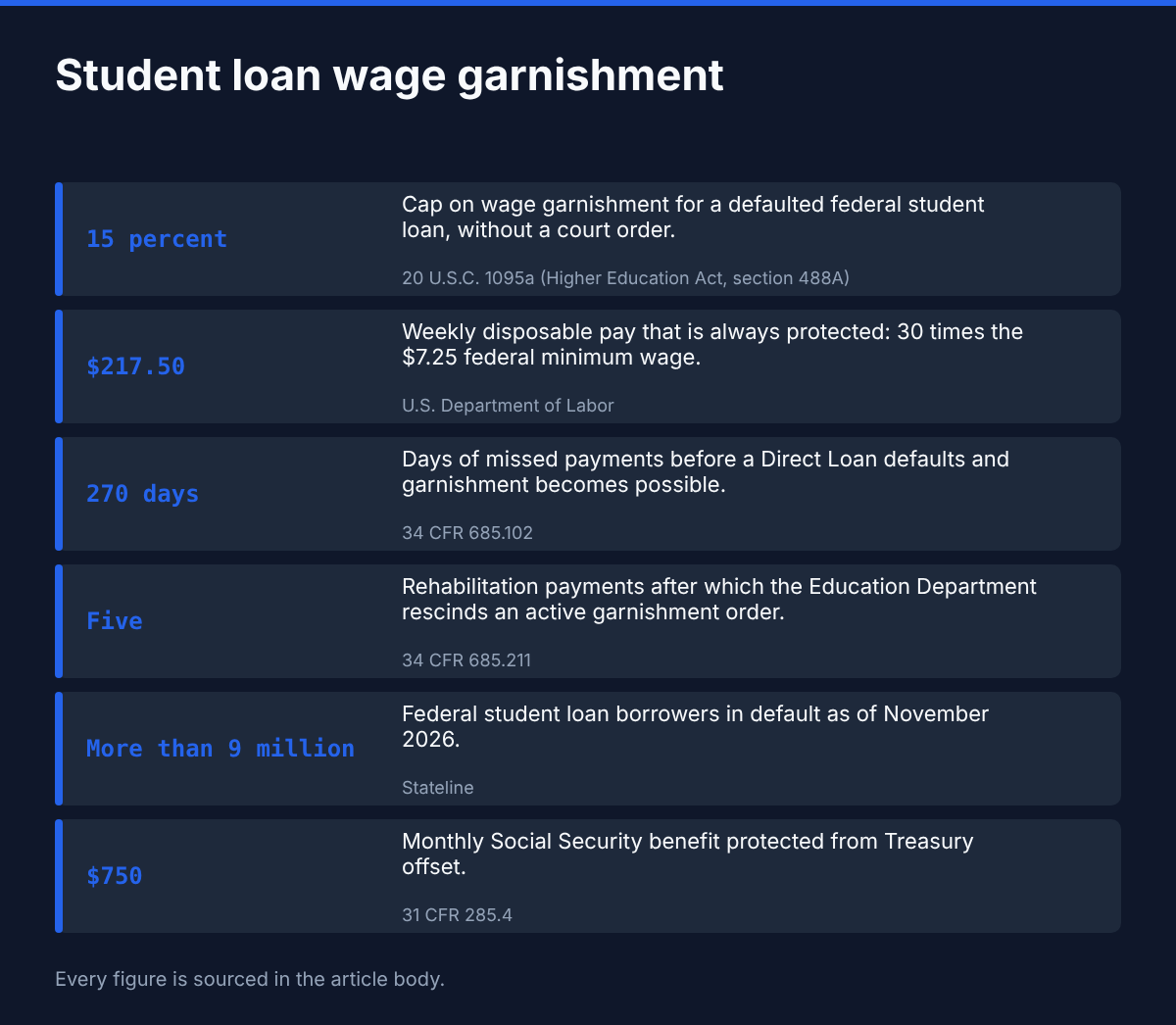
- → 15 percent Cap on wage garnishment for a defaulted federal student loan, without a court order. (20 U.S.C. 1095a (Higher Education Act, section 488A), 2026)
- → $217.50 Weekly disposable pay that is always protected: 30 times the $7.25 federal minimum wage. (U.S. Department of Labor, 2026)
- → 270 days Days of missed payments before a Direct Loan defaults and garnishment becomes possible. (34 CFR 685.102, 2026)
- → 5 Rehabilitation payments after which the Education Department rescinds an active garnishment order. (34 CFR 685.211, 2026)
- → More than 9 million Federal student loan borrowers in default as of November 2026. (Stateline, 2026)
- → $750 Monthly Social Security benefit protected from Treasury offset. (31 CFR 285.4, 2026)
If a federal student loan goes into default, the government does not need to sue you to take part of your paycheck. Under the Higher Education Act it can order your employer to withhold up to 15 percent of your disposable pay (20 U.S.C. 1095a (Higher Education Act, section 488A), 2026), and a federal floor protects only the first $217.50 of each week’s pay (U.S. Department of Labor, 2026). Those two numbers decide what you take home, and most explanations stop before doing the arithmetic.
Below you will find what is left of a paycheck at several pay levels, how long the process takes from the first missed payment to the first deduction, how many borrowers are exposed as collections move toward a restart, and every route the regulations give you to stop or shrink the deduction. Each rule is quoted from the statute or the Code of Federal Regulations, linked so you can read it yourself. It sits alongside our guide to getting out of default through rehabilitation or consolidation.
One note before the numbers. This page is general information only; it is not legal or financial advice, the author is not a lawyer, and you remain responsible for your own decisions. It covers defaulted federal student loans held by the U.S. Department of Education. Private student loans can be garnished only after a lender wins a court judgment, and then state law and the general 25 percent federal limit apply. FFEL loans held by guaranty agencies follow parallel rules (34 CFR 682.410) with timelines that can differ, and Perkins loans have their own default rules, so check who holds your loan on StudentAid.gov. Talk to your loan holder or a qualified adviser if you need to, but do not let the hearing deadline printed on your notice pass while you do; a hearing request can be filed first.
1 How Much of Your Paycheck Can Be Garnished? 15 Percent, With a $217.50 Floor
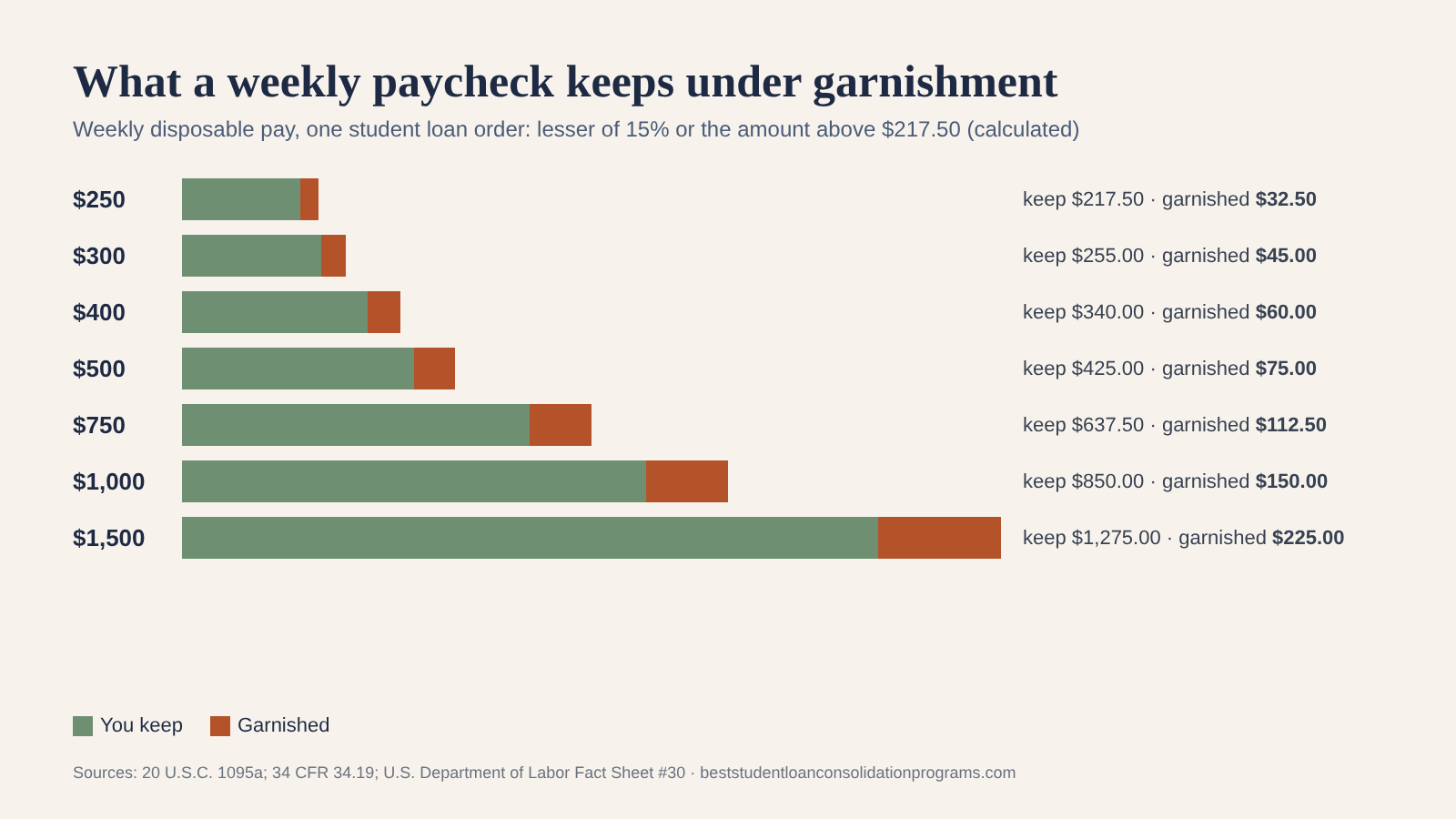
For a defaulted federal student loan, the deduction may not exceed 15 percent of disposable pay in any pay period (20 U.S.C. 1095a (Higher Education Act, section 488A), 2026). Your employer withholds the smaller of that amount or the part of weekly disposable pay above $217.50, which is 30 times the $7.25 federal minimum wage (34 CFR 34.19, 2026). Disposable pay is what remains after taxes and other legally required withholding, and after health insurance premiums (34 CFR 34.19, 2026).
| WEEKLY DISPOSABLE PAY | GARNISHED PER WEEK | YOU KEEP PER WEEK | GARNISHED PER YEAR |
|---|---|---|---|
| $250 | $32.50 (floor applies, calculated) | $217.50 | About $1,690 |
| $300 | $45.00 (calculated) | $255.00 | About $2,340 |
| $400 | $60.00 (calculated) | $340.00 | About $3,120 |
| $500 | $75.00 (calculated) | $425.00 | About $3,900 |
| $750 | $112.50 (calculated) | $637.50 | About $5,850 |
| $1,000 | $150.00 (calculated) | $850.00 | About $7,800 |
| $1,500 | $225.00 (calculated) | $1,275.00 | About $11,700 |
The table uses the two limits exactly as the rules set them. For almost everyone the 15 percent limit is the one that binds. The floor only matters at very low pay: below about $255.88 of weekly disposable pay (calculated), taking 15 percent would push take-home pay under $217.50, so the deduction shrinks to whatever sits above the floor. At $250 a week that is $32.50 rather than $37.50, and at $217.50 or less nothing can be taken (U.S. Department of Labor, 2026).
It helps to compare this with other debts. For an ordinary creditor who wins a court judgment, the general federal limit is 25 percent of disposable earnings (U.S. Department of Labor, 2026). Student loans are capped lower, at 15 percent, but the trade-off is speed: no lawsuit and no judge are involved. The Department of Labor notes that these student loan garnishments are subject to the federal Consumer Credit Protection Act but not to state garnishment laws (U.S. Department of Labor, 2026), so a state with a more generous exemption cannot reduce the federal deduction.
Two more points. First, under the Education Department’s rule, disposable pay is what remains after legally required withholding, such as income and Social Security taxes, and after health insurance premiums; other voluntary deductions, such as 401(k) contributions, do not reduce it (34 CFR 34.19, 2026). Second, the statute allows a higher percentage only with your written consent (20 U.S.C. 1095a (Higher Education Act, section 488A), 2026). If a payment arrangement asks you to sign for more than 15 percent, that is a choice, not a requirement.
2 What Is Protected in Each Pay Period? $217.50 a Week to $942.50 a Month
The floor scales with how often you are paid. The Department of Labor sets the protected amount at $217.50 weekly, $435.00 biweekly, $471.25 semimonthly and $942.50 monthly, all based on the $7.25 federal minimum wage (U.S. Department of Labor, 2026).
| PAY PERIOD | PROTECTED AMOUNT | 15% LIMIT BINDS ABOVE (CALCULATED) | EXAMPLE: DEDUCTION ON A TYPICAL CHECK |
|---|---|---|---|
| Weekly | $217.50 | About $255.88 | $1,000 check: $150 |
| Biweekly | $435.00 | About $511.76 | $2,000 check: $300 |
| Semimonthly | $471.25 | About $554.41 | $2,000 check: $300 |
| Monthly | $942.50 | About $1,108.82 | $4,000 check: $600 |
The protected amounts are tied to the federal minimum wage, which has not changed in years. That means the floor does not rise with prices, and in practice it protects only very low earners. Anyone with disposable pay above the thresholds in the third column loses the full 15 percent on every check.
Pay frequency does not change the share taken; it only changes how the floor is counted. A worker paid $1,000 a week and a worker paid $4,333 a month lose roughly the same amount over a year. What changes the result is disposable pay itself, so a raise, extra hours or a bonus check all increase the deduction for that pay period.
If another withholding order already applies, such as child support, combined limits and priority rules apply under 34 CFR 34.20. Your notice should say how the Education Department treats your situation; if it does not, ask in writing.
3 How Long Before Wage Garnishment Starts? About a Year From the First Missed Payment
A Direct Loan is in default after 270 days of missed payments (34 CFR 685.102, 2026). The government must then send written notice at least 30 days before starting proceedings (20 U.S.C. 1095a, 2026), and if you do not request a hearing in time it issues the order to your employer within 30 days after the hearing deadline (34 CFR 34.18, 2026).
| STEP | RULE | EARLIEST TIMING (CALCULATED) |
|---|---|---|
| Loan enters default | 270 days of missed payments | Day 270 |
| Notice of proposed garnishment | At least 30 days before proceedings | Day 270 or later |
| Deadline to request a hearing | 30th day after the notice | About day 300 |
| Garnishment order sent to employer | within 30 days after the hearing deadline | About day 300 to 330 |
| Hearing decision if you asked in time | Within 60 days of your request | Order waits for the decision |
The calculated column is a floor, not a forecast. Default is the first step that makes garnishment possible, but the Education Department decides when to send notices, and wage garnishment has been largely on hold since March 2020. After the pandemic pause, the department planned to mail the first notices to about 1,000 borrowers in January 2026, according to Bloomberg’s reporting of a department spokesperson (Bloomberg, 2025). It then delayed wage garnishment and Treasury offset with no end date set (U.S. Department of Education, 2026).
The single most useful date on a notice is the hearing deadline. If your request is postmarked or received by the 30th day after the notice, the department must wait to issue a garnishment order until it has held the hearing and decided your objections (34 CFR 34.11, 2026). A late request still gets a hearing, but the order is not delayed unless the lateness was outside your control, though the department must suspend an order if it has not decided a late request within 60 days. The statute itself uses a shorter 15-day window for a pre-order hearing (20 U.S.C. 1095a, 2026), and guaranty agencies collecting FFEL loans may follow it, so treat the date on your own notice as binding.
Notices go to your last known address. If you have moved since you last dealt with your servicer, update your contact details on StudentAid.gov now, because a deadline you never saw is treated the same as one you ignored. Our student loan default articles explain what default does to the rest of your loan.
4 How Many Borrowers Face Garnishment? More Than 9 Million in Default
More than 9 million borrowers are in default on federal student loans, owing $234 billion in total, Stateline reported on November 12, 2026 (Stateline, 2026). The same report said collections, including wage garnishment and seized tax refunds, could resume in 2027.
| METRIC | VALUE | SOURCE |
|---|---|---|
| Federal borrowers in default | More than 9 million | Stateline |
| Amount owed by defaulted borrowers | $234 billion | Stateline |
| Planned first notices, January 2026 | 1,000 (reported) | Bloomberg |
| Status of wage garnishment and Treasury offset | Delayed, no end date | U.S. Department of Education |
| Social Security offset limit | 15 percent of the benefit | 31 CFR 285.4 |
| Social Security protected each month | $750 | 31 CFR 285.4 |
Wage garnishment is only one of the tools waiting on the restart. The Treasury Offset Program can also take federal tax refunds and part of federal benefits, one of several involuntary collection tools the government can use. For Social Security, the offset is the smallest of the debt, 15 percent of the monthly benefit, or the amount above $750 (31 CFR 285.4, 2026). On an $850 benefit that would mean $100, because only the part above $750 can be touched; Supplemental Security Income cannot be offset. Treasury offset is delayed along with wage garnishment (U.S. Department of Education, 2026).
The scale matters for a practical reason. When collections restart for millions of accounts at once, call centers and processing queues will be under strain, and hearing requests and rehabilitation paperwork may take longer than the rules suggest. Starting before a notice arrives is the safest way to keep control of the timing.
The exact restart date was not public when this was written. We will update this page when the Education Department announces it, together with any change to how notices are sent, as set out in our editorial policy. Related guides sit in the federal loan consolidation section.
5 How Do You Stop Student Loan Wage Garnishment? Four Routes, and One That Waits
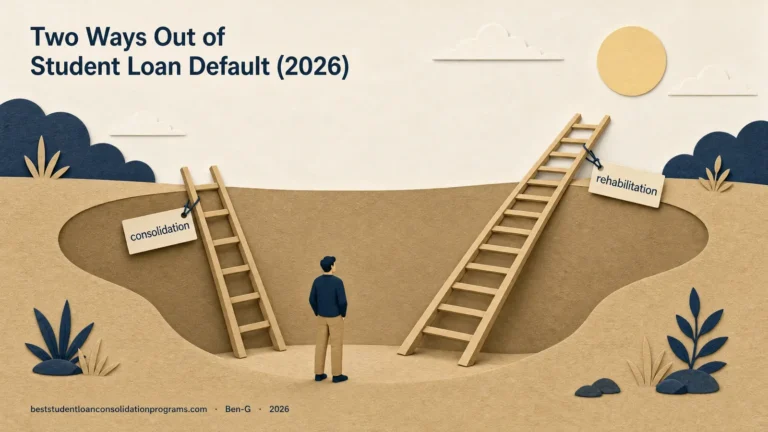
Rehabilitation is the route the regulations tie directly to ending an active order: after 5 qualifying rehabilitation payments the department rescinds the order (34 CFR 685.211, 2026). You can also dispute the debt at a hearing, claim financial hardship, or show you were laid off and have been back at work for less than 12 months (34 CFR 34.23, 2026). Consolidation does not work while an order is active (34 CFR 685.220, 2026).
| ROUTE | WHAT IT DOES | LIMIT IN THE RULES |
|---|---|---|
| Hearing on the debt | Challenges whether the debt exists, its amount or whether it can be collected | Ask by the 30th day after the notice to delay the order |
| Hardship claim | Reduces the deduction to what leaves room for proven basic living expenses | Before the order: raise it with your hearing request. On an existing order: after six months, unless your finances changed substantially; a finding lasts six months |
| Involuntary job loss | No garnishment until you have been back at work continuously for 12 months | You must tell the department about the layoff |
| Rehabilitation | Order rescinded after 5 qualifying payments; default removed after 9 within 10 months | Once per loan now; twice for loans that default on or after July 1, 2027 |
| Consolidation | Leaves default by repaying the old loans with a new one | Not allowed until the order is lifted |
Loan rehabilitation works because it gives you a payment set by your income instead of 15 percent of your pay. The regulation sets the payment at what an income-driven plan would require, with a minimum of $10 from July 1, 2027 ($5 before then) (34 CFR 685.211, 2026). Garnishment continues alongside the first payments, but once the fifth qualifying payment is made the order is lifted. The catch is that money taken by garnishment does not count toward the nine payments, because rehabilitation payments must be voluntary (34 CFR 685.102, 2026).
A Direct Consolidation Loan can take you out of default without nine months of payments, but the rules close that door while you are being garnished. A borrower subject to a wage garnishment order cannot get a Direct Consolidation Loan unless the order has been lifted (34 CFR 685.220, 2026). That makes consolidation a route to use before the order is issued, or after rehabilitation payments have lifted it. One catch since July 1, 2026: a new Direct Consolidation Loan can only be repaid under the standard plan or the Repayment Assistance Plan (20 U.S.C. 1087e(g)(3)), so consolidating ends access to IBR, including the garnishment credit described below. A consolidation that includes a Parent PLUS loan cannot use RAP either. Check which plans you would lose before choosing consolidation over rehabilitation. Our comparison of rehabilitation and consolidation re-default rates shows which route holds up better afterwards.
A hardship claim is the route for people whose budget cannot absorb the deduction. You have to prove your basic living expenses and income with documents, and if the department agrees it lowers the deduction to an amount that leaves those expenses covered (34 CFR 34.25, 2026). The relief is temporary by design: the finding lasts no longer than six months, after which you can be asked for updated figures. Paying the balance in full or negotiating a settlement also ends garnishment, but few borrowers in default have that option.
6 Does Garnished Money Count Toward Anything? Yes for IBR, No for Rehabilitation
Under the income-based repayment rules, amounts collected through wage garnishment can count toward IBR forgiveness at the amount you would have owed under IBR (34 CFR 685.209, 2026). They do not count toward the nine voluntary payments needed to rehabilitate a loan (34 CFR 685.102, 2026).
| QUESTION | ANSWER IN THE RULES | SOURCE |
|---|---|---|
| Do garnished amounts count toward IBR forgiveness? | Can count toward IBR forgiveness | 34 CFR 685.209 |
| Do garnished amounts count toward rehabilitation? | No, not counted as voluntary payments | 34 CFR 685.102 |
| Can garnishment be suspended through rehabilitation more than once? | Once per loan now; twice for loans that default on or after July 1, 2027 | 34 CFR 685.211 |
| Minimum rehabilitation payment from July 1, 2027 | $10 | 34 CFR 685.211 |
The IBR rule is narrow and easy to overstate. The credit is limited to the amount you would owe under IBR and to the months until your next recertification date, so garnishment cannot speed up forgiveness beyond what IBR payments would have done. It applies to the IBR plan only (34 CFR 685.209, 2026), and putting a defaulted loan on IBR is not automatic. How such months are treated if you later move to the Repayment Assistance Plan is not spelled out in the servicer guidance we read, so ask your servicer in writing.
The rehabilitation rule matters more for most people. Because garnished money is not voluntary, a borrower who relies on garnishment alone never leaves default. Leaving default is also only half the job: the re-default numbers show how often borrowers slip back. Making the rehabilitation payments on top of the garnishment for five months is what turns the order off, and finishing all nine is what removes the default. If you work toward Public Service Loan Forgiveness, payment counting has its own rules, covered in our PSLF payment count guide.
Explore every figure in this article
Methodology
Every rule on this page was read on November 15, 2026 from the statute (20 U.S.C. 1095a, via Cornell’s Legal Information Institute), the electronic Code of Federal Regulations (34 CFR parts 34 and 685 and 31 CFR 285.4) and the Department of Labor’s garnishment fact sheet. Take-home figures in the first two tables are our own calculations from those limits for a single student loan garnishment order, rounded to the cent; annual figures assume 52 equal weekly checks. Default counts come from Stateline’s November 12, 2026 report. The January 2026 notice plan comes from Bloomberg’s reporting of an unnamed department spokesperson and is marked as reported. The Education Department’s delay announcement and the Bloomberg article were read in full on November 15, 2026.
- Sources consulted: 22
- Sources cited: 16
- Data range: 2025-12-23 to 2026-11-15
- Research date: 2026-11-15
- Update schedule: When the Education Department announces a restart date, and whenever the federal minimum wage changes
- Limitations: Take-home figures are calculated from the federal rules for a single garnishment order and assume disposable pay is already known; state law cannot lower the federal 15 percent cap but other orders such as child support can change the order of withholding. The restart date for collections had not been announced on November 15, 2026.
Frequently Asked Questions
How much can the government garnish for a defaulted student loan?
Up to 15 percent of disposable pay per pay period, which is pay left after legally required withholding such as taxes and, under the Education Department's rule, health insurance premiums. The employer withholds the smaller of that 15 percent or the amount by which weekly disposable pay exceeds $217.50, which is 30 times the federal minimum wage. No court order is needed. (20 U.S.C. 1095a, 2026)
How long after default does wage garnishment start?
A Direct Loan defaults after 270 days of missed payments. The government must then mail a notice at least 30 days before starting proceedings, and it issues the order to your employer within 30 days after your hearing deadline passes. In practice that is almost a year from the first missed payment at the earliest, and timing in 2026 has depended on when the Education Department restarts collections. (34 CFR 34.18, 2026)
Can I stop student loan wage garnishment once it has started?
Yes. If your objection fits, a hearing or the job-loss exclusion can stop or block it outright. Rehabilitation is the route the rules tie directly to an active order: after the fifth qualifying rehabilitation payment the Education Department rescinds it. You can also claim financial hardship, either at the hearing before an order is issued or, on an existing order, after it has run six months (sooner after a substantial change such as injury, divorce or catastrophic illness). (34 CFR 685.211, 2026)
Can I consolidate to stop wage garnishment?
Not while the order is active. The Direct Consolidation rules exclude a borrower who is subject to a wage garnishment order unless the order has been lifted. Consolidation is a route out of default before garnishment begins, or after the order is lifted. Since July 1, 2026, a new Direct Consolidation Loan can only be repaid under the standard plan or the Repayment Assistance Plan, so consolidating ends access to IBR. (34 CFR 685.220, 2026)
Can student loans take my Social Security?
The rules allow it through the Treasury Offset Program: up to 15 percent of a monthly Social Security benefit, but never so much that the payment falls below $750, and Supplemental Security Income cannot be offset. On an $850 benefit the offset would be $100. As of November 2026 the Education Department had delayed Treasury offset collections with no end date announced. (31 CFR 285.4, 2026)
Sources & References
- Legal Information Institute (U.S. Code). “20 U.S. Code 1095a – Wage garnishment requirement.” law.cornell.edu/uscode/text/20/1095a. Accessed 2026-11-15.
- U.S. Department of Labor. “Fact Sheet #30: The Federal Wage Garnishment Law, Consumer Credit Protection Act's Title III.” dol.gov/agencies/whd/fact-sheets/30-cppa. Accessed 2026-11-15.
- eCFR. “34 CFR 34.19 Amounts to be withheld under a garnishment order.” ecfr.gov/current/title-34/subtitle-A/part-34/section-34.19. Accessed 2026-11-15.
- eCFR. “34 CFR 34.11 Timely request for a hearing.” ecfr.gov/current/title-34/subtitle-A/part-34/section-34.11. Accessed 2026-11-15.
- eCFR. “34 CFR 34.18 Issuance of the wage garnishment order.” ecfr.gov/current/title-34/subtitle-A/part-34/section-34.18. Accessed 2026-11-15.
- eCFR. “34 CFR 34.23 Exclusions from garnishment.” ecfr.gov/current/title-34/subtitle-A/part-34/section-34.23. Accessed 2026-11-15.
- eCFR. “34 CFR 34.24 Claim of financial hardship.” ecfr.gov/current/title-34/subtitle-A/part-34/section-34.24. Accessed 2026-11-15.
- eCFR. “34 CFR 34.25 Determination of financial hardship.” ecfr.gov/current/title-34/subtitle-A/part-34/section-34.25. Accessed 2026-11-15.
- eCFR. “34 CFR 685.102 Definitions.” ecfr.gov/current/title-34/subtitle-B/chapter-VI/part-685/subpart-A/section-685.1. Accessed 2026-11-15.
- eCFR. “34 CFR 685.211 Miscellaneous repayment provisions.” ecfr.gov/current/title-34/subtitle-B/chapter-VI/part-685/subpart-B/section-685.2. Accessed 2026-11-15.
- eCFR. “34 CFR 685.220 Consolidation.” ecfr.gov/current/title-34/subtitle-B/chapter-VI/part-685/subpart-B/section-685.2. Accessed 2026-11-15.
- eCFR. “34 CFR 685.209 Income-driven repayment plans.” ecfr.gov/current/title-34/subtitle-B/chapter-VI/part-685/subpart-B/section-685.2. Accessed 2026-11-15.
- eCFR. “31 CFR 285.4 Offset of Federal benefit payments.” ecfr.gov/current/title-31/subtitle-B/chapter-II/part-285/subpart-A/section-285.4. Accessed 2026-11-15.
- U.S. Department of Education. “U.S. Department of Education Delays Involuntary Collections.” ed.gov/about/news/press-release/us-department-of-education-delays-involuntary-co. Accessed 2026-11-15.
- Stateline. “Collections are coming for millions of student loans in default.” stateline.org/2026/11/12/collections-are-coming-for-millions-of-student-loans-in. Accessed 2026-11-15.
- Bloomberg. “US Set to Garnish Wages for Student Debt Collection in 2026.” bloomberg.com/news/articles/2025-12-23/us-to-begin-garnishing-wages-for-student-. Accessed 2026-11-15.
Last updated:

One Comment