Student Loan Rehabilitation vs Consolidation: The Re-Default Numbers Nobody Shows You (2026)
Student loan rehabilitation vs consolidation is the choice every borrower in default faces, and the re-default data shows the plan you land in matters more than the route you take.
KEY TAKEAWAYS
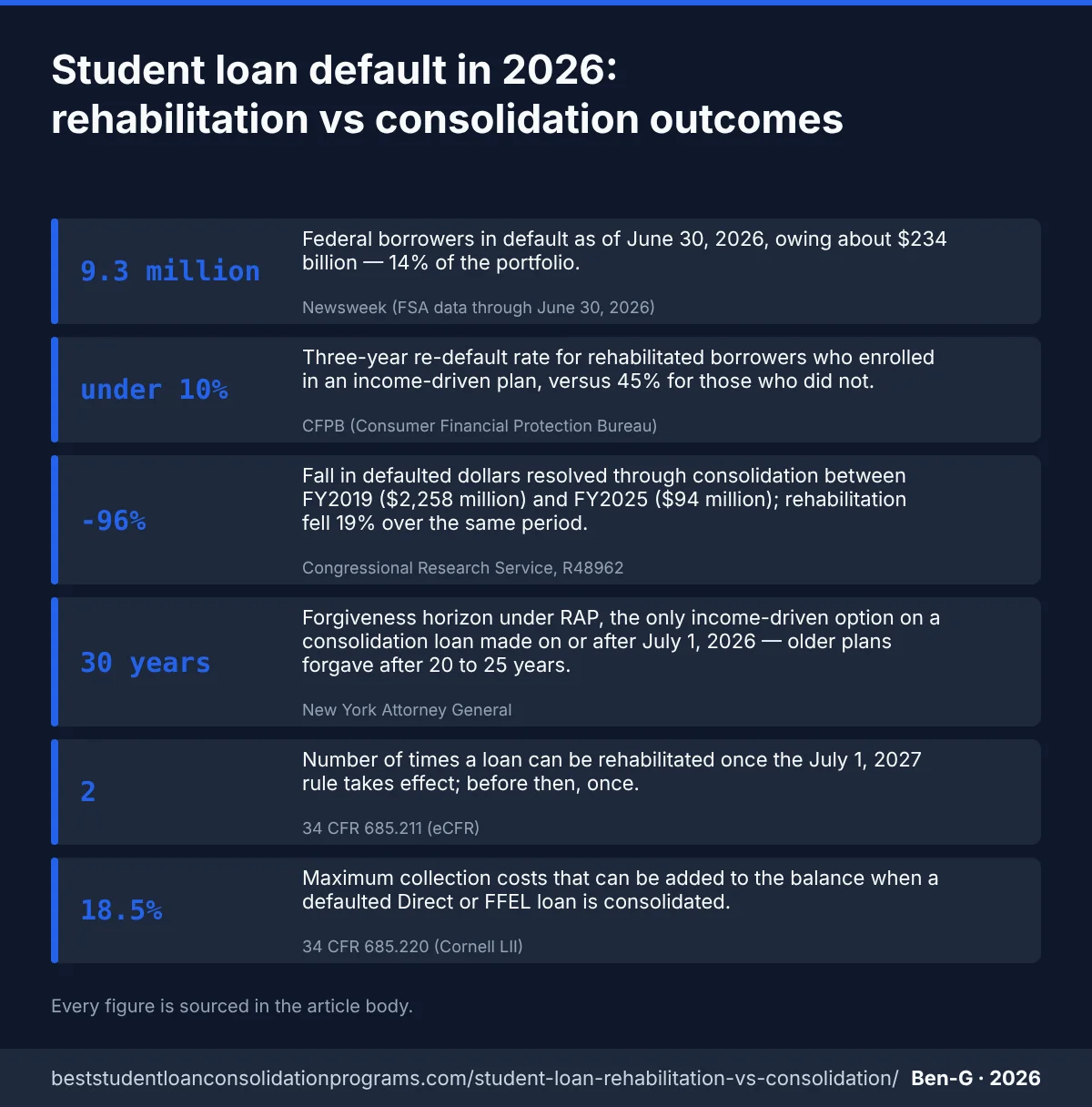
- → 9.3 million Federal borrowers in default as of June 30, 2026, owing about $234 billion — 14% of the portfolio. (FSA data, as reported by Newsweek (secondary))
- → under 10% Three-year re-default rate for rehabilitated borrowers who enrolled in an income-driven plan, versus 45% for those who did not. (CFPB (Consumer Financial Protection Bureau), 2016)
- → -96% Fall in defaulted dollars resolved through consolidation between FY2019 ($2,258 million) and FY2025 ($94 million); rehabilitation fell 19% over the same period. (Congressional Research Service, R48962)
- → 30 years Forgiveness horizon under RAP, the only income-driven option on a consolidation loan made on or after July 1, 2026 — older plans forgave after 20 to 25 years. (New York Attorney General, 2026)
- → 2 Number of times a loan can be rehabilitated once the July 1, 2027 rule takes effect; before then, once. (34 CFR 685.211 (eCFR), 2026)
- → 18.5% Maximum collection costs that can be added to the balance when a defaulted Direct or FFEL loan is consolidated. (34 CFR 685.220 (eCFR))
- → paused Status of wage garnishment and Treasury offset on October 29, 2026, per the Education Department — paused since the January 16, 2026 announcement. (Yahoo Finance, quoting the Education Department (secondary))
Every guide to student loan rehabilitation vs consolidation says the same two things: rehabilitation is slow but cleans your credit report, consolidation is fast but leaves the default on it. Both are true. Neither answers the question people in default actually ask, which is whether they will end up right back where they started. This page answers it with the only outcome data that exists. When the Consumer Financial Protection Bureau pulled servicer records on borrowers who had exited default, it found that 45% of rehabilitated borrowers who were not in an income-driven plan had defaulted again within three years, against under 10% of those who were (CFPB (Consumer Financial Protection Bureau), 2016). The route out mattered far less than the plan a borrower landed in afterward.
That finding collides with a rule change most comparison articles have not caught up with. Since the first of July this year, a Direct Consolidation Loan is treated as a brand-new loan with exactly one income-driven option, the Repayment Assistance Plan, which forgives after 30 years rather than the 20-25 of the older plans (New York Attorney General, 2026). Consolidation used to re-default less precisely because it forced a plan choice; today the plan it forces is RAP. Meanwhile the stock of defaulted borrowers has grown to 9.3 million (FSA data, as reported by Newsweek (secondary)), involuntary collections are paused but reported to be restarting, and the dollars leaving default through consolidation have fallen -96% in six fiscal years (Congressional Research Service, R48962).
What follows is a side-by-side built from the regulations themselves, the Congressional Research Service’s collections tables, FSA portfolio data and the CFPB’s re-default analysis. Where a figure is an agency’s own claim or an attorney’s estimate, the source column says so. If you are deciding between the two exits this month, the honest summary is short: pick the one your deadline allows, and enroll in an income-driven plan before the first bill arrives.
1 How Many Borrowers Are in Default in 2026? 9.3 Million and Rising
Federal Student Aid data through the end of June puts 9.3 million borrowers in default on $234 billion of loans, 14% of the portfolio, up 400,000 in a single quarter (FSA data, as reported by Newsweek (secondary)). Another 1.5 million are in late-stage delinquency and could default within six months. At the end of last year the count was 7.8 million (Congressional Research Service, R48962).
| METRIC | VALUE | SOURCE |
|---|---|---|
| Borrowers in default, end of June this year | 9.3 million | FSA data, as reported by Newsweek (secondary) |
| Dollars in default, end of June this year | $234 billion | FSA data, as reported by Newsweek (secondary) |
| Share of the federal portfolio in default | 14% | FSA data, as reported by Newsweek (secondary) |
| Quarterly increase in defaulted borrowers (Q2 vs Q1) | 400,000 | FSA data, as reported by Newsweek (secondary) |
| Borrowers in late-stage delinquency | 1.5 million | FSA data, as reported by Newsweek (secondary) |
| Borrowers in default, end of March this year | 9 million | FSA Data Center figures, as reported by NASFAA (secondary) |
| Dollars in default, end of March this year | $220 billion | FSA Data Center figures, as reported by NASFAA (secondary) |
| Quarterly increase (Q1 vs Q4 last year) | 1.3 million | FSA Data Center figures, as reported by NASFAA (secondary) |
| Borrowers 30+ days delinquent, March | 3.5 million | FSA Data Center figures, as reported by NASFAA (secondary) |
| Borrowers in default, end of last year | 7.8 million | Congressional Research Service, R48962 |
| Dollars in default, end of last year | $179 billion | Congressional Research Service, R48962 |
| Borrowers in default for more than six years | 5 million | U.S. Department of the Treasury press release |
| Defaulted debt transferred to Treasury, March | $180 billion | Debt Collection Lab |
| Days of nonpayment before default | 270 | CFPB Ask CFPB |
The growth is not a slow drift. Between the end of last year and the end of June the defaulted population rose from 7.8 million to 9.3 million, and the dollars from $179 billion to $234 billion. The first quarter alone added 1.3 million borrowers as the delinquencies that returned to credit reports in the previous year aged past the 270-day line (FSA Data Center figures, as reported by NASFAA (secondary)). Behind them sit 3.5 million borrowers more than thirty days late, a fifth of everyone in active repayment, and 1.5 million in the late-stage bucket that FSA itself flags as likely to default within half a year.
Two features of this population shape the rehabilitation-versus-consolidation choice. First, it is old: Treasury says 5 million borrowers have been in default for more than six years (U.S. Department of the Treasury press release, 2026), which means collection costs, interest and credit damage have had years to compound. Second, it has changed hands. In March the Department of Education handed roughly $180 billion of defaulted debt to Treasury’s Bureau of the Fiscal Service (Debt Collection Lab, 2026), and the Debt Collection Lab’s review of that transfer describes a system of record with missing years of data and inaccurate balances. Anyone choosing an exit route should pull their own loan history from the consolidation program overview and the federal dashboard before signing anything, because the balance a counselor quotes may not be the balance the regulation entitles them to collect.
2 Student Loan Rehabilitation vs Consolidation: What the Regulations Require
Rehabilitation takes 9 voluntary payments within 10, with a floor of $5 a month, and the Department instructs credit bureaus to remove the default (34 CFR 685.211 (eCFR), 2026). Consolidation needs 3 consecutive on-time payments or an agreement to repay under an income-driven plan (34 CFR 685.102 (eCFR)), can add up to 18.5% in collection costs (34 CFR 685.220 (eCFR)), and leaves the default notation on your report for 7 years (Experian, 2026).
| METRIC | VALUE | SOURCE |
|---|---|---|
| Rehabilitation: payments required | 9 | 34 CFR 685.211 (eCFR) |
| Rehabilitation: window for those payments | 10 months | 34 CFR 685.211 (eCFR) |
| Rehabilitation: minimum payment, before July 2027 | $5 | 34 CFR 685.211 (eCFR) |
| Rehabilitation: minimum payment, from July 2027 | $10 | 34 CFR 685.211 (eCFR) |
| Rehabilitations allowed per loan, before July 2027 | 1 | 34 CFR 685.211 (eCFR) |
| Rehabilitations allowed per loan, from July 2027 | 2 | 34 CFR 685.211 (eCFR) |
| Consolidation: consecutive on-time payments (route one) | 3 | 34 CFR 685.102 (eCFR) |
| Consolidation: days of grace for ‘on-time’ | 20 | 34 CFR 685.102 (eCFR) |
| Consolidation: maximum collection costs added | 18.5% | 34 CFR 685.220 (eCFR) |
| Consolidation: years the default stays on your credit report | 7 | Experian |
| Consolidation: typical processing time (attorney estimate) | 4-8 weeks | Tate Law (attorney estimate; secondary) |
| RAP forgiveness horizon (only IDR option after a July 2026 consolidation) | 30 years | New York Attorney General |
| Older IDR plans’ forgiveness horizon | 20-25 years | New York Attorney General |
The two routes are defined in three sections of the Code of Federal Regulations, and reading them removes most of the folklore. Rehabilitation under section 685.211 requires 9 payments, each within 20 days of its due date, inside 10 consecutive months. The payment is whatever an eligible income-driven plan would charge, with a $5 floor that rises to $10 for rehabilitations on or after the first of July next year. On completion the Department tells every bureau that received the default to remove it, which is the credit-repair advantage every guide mentions. The late payments that preceded the default stay on the file (Experian, 2026). Until next July a loan can be rehabilitated 1 time; the new rule allows 2 (34 CFR 685.211 (eCFR), 2026).
Consolidation under sections 685.220 and 685.102 is a different animal. You qualify by making 3 consecutive voluntary payments or simply by agreeing to repay the new loan under an income-driven plan, which is why it can be done in weeks rather than months; Tate Law puts the processing time at 4-8 weeks, an estimate rather than an official figure (Tate Law (attorney estimate; secondary)). The costs are explicit: the Secretary may add up to 18.5% of outstanding principal and interest in collection costs to the new loan, and the route is closed to anyone subject to a court judgment or an active wage-garnishment order. The default notation stays on the credit report for 7 years. Since the first of July this year the New York Attorney General adds a third cost: the consolidation loan is treated as a new borrower’s loan with only RAP available, forgiving after 30 years instead of the 20-25 years of the plans a rehabilitated loan keeps (New York Attorney General, 2026). For Parent PLUS borrowers the Attorney General’s warning is starker still: consolidating now leaves only the Tiered Standard plan, with no income-driven option at all.
3 Student Loan Rehabilitation vs Consolidation: Which Re-Defaults Less? 45% vs Under 10%, Decided by the Plan
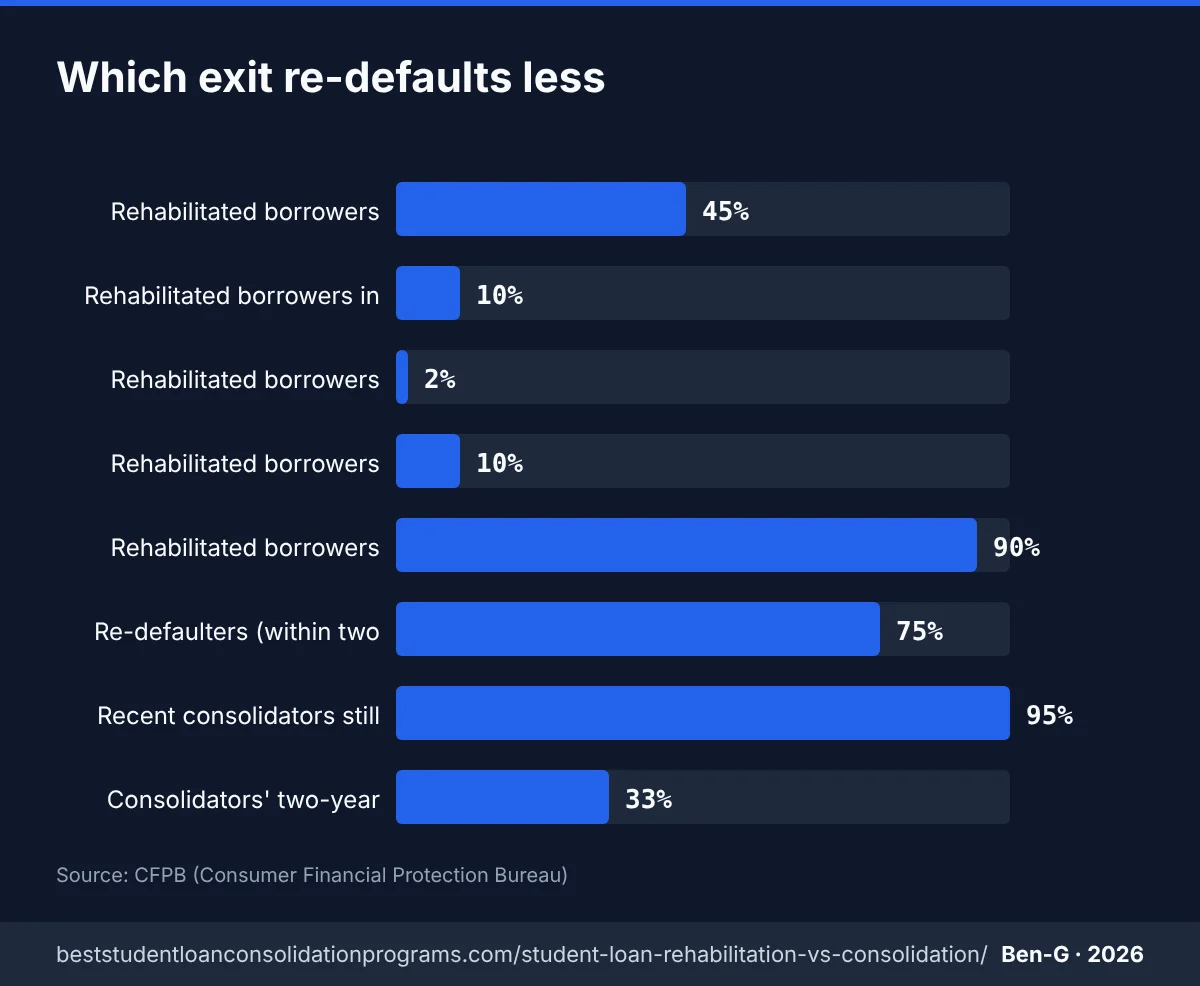
In the CFPB’s servicer data, 45% of rehabilitated borrowers who were not in an income-driven plan were back in default within three years, versus under 10% of those who were, a 5x difference (CFPB (Consumer Financial Protection Bureau), 2016). Consolidators defaulted at a rate 33% lower than rehabilitators after two years, and 95% were still in active repayment at twelve months.
| METRIC | VALUE | SOURCE |
|---|---|---|
| Rehabilitated, not in IDR: re-defaulted within three years | 45% | CFPB (Consumer Financial Protection Bureau) |
| Rehabilitated, in IDR: re-defaulted within three years | under 10% | CFPB (Consumer Financial Protection Bureau) |
| Re-default likelihood, non-IDR vs IDR | 5x | CFPB (Consumer Financial Protection Bureau) |
| Rehabilitated borrowers paying under IDR at first bill | under 2% | CFPB (Consumer Financial Protection Bureau) |
| Rehabilitated borrowers paying under IDR by ninth bill | under 10% | CFPB (Consumer Financial Protection Bureau) |
| Rehabilitated borrowers not in IDR almost a year later | over 90% | CFPB (Consumer Financial Protection Bureau) |
| Two-year re-defaulters who paid nothing after rehabilitation | over 75% | CFPB (Consumer Financial Protection Bureau) |
| Consolidators still in active repayment at twelve months | 95% | CFPB (Consumer Financial Protection Bureau) |
| Consolidators’ two-year default rate vs rehabilitators | 33% lower | CFPB (Consumer Financial Protection Bureau) |
| Second-time defaulters not in IDR at re-default | over 95% | CFPB (Consumer Financial Protection Bureau) |
| Rehabilitated borrowers CFPB estimated could qualify for a zero-dollar IDR payment | 4 in 5 | CFPB (Consumer Financial Protection Bureau) |
This is the section every other comparison page skips, because the data is old and inconvenient. The CFPB’s analysis rests on records servicers handed over voluntarily a decade ago, and no agency has published anything comparable since; FSA’s quarterly releases count borrowers in default but never report who came back. The findings are still the only measured outcomes we have, and they are unambiguous. Rehabilitation on its own did very little: under 2% of rehabilitated borrowers were paying under an income-driven plan at their first bill, under 10% by the ninth, and over 90% were outside IDR almost a year after exiting default. Among those who re-defaulted within two years, over 75% had not made a single payment after rehabilitation ended (CFPB (Consumer Financial Protection Bureau), 2016). The CFPB’s own estimate was that 4 in 5 of them could have qualified for a zero-dollar IDR payment.
Consolidation looked better in the same data, with 95% of consolidators still in active repayment after a year and a two-year default rate 33% lower than rehabilitators’. The reason is mechanical rather than virtuous: a borrower who consolidates out of default by agreeing to an income-driven plan is already enrolled when the first bill arrives, while a rehabilitated borrower returns to a servicer with a standard-plan bill and a form to fill in. That is exactly the mechanism the new rule disturbs. The plan a consolidation now forces is RAP, with its 30-year horizon, and a rehabilitated loan keeps access to the older plans. The historic advantage of consolidation has become its cost, and over 95% of second-time defaulters having been outside IDR tells you what to do regardless of route: enroll before the first bill, not after.
4 How Many Borrowers Actually Use Each Route? Consolidation Exits Fell 96%
Dollars leaving default through rehabilitation fell from $9,801 million in fiscal 2019 to $7,984 million in fiscal 2025, a -19% drop, while consolidation resolutions collapsed from $2,258 million to $94 million, down -96% (Congressional Research Service, R48962). Treasury says the new online portal lifted approved rehabilitation applications 69% and consolidations 95% (U.S. Department of the Treasury press release, 2026).
| METRIC | VALUE | SOURCE |
|---|---|---|
| Resolved by rehabilitation, fiscal 2019 | $9,801 million | Congressional Research Service, R48962 |
| Resolved by rehabilitation, fiscal 2025 | $7,984 million | Congressional Research Service, R48962 |
| Change in rehabilitation resolutions | -19% | Congressional Research Service, R48962 |
| Resolved by consolidation, fiscal 2019 | $2,258 million | Congressional Research Service, R48962 |
| Resolved by consolidation, fiscal 2025 | $94 million | Congressional Research Service, R48962 |
| Change in consolidation resolutions | -96% | Congressional Research Service, R48962 |
| Total defaulted dollars resolved, fiscal 2025 | $8,079 million | Congressional Research Service, R48962 |
| Increase in approved rehabilitation applications since the ED-Treasury partnership (agency claim) | 69% | U.S. Department of the Treasury press release |
| Increase in consolidations out of default after a technical fix (agency claim) | 95% | U.S. Department of the Treasury press release |
| Portal users who found the application easy to complete | 89% | U.S. Department of the Treasury press release |
The Congressional Research Service’s table on default resolutions is the closest thing to a usage count that exists, and it shows the two routes moving in opposite directions. Rehabilitation held up, falling -19% across a period that included a four-year collections pause and the Fresh Start initiative. Consolidation out of default nearly vanished, from $2,258 million to $94 million, a -96% decline that Treasury attributes partly to a technical problem on the Department’s side that made consolidating a defaulted loan difficult. Total resolutions fell to $8,079 million (Congressional Research Service, R48962). Borrower preference did not do this; the pipeline did.
Whether the pipeline has been fixed is now the live question. On the last day of September, Treasury and the Department launched the Defaulted Loans Support Center, an online portal that replaces the mail-and-fax rehabilitation process and lets borrowers apply for either route and e-sign. Treasury’s release claims a 69% rise in approved rehabilitation applications in under six months and a 95% rise in consolidations, with 89% of early users calling the application easy (U.S. Department of the Treasury press release, 2026). Those are the agency’s own numbers with no baseline period stated, so they are reported here as claims rather than measurements. If they hold, the fiscal 2026 table will look very different from fiscal 2025, and the first question a careful reader should ask is which plan those new consolidators were enrolled in.
5 What Happens If Collections Restart? Up to 15% of Your Pay and 100% of Your Refund
Administrative wage garnishment can take up to 15% without a court order, Treasury offset can take 100% of a tax refund and 15% (Congressional Research Service, R48962). Involuntary collections have been paused since January (Yahoo Finance, quoting the Education Department (secondary)); total involuntary collections fell from $6,563 million to $560 million between fiscal 2019 and fiscal 2025.
| METRIC | VALUE | SOURCE |
|---|---|---|
| Wage garnishment cap | 15% | Congressional Research Service, R48962 |
| Treasury offset: share of a tax refund that can be taken | 100% | Congressional Research Service, R48962 |
| Treasury offset: Social Security cap | 15% | Congressional Research Service, R48962 |
| Wage garnishment collected, fiscal 2019 | $1,341 million | Congressional Research Service, R48962 |
| Wage garnishment collected, fiscal 2025 | $0.51 million | Congressional Research Service, R48962 |
| Treasury offset collected, fiscal 2019 | $4,453 million | Congressional Research Service, R48962 |
| Treasury offset collected, fiscal 2025 | $366 million | Congressional Research Service, R48962 |
| Total involuntary collections, fiscal 2019 to fiscal 2025 | $6,563 million to $560 million | Congressional Research Service, R48962 |
| Borrowers with no payment in a year when collections were announced (April last year) | 5 million | U.S. Department of Education (Apr. 21, 2025) |
| Borrowers in late-stage delinquency, 91-180 days (April last year) | 4 million | U.S. Department of Education (Apr. 21, 2025) |
| Total federal borrowers and balance (April last year) | 42.7 million / $1.6 trillion | U.S. Department of Education (Apr. 21, 2025) |
| Borrowers in default cited in October restart reporting | 10 million | Forbes, citing The Washington Sun (secondary) |
| Status of involuntary collections, late October | paused | Yahoo Finance, quoting the Education Department (secondary) |
The urgency that pushes borrowers toward the fast exit comes from collections, so it is worth being precise about where collections stand. Involuntary collections were suspended in March of the pandemic year, resumed on the fifth of May last year when the Department announced that 5 million borrowers had gone a year without paying and 4 million more were in late-stage delinquency (U.S. Department of Education (Apr. 21, 2025)), and were paused again on the sixteenth of January this year while the Department implements the new repayment law. On the twenty-ninth of October the Department told Yahoo Finance that involuntary collections paused (Yahoo Finance, quoting the Education Department (secondary)). The fiscal numbers show how complete the pause has been: wage garnishment yielded $1,341 million in fiscal 2019 and $0.51 million in fiscal 2025, Treasury offset $4,453 million and $366 million, and the two together fell from $6,563 million to $560 million (Congressional Research Service, R48962).
Reporting in October, first by The Washington Sun and then by Forbes, describes Treasury hiring private collectors to pursue the 10 million borrowers in default, possibly as soon as November, and the Department has threatened and withdrawn restarts before (Forbes, citing The Washington Sun (secondary)). When garnishment does resume the tools are set in regulation: 15%, 100%, and 15%. That timing matters for the choice between routes in a way the guides rarely spell out. Once a wage-garnishment order is in effect, consolidation out of default is no longer available under section 685.220 unless the order is lifted, and the suspension of garnishment during rehabilitation can be obtained only once before next July. A borrower who waits for the first garnishment notice has, in practice, lost the fast exit. A claim circulating in borrower groups that most rehabilitated loans default again is not supported by any primary source we could find; the measured figures are the CFPB’s, and they turn on income-driven enrollment, not on the route.
Explore every figure in this article
Methodology
Sources. The federal regulations at 34 CFR 685.211, 685.220 and 685.102; the Congressional Research Service report R48962 (June 2026); Department of Education and Treasury press releases from January and September 2026; the New York Attorney General’s November 2026 advisory; CFPB research on re-default; and Experian’s guidance on credit reporting. Default counts come from the Federal Student Aid Data Center portfolio reports, as reported by NASFAA and Newsweek; where a figure reached us only through a news report, the source is marked secondary.
How the figures were checked. Every rule and number was compared against its source in early November 2026. Figures that sources word or round differently (for example “less than 10 percent”) were confirmed by reading the original page.
Limitations. The only published measurement of re-default after rehabilitation is the CFPB’s analysis of 2016 servicer data, released in 2017; newer outcome data has not been published. The Treasury’s September 2026 increases in rehabilitations and consolidations are the agency’s own figures, without a stated baseline. The date collections restart is based on news reporting, not an official notice. A widely shared claim that 80% of rehabilitations re-default has no traceable source and is not used here.
Frequently Asked Questions
Is rehabilitation or consolidation better for getting student loans out of default in 2026?
Rehabilitation removes the default record from your credit report and keeps your prior repayment-plan options; it takes 9 payments in 10 months (34 CFR 685.211). Consolidation is faster but leaves the default notation on your report for 7 years (Experian, 2026) and, for loans consolidated on or after July 1, 2026, limits you to RAP with 30-year forgiveness (NY Attorney General, 2026). The CFPB's data says what matters most is enrolling in an income-driven plan afterward. (34 CFR 685.211 (eCFR), 2026)
How many people re-default after loan rehabilitation?
In the only published comparison, the CFPB found that 45% of rehabilitated borrowers who were not in an income-driven plan were back in default within three years, versus under 10% of those who were. Over 75% of those who re-defaulted within two years had not paid a single bill after rehabilitation. The data was gathered from servicers in 2016. (CFPB (Consumer Financial Protection Bureau), 2016)
How long does it take to consolidate out of default?
Under 34 CFR 685.102 you qualify by making three consecutive on-time payments (within 20 days of the due date) or by agreeing to repay under an income-driven plan. Student loan attorneys put the processing time at roughly 4 to 8 weeks (Tate Law, 2026), compared with the 10-month rehabilitation window. Consolidation is unavailable while a wage-garnishment order or court judgment is in effect. (34 CFR 685.102 (eCFR))
Does consolidating a defaulted loan add collection fees?
It can. 34 CFR 685.220(f) caps collection costs on a defaulted Direct or FFEL loan being consolidated at 18.5% of outstanding principal and interest, which is added to the new loan balance. Rehabilitation is governed separately under 685.211. (34 CFR 685.220 (eCFR))
Can you rehabilitate a student loan twice?
Not yet. For loans rehabilitated before July 1, 2027, 34 CFR 685.211(f)(12) says the borrower cannot rehabilitate the loan again if it returns to default. On or after July 1, 2027, a loan may be rehabilitated up to two times, and the minimum rehabilitation payment rises from $5 to $10. (34 CFR 685.211 (eCFR), 2026)
Are wage garnishment and tax refund offsets happening right now?
As of October 29, 2026 the Education Department told Yahoo Finance that 'Involuntary collections remain paused'; the pause was announced January 16, 2026 to implement the new repayment law. Collections had resumed May 5, 2025 after the pandemic pause. Reporting in October 2026 (Forbes, citing The Washington Sun) describes plans to restart garnishment with private collectors, with no confirmed date. (Yahoo Finance, quoting the Education Department (secondary))
How many federal student loan borrowers are in default?
About 9.3 million as of June 30, 2026, owing roughly $234 billion (14% of the portfolio), up about 400,000 in one quarter per FSA data reported by Newsweek. At December 31, 2025 the figure was 7.8 million and $179 billion (CRS). More than 5 million have been in default for over six years (Treasury, September 2026). (FSA data, as reported by Newsweek (secondary))
Sources & References
- CFPB (Consumer Financial Protection Bureau). “New data documents a disturbing cycle of defaults for struggling student loan borrowers (May 15, 2017).” consumerfinance.gov/about-us/blog/new-data-documents-disturbing-cycle-defaults-s. Accessed 2026-11-07.
- NASFAA (secondary) (FSA Data Center, Q1 2026). “New FSA Data Shows 1.3 Million Uptick in Defaulted Borrowers (June 25, 2026).” nasfaa.org/news-item/39233/New_FSA_Data_Shows_1_3_Million_Uptick_in_Defaulted_Bo. Accessed 2026-11-07.
- Newsweek (secondary) (FSA data through June 30, 2026). “Student Loan Update: 400,000 More Borrowers in Default (September 24, 2026).” newsweek.com/student-loan-update-400000-more-borrowers-in-default-under-trump-ad. Accessed 2026-11-07.
- 34 CFR 685.211 (eCFR). “34 CFR 685.211 — Miscellaneous repayment provisions (loan rehabilitation).” ecfr.gov/current/title-34/subtitle-B/chapter-VI/part-685/subpart-B/section-685.2. Accessed 2026-11-07.
- U.S. Department of Education press release. “U.S. Department of Education Delays Involuntary Collections Amid Ongoing Student Loan Repayment Improvements (January 16, 2026).” ed.gov/about/news/press-release/us-department-of-education-delays-involuntary-co. Accessed 2026-11-07.
- U.S. Department of the Treasury press release. “Treasury and Education Launch New Defaulted Loans Support Center (September 30, 2026).” home.treasury.gov/news/press-releases/sb0639. Accessed 2026-11-07.
- New York Attorney General. “Attorney General James Warns Student Loan Borrowers About the Risks of Loan Consolidation (November 4, 2026).” ag.ny.gov/press-release/2026/attorney-general-james-warns-student-loan-borrowers. Accessed 2026-11-07.
- Forbes (secondary) (Adam Minsky, citing The Washington Sun). “Education Department Is About To Seize Student Loan Borrowers' Wages And Benefits (October 19, 2026).” forbes.com/sites/adamminsky/2026/10/19/education-department-is-about-to-seize-st. Accessed 2026-11-07.
- Experian. “How to Get Out of Student Loan Default (May 18, 2026).” experian.com/blogs/ask-experian/how-to-get-student-loans-out-of-default/. Accessed 2026-11-07.
- CFPB Ask CFPB. “What happens if I default on a federal student loan?.” consumerfinance.gov/ask-cfpb/what-happens-if-i-default-on-a-federal-student-loan. Accessed 2026-11-07.
- Debt Collection Lab. “The Missing Data Behind the Default Cliff (October 14, 2026).” debtcollectionlab.org/research/missing-data-behind-default-cliff/. Accessed 2026-11-07.
- Yahoo Finance (secondary) (quoting the Education Department). “Student debt collection may be coming back: 5 steps to avoid wage garnishment (October 29, 2026).” finance.yahoo.com/personal-finance/student-loans/article/student-debt-collection. Accessed 2026-11-07.
- Tate Law (secondary). “How to Get Student Loans Out of Default: Your Options in 2026 (October 30, 2026).” tateesq.com/learn/get-student-loans-out-of-default-fast. Accessed 2026-11-07.
- Congressional Research Service. “Transition of Servicing Defaulted Federal Student Loans to the Department of the Treasury: Background and Observations, R48962 (updated June 9, 2026).” congress.gov/crs-product/R48962. Accessed 2026-11-14.
- 34 CFR 685.220 (eCFR). “34 CFR 685.220: Consolidation.” ecfr.gov/current/title-34/subtitle-B/chapter-VI/part-685/subpart-B/section-685.220. Accessed 2026-11-14.
- 34 CFR 685.102 (eCFR). “34 CFR 685.102: Definitions (satisfactory repayment arrangement).” ecfr.gov/current/title-34/subtitle-B/chapter-VI/part-685/subpart-A/section-685.102. Accessed 2026-11-14.
- U.S. Department of Education. “U.S. Department of Education to Begin Federal Student Loan Collections, Other Actions to Help Borrowers Get Back into Repayment (Apr. 21, 2025).” ed.gov/about/news/press-release/us-department-of-education-begin-federal-student-loan-collections-other-actions-help-borrowers-get-back-repayment. Accessed 2026-11-14.
- Federal Student Aid Data Center. “Federal Student Loan Portfolio.” studentaid.gov/data-center/student/portfolio. Accessed 2026-11-14.
Last updated:
This article is general information for U.S. student loan borrowers, not financial or legal advice. Confirm details with your loan servicer or studentaid.gov before acting. See our editorial policy and disclaimer.
One Comment
Comments are closed.