Repayment Assistance Plan Payment by Income: Full Table and the $10,000 Band Cliffs (2026)
KEY TAKEAWAYS
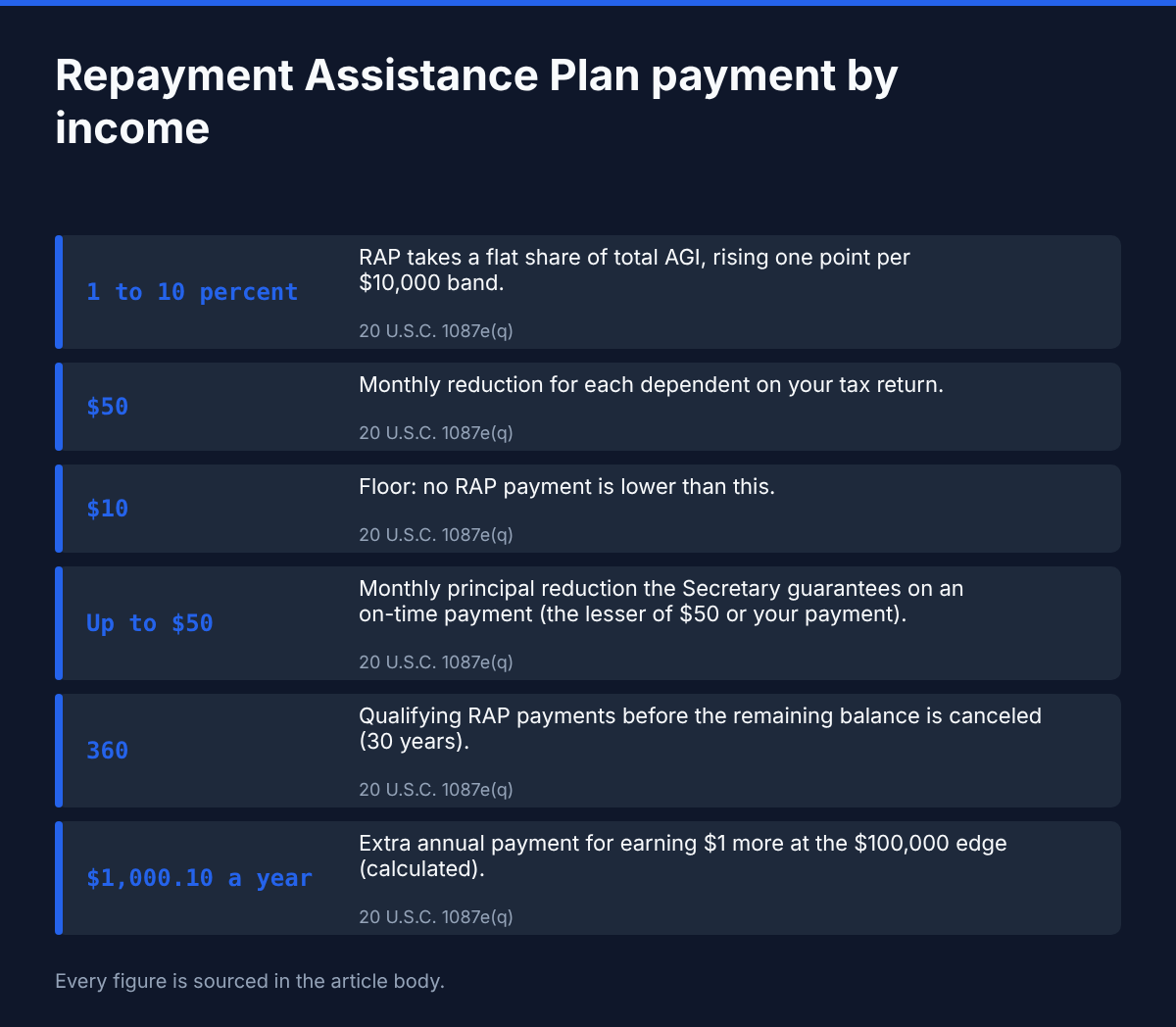
- → 1 to 10 percent RAP takes a flat share of total AGI, rising one point per $10,000 band. (20 U.S.C. 1087e(q), 2026)
- → $50 Monthly reduction for each dependent on your tax return. (20 U.S.C. 1087e(q), 2026)
- → $10 Floor: no RAP payment is lower than this. (20 U.S.C. 1087e(q), 2026)
- → Up to $50 Monthly principal reduction the Secretary guarantees on an on-time payment (the lesser of $50 or your payment). (20 U.S.C. 1087e(q), 2026)
- → 360 Qualifying RAP payments before the remaining balance is canceled (30 years). (20 U.S.C. 1087e(q), 2026)
- → $1,000.10 a year Extra annual payment for earning $1 more at the $100,000 edge (calculated). (20 U.S.C. 1087e(q), 2026)
The Repayment Assistance Plan (RAP) opened on July 1, 2026 (20 U.S.C. 1087e (HEA section 455), 2026), and borrowers with loans made from that date can only choose RAP or a standard plan. The formula is short: a share of your adjusted gross income (AGI), set by $10,000 bands from 1 to 10 percent, divided by 12, minus $50 for each dependent, with a floor of $10 a month (20 U.S.C. 1087e(q), 2026). What the formula does not show is what that means in dollars, where the jumps are, and when RAP costs more than the plan you may be leaving.
Below, all three are worked out from the statute itself. The tables are our own arithmetic, labeled as calculated, so you can redo any line. For the rules on consolidating first, see our guide to what consolidation does to a PSLF count, and for loans already in default, rehabilitation versus consolidation.
This site introduces the topic for general information. It is not legal or financial advice and the author is not a lawyer; your servicer’s figure is the one you will be billed, so check it against your own tax return before choosing a plan.
1 What Is the RAP Payment at Each Income? $10 to $1,250 a Month
On RAP, a single borrower pays $10 a month at very low income, $166.67 at $50,000 of AGI and $1,250 at $150,000 (calculated). Each dependent on your tax return lowers the monthly payment by $50 (20 U.S.C. 1087e(q), 2026), but never below the $10 floor.
| AGI | 0 DEPENDENTS | 1 DEPENDENT | 2 DEPENDENTS | 3 DEPENDENTS |
|---|---|---|---|---|
| $0 to $10,000 | $10 | $10 | $10 | $10 |
| $15,000 | $12.50 | $10 | $10 | $10 |
| $25,000 | $41.67 | $10 | $10 | $10 |
| $35,000 | $87.50 | $37.50 | $10 | $10 |
| $45,000 | $150.00 | $100.00 | $50.00 | $10 |
| $55,000 | $229.17 | $179.17 | $129.17 | $79.17 |
| $65,000 | $325.00 | $275.00 | $225.00 | $175.00 |
| $75,000 | $437.50 | $387.50 | $337.50 | $287.50 |
| $85,000 | $566.67 | $516.67 | $466.67 | $416.67 |
| $95,000 | $712.50 | $662.50 | $612.50 | $562.50 |
| $120,000 | $1,000.00 | $950.00 | $900.00 | $850.00 |
| $150,000 | $1,250.00 | $1,200.00 | $1,150.00 | $1,100.00 |
All amounts are monthly and calculated from the brackets in the statute: $120 a year at AGI of $10,000 or less, then 1 percent of AGI above $10,000, 2 percent above $20,000 and so on, up to 10 percent above $100,000 (20 U.S.C. 1087e(q), 2026). The annual figure is divided by 12, then $50 per dependent comes off.
Below about $45,000, dependents matter more than income: a borrower with two dependents pays the $10 minimum up to $40,000 of AGI and $33.34 just above it. Above $100,000, the payment is simply 10 percent of AGI, about the same share many borrowers paid on older income-driven plans but without any protected income.
Married borrowers who file jointly are measured on combined AGI, according to the servicer Edfinancial (Edfinancial (federal loan servicer), 2026); filing separately leaves the spouse’s income out under the statute’s definition (20 U.S.C. 1087e(q), 2026). If both spouses have federal loans the payment is reduced, but no formula has been published, so the tables here do not apply to that case.
2 Where Are the RAP Cliffs? $200 to $1,000 More a Year for $1 More Income
Because the rate applies to all of your AGI, not just the part above the band edge, crossing a $10,000 line raises the yearly payment in one step. At $40,000 the payment is $1,200 a year; at $40,001 it is $1,600.04 (calculated). At the $100,000 edge the jump is $1,000.10 a year (20 U.S.C. 1087e(q), 2026).
| BAND EDGE | YEARLY PAYMENT AT THE EDGE | YEARLY PAYMENT $1 ABOVE | JUMP (CALCULATED) | MONTHLY BEFORE AND AFTER |
|---|---|---|---|---|
| $20,000 | $200.00 | $400.02 | +$200.02 | $16.67 to $33.34 |
| $30,000 | $600.00 | $900.03 | +$300.03 | $50.00 to $75.00 |
| $40,000 | $1,200.00 | $1,600.04 | +$400.04 | $100.00 to $133.34 |
| $50,000 | $2,000.00 | $2,500.05 | +$500.05 | $166.67 to $208.34 |
| $60,000 | $3,000.00 | $3,600.06 | +$600.06 | $250.00 to $300.00 |
| $70,000 | $4,200.00 | $4,900.07 | +$700.07 | $350.00 to $408.34 |
| $80,000 | $5,600.00 | $6,400.08 | +$800.08 | $466.67 to $533.34 |
| $90,000 | $7,200.00 | $8,100.09 | +$900.09 | $600.00 to $675.01 |
| $100,000 | $9,000.00 | $10,000.10 | +$1,000.10 | $750.00 to $833.34 |
The cliffs are a direct result of the wording: each band applies its percentage to “such adjusted gross income”, the whole amount (20 U.S.C. 1087e(q), 2026). A tax bracket works the other way, taxing only the slice above the line. The jumps are figures before the dependent reduction; with dependents, the monthly amounts drop but the size of each jump stays the same.
Because RAP uses adjusted gross income, anything that changes AGI on the return your servicer uses also changes which band applies. How that interacts with retirement or tax planning depends on your whole situation; a tax professional can tell you whether it applies to you. The table only shows where the edges are.
Income is usually taken from the most recent tax return, so the cliff that counts is the one your filed AGI lands on, not your current salary. If your income has dropped since then, ask your servicer how to report current income.
3 Does Interest Grow on RAP? Not on an On-Time Payment
Interest left unpaid after an on-time RAP payment is not charged (20 U.S.C. 1087e(q), 2026), and when a payment reduces principal by less than $50, the Secretary adds a matching principal reduction of Up to $50 (20 U.S.C. 1087e(q), 2026). The result: on a $30,000 loan at 6.52%, the balance falls at least $500 a year at every income in this example table (calculated); at the $10 minimum payment it falls about $120 a year.
| AGI (SINGLE) | RAP PAYMENT | INTEREST NOT CHARGED | PRINCIPAL PAID BY YOU | PRINCIPAL MATCH | BALANCE FALLS PER YEAR |
|---|---|---|---|---|---|
| $25,000 | $41.67 | $121.33 | $0 | $41.67 | $500.00 |
| $35,000 | $87.50 | $75.50 | $0 | $50.00 | $600.00 |
| $45,000 | $150.00 | $13.00 | $0 | $50.00 | $600.00 |
| $55,000 | $229.17 | $0 | $66.17 | $0 | $794.00 |
| $75,000 | $437.50 | $0 | $274.50 | $0 | $3,294.00 |
The example assumes a $30,000 balance at the 6.52% undergraduate rate for 2026-27 (Federal Student Aid, 2026), which accrues about $163 of interest a month. At $35,000 of AGI the RAP payment of $87.50 covers none of the principal, so $75.50 of interest is waived and the Secretary matches $50 of principal. The balance falls $600 a year even though the borrower never covers the interest.
The match is the lesser of $50 or the payment, minus whatever part of the payment already went to principal (20 U.S.C. 1087e(q), 2026). That is why the $25,000 borrower, paying $41.67, gets a $41.67 match rather than $50. Once a payment covers interest plus $50 of principal, the match stops and the borrower is simply repaying the loan.
Both benefits depend on paying on time. A late payment loses the interest waiver and the match for that month. Deferment and forbearance months do not get the match either.
4 Is RAP Cheaper Than IBR? Between About $30,000 and $70,000 for a Single Borrower
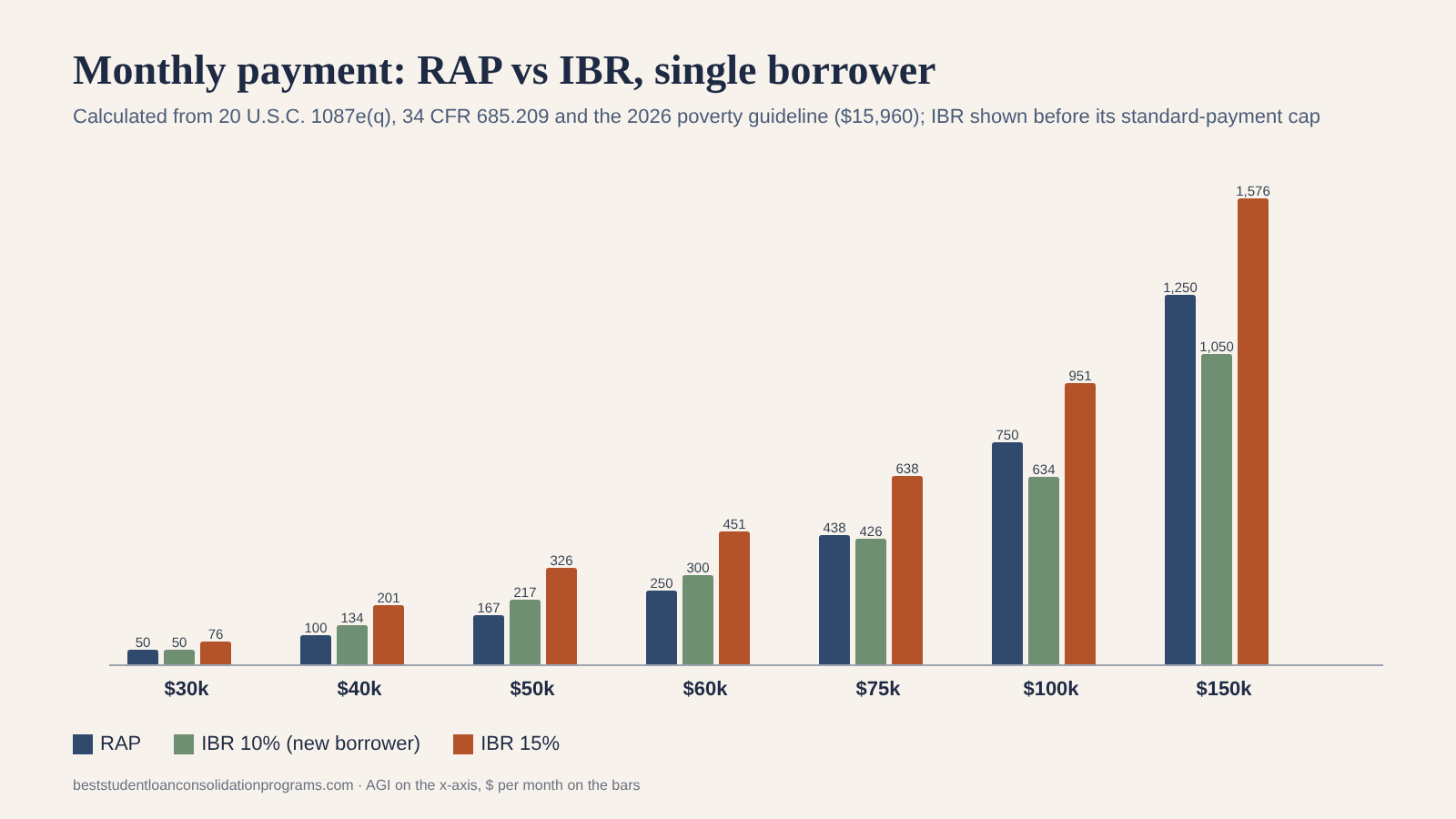
For a single borrower, RAP is lower than IBR at 10 percent from about $30,000 to $70,000 of AGI (calculated). Below about $30,000 IBR is cheaper, and below $23,940 IBR is $0 while RAP is at least $10; above $70,000 RAP is higher at most incomes. IBR at 15 percent costs more than RAP from about $28,000 up. IBR protects 150 percent of the poverty guideline (34 CFR 685.209, 2026); RAP protects nothing but subtracts $50 per dependent.
| AGI | HOUSEHOLD | RAP | IBR AT 10% | IBR AT 15% |
|---|---|---|---|---|
| $15,000 | Single | $12.50 | $0 | $0 |
| $25,000 | Single | $41.67 | $8.83 | $13.25 |
| $30,000 | Single | $50.00 | $50.50 | $75.75 |
| $40,000 | Single | $100.00 | $133.83 | $200.75 |
| $50,000 | Single | $166.67 | $217.17 | $325.75 |
| $60,000 | Single | $250.00 | $300.50 | $450.75 |
| $75,000 | Single | $437.50 | $425.50 | $638.25 |
| $100,000 | Single | $750.00 | $633.83 | $950.75 |
| $150,000 | Single | $1,250.00 | $1,050.50 | $1,575.75 |
| $50,000 | 3 (two dependents) | $66.67 | $75.17 | $112.75 |
| $75,000 | 3 (two dependents) | $337.50 | $283.50 | $425.25 |
| $100,000 | 3 (two dependents) | $650.00 | $491.83 | $737.75 |
This comparison only matters if you can still choose. Loans first made on or after July 1, 2026, and any Direct Consolidation Loan made on or after that date, can be repaid only under RAP or the new standard plan (20 U.S.C. 1087e(d)(7), (g)(3)); IBR stays open only to loans made before then. IBR payments are calculated on discretionary income: AGI minus 150 percent of the poverty guideline, which for 2026 is $15,960 for one person and $27,320 for three in the 48 states and DC (Federal Register, HHS, 2026). The rate is 10 percent for a “new borrower” and 15 percent for others, and the definition of a new borrower depends on loan dates going back to July 1, 2014 (34 CFR 685.209, 2026). IBR payments are also capped at the 10-year standard payment, which our table does not apply.
The comparison is not only about the monthly bill. IBR forgives the balance after 20 or 25 years (Edfinancial (federal loan servicer), 2026); RAP takes 360 qualifying monthly payments, or 30 years (20 U.S.C. 1087e(q), 2026). On the other hand, RAP’s interest waiver and principal match mean the balance cannot grow on time, which IBR does not promise.
Not every loan can choose. Parent PLUS loans and consolidation loans that repaid one are not eligible for RAP (20 U.S.C. 1087e(d)(1)(F), 2026). The SAVE plan was ended by a court order on March 10, 2026; servicers notified SAVE borrowers between July 1 and August 15, 2026 and gave them 90 days to choose a new plan (Edfinancial (federal loan servicer), 2026), so if you never chose, check StudentAid.gov for the plan you were placed in. Our RAP and federal loan consolidation guides follow the changes as the Department of Education publishes them.
5 How Do You Check Your Own RAP Payment? Four Numbers From Your Tax Return
You need four numbers: the adjusted gross income line on your latest federal return (Form 1040), your filing status, the number of dependents you claimed, and whether your spouse has federal loans. The first two set the band and rate from 1 to 10 percent; each dependent takes off $50 a month, down to the $10 floor (20 U.S.C. 1087e(q), 2026).
| STEP | WHAT TO LOOK UP | WHERE IT COMES FROM |
|---|---|---|
| 1 | Adjusted gross income | Form 1040, adjusted gross income line, latest filed year |
| 2 | Band and rate | 20 U.S.C. 1087e(q): 1 percent per $10,000 band, 10 percent above $100,000 |
| 3 | Divide by 12 | Gives the monthly figure before dependents |
| 4 | Minus $50 per dependent | Dependents claimed on that return |
| 5 | Apply the $10 floor | No payment below $10 a month |
Run the numbers before you pick a plan, and again whenever your income changes by enough to cross a band edge. A raise from $49,000 to $51,000 moves a single borrower from 4 to 5 percent, and the payment from $163.33 to $212.50 a month (calculated). A borrower close to an edge may want to ask a tax professional how their AGI is likely to land.
Compare the result with your current bill, not only with IBR. If you are working toward Public Service Loan Forgiveness, on-time RAP payments count toward it (20 U.S.C. 1087e(m)), and a lower payment means less paid before forgiveness; our PSLF articles explain the counting rules. If you hold older FFEL loans, RAP is open only to Direct Loans, and a Direct Consolidation Loan made now can only be repaid under RAP or the standard plan, which ends any access to IBR. Compare both, and check what consolidating does to your payment history, before you apply.
Borrowers in default cannot simply switch plans. They first need to leave default through loan rehabilitation or consolidation, which our student loan default guides cover. If you are thinking about leaving the federal system altogether, read how refinancing affects your credit and the credit scores lenders approve first: a private loan has no RAP, no interest waiver and no forgiveness. Corrections are handled under our editorial policy.
Explore every figure in this article
Methodology
All RAP figures are calculated from 20 U.S.C. 1087e(q) as published by Cornell’s Legal Information Institute and cross-checked with the federal servicer Edfinancial’s RAP page on November 16, 2026. IBR figures use 34 CFR 685.209 and the 2026 HHS poverty guidelines from the Federal Register; they are shown before IBR’s cap at the standard payment. The interest example uses Federal Student Aid’s 2026-27 undergraduate rate on a $30,000 balance with 30.4-day months approximated as one twelfth of a year. Amounts are rounded to the cent; servicers may round differently.
- Sources consulted: 14
- Sources cited: 6
- Data range: 2026-01-15 to 2026-11-16
- Research date: 2026-11-16
- Update schedule: When the Department of Education publishes RAP regulations or a new poverty guideline
- Limitations: Payments are calculated from the statutory formula for one borrower; spouse loans, separate filing and servicer rounding can change real bills. IBR figures are shown before IBR's cap at the 10-year standard payment and assume the 2026 poverty guideline for the 48 states and DC.
Frequently Asked Questions
How is the RAP payment calculated?
Take your adjusted gross income, apply the rate for its $10,000 band (1 percent above $10,000, rising one point per band to 10 percent above $100,000; $120 a year at $10,000 or less), divide by 12, then subtract $50 for each dependent. The payment never falls below $10 a month. (20 U.S.C. 1087e(q), 2026)
What is the RAP payment on $50,000 of income?
With no dependents, 4 percent of $50,000 is $2,000 a year, or $166.67 a month. With two dependents it is $66.67. At $50,001 the rate becomes 5 percent and the single payment rises to $208.34 (calculated). (20 U.S.C. 1087e(q), 2026)
Does interest still grow on RAP?
Not on an on-time payment. Interest left unpaid after an on-time RAP payment is not charged, and if the payment reduces principal by less than $50 the Secretary adds a matching principal reduction, so the balance falls every month you pay on time. (20 U.S.C. 1087e(q), 2026)
Is RAP cheaper than IBR?
It depends on income and family size. Only borrowers with loans made before July 1, 2026 can still choose IBR. For a single borrower, RAP is lower than 10-percent IBR from about $30,000 to $70,000 of AGI and higher at most incomes above that; below about $30,000 IBR is cheaper, and below $23,940 IBR is $0 while RAP is at least $10. Against 15-percent IBR, RAP is lower from about $28,000 up (calculated). IBR uses 150 percent of the poverty guideline as protected income; RAP protects nothing but subtracts $50 per dependent. (34 CFR 685.209, 2026)
Can Parent PLUS borrowers use RAP?
No. Parent PLUS loans, and Direct Consolidation loans that repaid a Parent PLUS loan, are excluded from RAP under the statute. (20 U.S.C. 1087e(d)(1)(F), 2026)
Sources & References
- Legal Information Institute (U.S. Code). “20 U.S. Code 1087e – Terms and conditions of loans; subsection (q) Repayment Assistance Plan.” law.cornell.edu/uscode/text/20/1087e. Accessed 2026-11-16.
- Edfinancial Services (U.S. Department of Education servicer). “Repayment Assistance Plan (RAP).” edfinancial.studentaid.gov/RAP. Accessed 2026-11-16.
- Edfinancial Services (U.S. Department of Education servicer). “Lower Payment Options.” edfinancial.studentaid.gov/Lower-Payment-Options. Accessed 2026-11-16.
- Legal Information Institute (CFR). “34 CFR 685.209 Income-driven repayment plans.” law.cornell.edu/cfr/text/34/685.209. Accessed 2026-11-16.
- Federal Register (HHS). “Annual Update of the HHS Poverty Guidelines.” govinfo.gov/content/pkg/FR-2026-01-15/html/2026-00755.htm. Accessed 2026-11-16.
- Federal Student Aid. “Federal Interest Rates and Fees.” studentaid.gov/understand-aid/types/loans/interest-rates. Accessed 2026-11-16.
Last updated:

One Comment