Parent PLUS Loan Deadlines After July 2026: The ICR Payment That Keeps IBR
KEY TAKEAWAYS
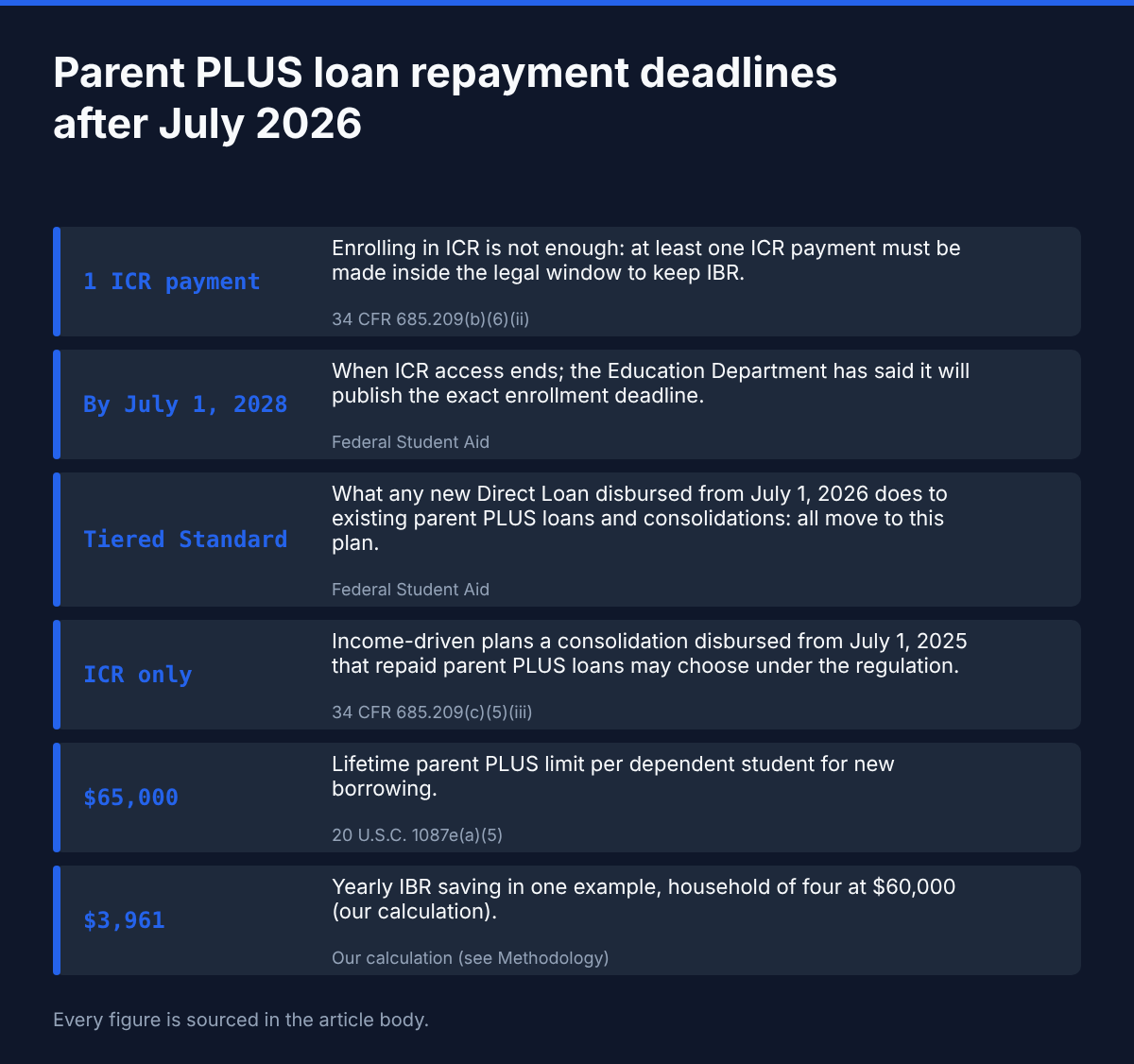
- → 1 ICR payment Enrolling in ICR is not enough: at least one ICR payment must be made inside the legal window to keep IBR. (34 CFR 685.209(b)(6)(ii), 2026)
- → By July 1, 2028 When ICR access ends; the Education Department has said it will publish the exact enrollment deadline. (Federal Student Aid, 2026)
- → Tiered Standard What any new Direct Loan disbursed from July 1, 2026 does to existing parent PLUS loans and consolidations: all move to this plan. (Federal Student Aid, 2026)
- → ICR only Income-driven plans a consolidation disbursed from July 1, 2025 that repaid parent PLUS loans may choose under the regulation. (34 CFR 685.209(c)(5)(iii), 2026)
- → $65,000 Lifetime parent PLUS limit per dependent student for new borrowing. (20 U.S.C. 1087e(a)(5), 2026)
- → $3,961 Yearly IBR saving in one example, household of four at $60,000 (our calculation). (Our calculation (see Methodology), 2026)
Parent PLUS borrowers who consolidated before July 1, 2026 still have one step that decides whether they keep income-driven repayment after 2028: making a payment under Income-Contingent Repayment (ICR). The regulation counts a loan as repaid under ICR only if at least one payment was made under ICR, PAYE or IBR (34 CFR 685.209(b)(6)(ii), 2026), and the law protects Income-Based Repayment (IBR) access for loans repaid that way from July 4, 2025 to June 30, 2028 (20 U.S.C. 1098e(a)(2)(B), 2026). Enrolling alone does not count.
The end date is less settled than many guides suggest. ICR access ends no later than July 1, 2028, and the Education Department says it will publish the ICR enrollment deadline for consolidated parent PLUS loans, which is not yet published as of this writing (Federal Student Aid, 2026). This page sets out every date, the rules around new loans and double consolidation, and what keeping IBR is worth in our own labeled calculations. For how consolidation affects a forgiveness count, see what consolidation does to a PSLF payment count.
This page is general information only. It is not legal, tax or financial advice, the author is not a lawyer, and you remain responsible for your own decisions. Loan histories differ, so confirm what applies to your loans with your servicer or studentaid.gov before acting.
1 Which Parent PLUS Deadlines Have Passed and Which Still Count?
Three dates have passed: July 1, 2025, July 4, 2025 and July 1, 2026. Still ahead are the ICR enrollment deadline the Education Department has said it will publish, the end of the legal window on June 30, 2028, and the end of ICR no later than July 1, 2028 (Federal Student Aid, 2026). Treat any date in 2028 as too late to start.
| DATE | WHAT CHANGED | STATUS (CHECKED NOV. 16, 2026) | SOURCE |
|---|---|---|---|
| July 1, 2025 | A consolidation disbursed from this date that repaid a parent PLUS loan may choose ICR only among income-driven plans; the double consolidation route closed | Passed | 34 CFR 685.209(c)(5)(iii) |
| July 4, 2025 | Start of the window in which an ICR payment keeps a parent PLUS consolidation eligible for IBR | Passed, window open | 20 U.S.C. 1098e(a)(2)(B) |
| July 1, 2026 | Consolidations made from this date with parent PLUS loans get the Tiered Standard Plan only; any new Direct Loan moves existing parent PLUS loans to it; new borrowing limits begin | Passed | 20 U.S.C. 1087e(d)(7)(E), (g)(3); studentaid.gov |
| To be announced | ICR enrollment deadline for consolidated parent PLUS loans | Not yet published | studentaid.gov |
| June 30, 2028 | End of the window for the ICR payment that protects IBR | Ahead | 20 U.S.C. 1098e(a)(2)(B) |
| July 1, 2028 at the latest | ICR ends; ICR borrowers must choose another plan before then or the Department assigns one | Ahead | 20 U.S.C. 1087e (note); 34 CFR 685.209(c)(7) |
The window that protects IBR runs July 4, 2025 to June 30, 2028 (20 U.S.C. 1098e(a)(2)(B), 2026). A consolidation loan that repaid a parent PLUS loan is not an excepted loan if it was repaid under ICR or another income-driven plan in that window, and being excepted is what bars a loan from IBR. Because the regulation defines that as at least one payment made (34 CFR 685.209(b)(6)(ii), 2026), an application that is still processing, or a month in processing forbearance, does not do the job. Applications can take weeks, so leave several months.
Two groups cannot use this route at all. A consolidation made on or after July 1, 2026 can only use the standard plan or RAP (20 U.S.C. 1087e(g)(3), 2026), and for parent PLUS debt that means the Tiered Standard Plan. Direct PLUS Consolidation Loans made before July 1, 2006 are excluded from ICR by the regulation (34 CFR 685.209(d)(3)), so they never reach the IBR route either.
ICR itself does not survive 2028. Borrowers on ICR must choose another plan before it ends; those who do not are placed in RAP or, for loans RAP does not cover such as parent PLUS consolidations, IBR (34 CFR 685.209(c)(7)). Choosing IBR yourself and checking the result with your servicer is safer than relying on automatic placement. The Massachusetts Attorney General’s office, which advised parents to apply to consolidate by April 1, 2026 (Massachusetts Attorney General's Office, 2026), gives the same order of steps: one ICR payment, then a switch to IBR before July 1, 2028.
2 Can You Switch to IBR Before 2028? Mostly Yes, With One Conflict
Probably yes, but the federal sources are not fully consistent. The Education Department’s OBBBA page and the Massachusetts Attorney General both say you can enroll in IBR after one ICR payment (Federal Student Aid, 2026), and the regulation lets ICR borrowers elect IBR before ICR ends. The Department’s plan table still lists parent PLUS consolidations as eligible for ICR only (Federal Student Aid, 2026), and for consolidations disbursed on or after July 1, 2025 the regulation allows ICR only (34 CFR 685.209(c)(5)(iii), 2026).
| SOURCE | WHAT IT SAYS | TYPE |
|---|---|---|
| Massachusetts Attorney General | After one ICR payment, switch to IBR using the studentaid.gov application | State guidance |
| studentaid.gov plan table | Consolidations that repaid parent PLUS loans: ICR eligible; RAP, PAYE and IBR not eligible | Federal guidance |
| studentaid.gov OBBBA page | Enroll in ICR, make at least one ICR payment, then enroll in IBR; you can enroll in IBR and ICR at any time until ICR ends | Federal guidance |
| 34 CFR 685.209(c)(7) | ICR borrowers may elect IBR, effective July 1, 2028 or earlier | Federal regulation |
| 34 CFR 685.209(c)(5)(iii) | Consolidation disbursed on or after July 1, 2025 that repaid parent PLUS: no income-driven plan except ICR | Federal regulation |
The step order is settled: every source agrees that one ICR payment comes first and that IBR is the plan that survives 2028. The open point is the regulation’s ICR-only rule for consolidations disbursed on or after July 1, 2025, so the answer may depend on when your consolidation was disbursed. Ask your servicer in writing after your first ICR payment, and keep the reply.
The question matters because IBR is usually cheaper than ICR. ICR charges the lesser of 20 percent of income above the poverty guideline or a 12-year fixed payment adjusted by an income factor (34 CFR 685.209, 2026). IBR charges 15 percent of income above 150 percent of the poverty guideline (34 CFR 685.209, 2026), or 10 percent for new borrowers. The 10 percent rate applies to new borrowers: people who had no outstanding Direct or FFEL loan balance on July 1, 2014, or no balance when they took a loan after that date; everyone else pays 15 percent (34 CFR 685.209, 2026).
If you are working toward Public Service Loan Forgiveness, the Massachusetts guidance suggests making the first ICR payment as soon as possible so payments begin to count. Our PSLF guides explain how qualifying payments are counted, and the payment count articles cover what consolidation does to an existing count.
3 What Is Keeping IBR Worth? Up to $5,536 a Year in Our Examples
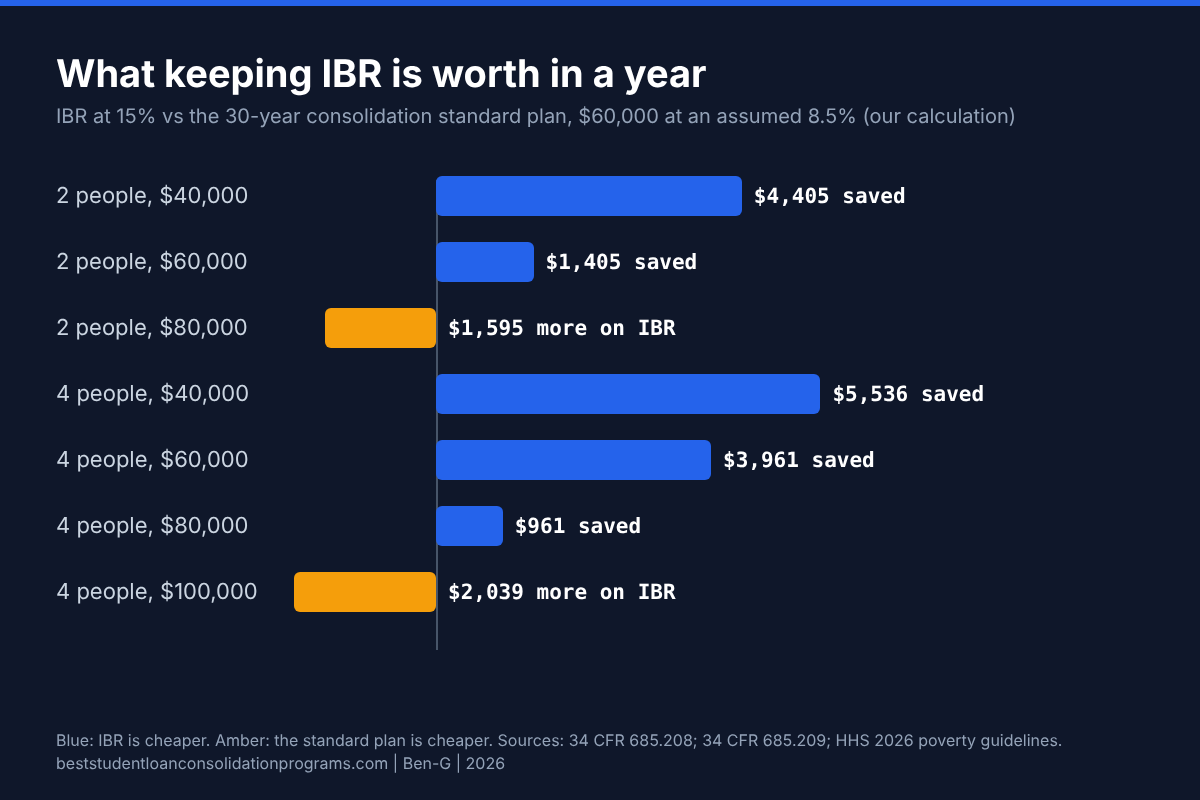
Compared with the 30-year standard plan that a pre-July 2026 consolidation falls back to, IBR at 15 percent costs up to $5,536 a year less in our examples. For a household of four with $60,000 of income, the difference is $3,961 a year (Our calculation (see Methodology), 2026).
| HOUSEHOLD | INCOME (AGI) | IBR AT 15% (MONTHLY) | 30-YEAR STANDARD (MONTHLY) | YEARLY DIFFERENCE (OUR CALCULATION) |
|---|---|---|---|---|
| 2 | $40,000 | $94.25 | $461.35 | $4,405 less on IBR |
| 2 | $60,000 | $344.25 | $461.35 | $1,405 less on IBR |
| 2 | $80,000 | $594.25 | $461.35 | $1,595 more on IBR |
| 4 | $40,000 | $0.00 | $461.35 | $5,536 less on IBR |
| 4 | $60,000 | $131.25 | $461.35 | $3,961 less on IBR |
| 4 | $80,000 | $381.25 | $461.35 | $961 less on IBR |
| 4 | $100,000 | $631.25 | $461.35 | $2,039 more on IBR |
The baseline is the plan a parent PLUS consolidation made before July 1, 2026 keeps if it misses the ICR payment: the older consolidation standard plan, which runs 30 years on a balance of $60,000 or more (34 CFR 685.208, 2026). On $60,000 at an assumed 8.5 percent that is $461.35 a month. IBR protects income up to 150 percent of the poverty guideline, which for 2026 is $21,640 for a household of two and $33,000 for four in the 48 states and DC (Federal Register, HHS, 2026).
The table also shows where IBR stops helping. At higher incomes the 30-year payment can be lower than IBR, so a parent who expects to earn well throughout repayment gains less from keeping IBR. At lower or falling incomes the gap is large, and a household of four at $40,000 would owe nothing under IBR in our example. At the 10 percent rate for new borrowers, the household of four at $60,000 would pay $87.50 a month, $4,486 a year less than the standard plan (our calculation).
The value of IBR is also insurance. A fixed plan does not respond if income falls in retirement or after a job loss, while IBR recalculates each year. That is worth weighing even for parents whose current income puts IBR above the standard payment.
4 What Does a New Loan or a Late Consolidation Do? The Tiered Standard Plan
Any Direct Loan disbursed on or after July 1, 2026 moves existing parent PLUS loans to the Tiered Standard Plan, including a consolidation already on ICR or IBR (Federal Student Aid, 2026). A consolidation of parent PLUS loans made on or after that date gets the Tiered Standard Plan only (20 U.S.C. 1087e(d)(7)(E), 2026), with a term of 10, 15, 20 or 25 years (20 U.S.C. 1087e(d)(7)(A), 2026).
| SITUATION | CAN CHOOSE ICR? | KEEPS IBR AFTER 2028? |
|---|---|---|
| Consolidation disbursed before July 1, 2026, no new Direct Loan since, at least one ICR payment made in the window | Yes, until ICR access ends | Yes |
| Same consolidation, no ICR, PAYE or IBR payment made in the window | Only until ICR access ends | No; keeps the older fixed plans |
| Borrower receives any new Direct Loan disbursed on or after July 1, 2026 | No | No; loans move to the Tiered Standard Plan |
| Parent PLUS consolidation made on or after July 1, 2026 | No | No; Tiered Standard Plan only |
| Direct PLUS Consolidation Loan made before July 1, 2006 | No | No |
| Parent PLUS loan never consolidated | No | No |
The new-loan rule is the easiest to trip over. Borrowing again, whether for a younger child, for your own studies or by consolidating again, moves your existing parent PLUS consolidation to the Tiered Standard Plan once the new loan enters repayment, ending both ICR and IBR (20 U.S.C. 1087e(d)(7)(E), 2026), even if you already made ICR payments. According to the Massachusetts Attorney General, the Tiered Standard Plan is also not eligible for PSLF.
The tiered term depends on the total principal of all your Direct Loans when you enter repayment, not just the new loan: under $25,000 repays over 10 years, $25,000 to under $50,000 over 15, $50,000 to under $100,000 over 20, and $100,000 or more over 25 (20 U.S.C. 1087e(d)(7)(A), 2026). On $60,000 at an assumed 8.5 percent, a 20-year term means $520.69 a month and about $64,967 in interest (our calculation). A consolidation loan’s rate is the weighted average of the loans it repays, rounded up to the nearest one-eighth of a percent; our weighted average guides show how that works.
Double consolidation no longer helps. A consolidation disbursed on or after July 1, 2025 that repaid a parent PLUS loan, directly or through an earlier consolidation, may choose ICR only among the income-driven plans (34 CFR 685.209(c)(5)(iii), 2026). If you completed a double consolidation before July 1, 2025, the law now treats that loan as excepted too unless an ICR, PAYE or IBR payment is made in the window (20 U.S.C. 1098e(a)(2)(B), 2026). The Education Department’s OBBBA page describes PAYE access for double consolidations disbursed before July 1, 2026, which conflicts with the regulation for those disbursed from July 1, 2025; confirm with your servicer.
If your loans are in default, be careful: consolidating out of default now creates a new consolidation loan, and for parent PLUS debt that loan gets the Tiered Standard Plan only. Rehabilitation keeps your existing loan and whatever options it still has. Our rehabilitation versus consolidation comparison and loan rehabilitation guides set out the general trade-offs, and FFEL parent PLUS loans that were not consolidated into a Direct Consolidation Loan before July 1, 2026 can no longer reach ICR or IBR. Get advice from your servicer or a nonprofit counselor before choosing a route.
5 How Much Can Parents Borrow Now? $20,000 a Year, $65,000 in Total
For loans made on or after July 1, 2026, Parent PLUS borrowing is capped at $20,000 per academic year and $65,000 in total for each dependent student (20 U.S.C. 1087e(a)(5), 2026). Students already enrolled with a federal loan on June 30, 2026 keep the old borrowing limits, not the old repayment options, for up to three academic years (20 U.S.C. 1087e(a)(8), 2026).
| ITEM | BEFORE JULY 1, 2026 | FROM JULY 1, 2026 |
|---|---|---|
| Annual limit | Cost of attendance minus other aid | $20,000 per dependent student |
| Aggregate limit | None | $65,000 per dependent student |
| Repayment plans for new loans | Standard, graduated, extended; ICR after consolidation | Tiered Standard Plan only |
| Interest rate | Same formula, set each year | 9.07% fixed for 2026-27 |
| Loan fee | 4.228% | 4.228% (unchanged through Sept. 30, 2027) |
The caps apply per student, across all parents combined, and the $65,000 total counts amounts already repaid, forgiven or discharged (20 U.S.C. 1087e(a)(5), 2026). The interim exception covers the borrowing limits only: any Parent PLUS loan disbursed on or after July 1, 2026 still goes on the Tiered Standard Plan and pulls the parent’s older parent PLUS loans onto it (Federal Student Aid, 2026).
Protections for new loans are thinner too. For loans made on or after July 1, 2027, unemployment and economic-hardship deferments are no longer available and forbearance is limited to 9 months in any 24 (20 U.S.C. 1087e(f), 2026). New Direct PLUS loans for 2026-27 carry 9.07% (Federal Student Aid, 2026) and a loan fee of 4.228%. A parent comparing a new PLUS loan with a private student loan is comparing two loans without income-driven repayment; the federal loan’s remaining advantages include death and disability discharge.
If you are thinking of moving existing debt out of the federal system instead, read how refinancing affects your credit and the credit scores lenders look for first. Refinancing permanently gives up ICR, IBR, PSLF and federal discharge options, so compare that loss before deciding. Our federal loan consolidation section follows the rules as the Department of Education publishes guidance.
Explore every figure in this article
Methodology
Dates and plan rules come from 20 U.S.C. 1087e and 1098e and 34 CFR 685.208 and 685.209 (as amended May 1, 2026) on Cornell’s Legal Information Institute, and from Federal Student Aid’s OBBBA and income-driven repayment pages, all read on November 16, 2026. Payment figures are our own calculations: an assumed 8.5 percent rate on $60,000, standard amortization, the 2026 HHS poverty guidelines for the 48 states and DC, and IBR at 15 percent capped at the 10-year standard payment. The Massachusetts Attorney General’s page is state guidance and is labeled as secondary. Amounts are rounded; servicers may round differently.
- Sources consulted: 9
- Sources cited: 9
- Data range: 2026-01-15 to 2026-11-16
- Research date: 2026-11-16
- Update schedule: When the Education Department publishes the ICR enrollment deadline for consolidated parent PLUS loans
- Limitations: Payment examples are our own calculations: an assumed 8.5 percent rate on a $60,000 balance, the 2026 poverty guidelines for the 48 states and DC, IBR at 15 percent capped at the 10-year standard payment, and standard amortization. ICR amounts are not tabled because ICR's alternative formula depends on an income factor published each year. Servicer processing and individual loan histories can change what applies to you.
Frequently Asked Questions
Is it too late to consolidate Parent PLUS loans for income-driven repayment?
Yes. A Direct Consolidation Loan disbursed on or after July 1, 2026 that includes parent PLUS loans can only be repaid under the Tiered Standard Plan. A parent PLUS consolidation disbursed before July 1, 2026 can still use ICR, and through it reach IBR. (Federal Student Aid, 2026)
Can Parent PLUS borrowers get IBR?
Only through a Direct Consolidation Loan disbursed before July 1, 2026, with at least one payment made under ICR (or, for an older double consolidation, under PAYE or IBR) between July 4, 2025 and the end of ICR access, and only if the borrower receives no new Direct Loan disbursed on or after July 1, 2026. The Education Department says it will publish the exact ICR enrollment deadline. (Federal Student Aid, 2026)
Does the double consolidation strategy still work?
No. Under the regulation, a Direct Consolidation Loan disbursed on or after July 1, 2025 that repaid a parent PLUS loan, directly or through an earlier consolidation, may choose only ICR among the income-driven plans. A double consolidation completed earlier is also treated as an excepted loan unless an ICR, PAYE or IBR payment is made in the legal window. (34 CFR 685.209, 2026)
How much can parents borrow in PLUS loans now?
For loans made on or after July 1, 2026, $20,000 per academic year and $65,000 in total per dependent student, across all parents combined, including amounts repaid or discharged. Students already enrolled with a federal loan on June 30, 2026 keep the old borrowing limits, not the old repayment options, for up to three academic years or the rest of the program if shorter. (20 U.S.C. 1087e(a), 2026)
What if I take out a new federal loan after July 1, 2026?
Any Direct Loan disbursed on or after July 1, 2026, whether a parent PLUS loan for another child, a loan for your own studies or a new consolidation, removes access to ICR and IBR. The Education Department says it will move your existing loans, including a parent PLUS consolidation already on ICR or IBR, to the Tiered Standard Plan. (Federal Student Aid, 2026)
Sources & References
- Federal Student Aid. “One Big Beautiful Bill Act Updates.” studentaid.gov/announcements-events/big-updates. Accessed 2026-11-16.
- Federal Student Aid. “Income-Driven Repayment Plans.” studentaid.gov/manage-loans/repayment/plans/income-driven. Accessed 2026-11-16.
- Legal Information Institute (U.S. Code). “20 U.S. Code 1087e – Terms and conditions of loans.” law.cornell.edu/uscode/text/20/1087e. Accessed 2026-11-16.
- Legal Information Institute (U.S. Code). “20 U.S. Code 1098e – Income-based repayment.” law.cornell.edu/uscode/text/20/1098e. Accessed 2026-11-16.
- Legal Information Institute (CFR). “34 CFR 685.209 Income-driven repayment plans (as amended May 1, 2026).” law.cornell.edu/cfr/text/34/685.209. Accessed 2026-11-16.
- Legal Information Institute (CFR). “34 CFR 685.208 Fixed payment repayment plans.” law.cornell.edu/cfr/text/34/685.208. Accessed 2026-11-16.
- Federal Register (HHS). “Annual Update of the HHS Poverty Guidelines.” govinfo.gov/content/pkg/FR-2026-01-15/html/2026-00755.htm. Accessed 2026-11-16.
- Federal Student Aid. “Federal Interest Rates and Fees.” studentaid.gov/understand-aid/types/loans/interest-rates. Accessed 2026-11-16.
- Massachusetts Attorney General's Office. “Parent PLUS Loan Deadlines and Changes.” mass.gov/info-details/parent-plus-loan-deadlines-and-changes. Accessed 2026-11-16.
Last updated:

One Comment