Cosigner Release Requirements by Lender: Terms and the 90% Denial Figure (2026 Terms)
KEY TAKEAWAYS
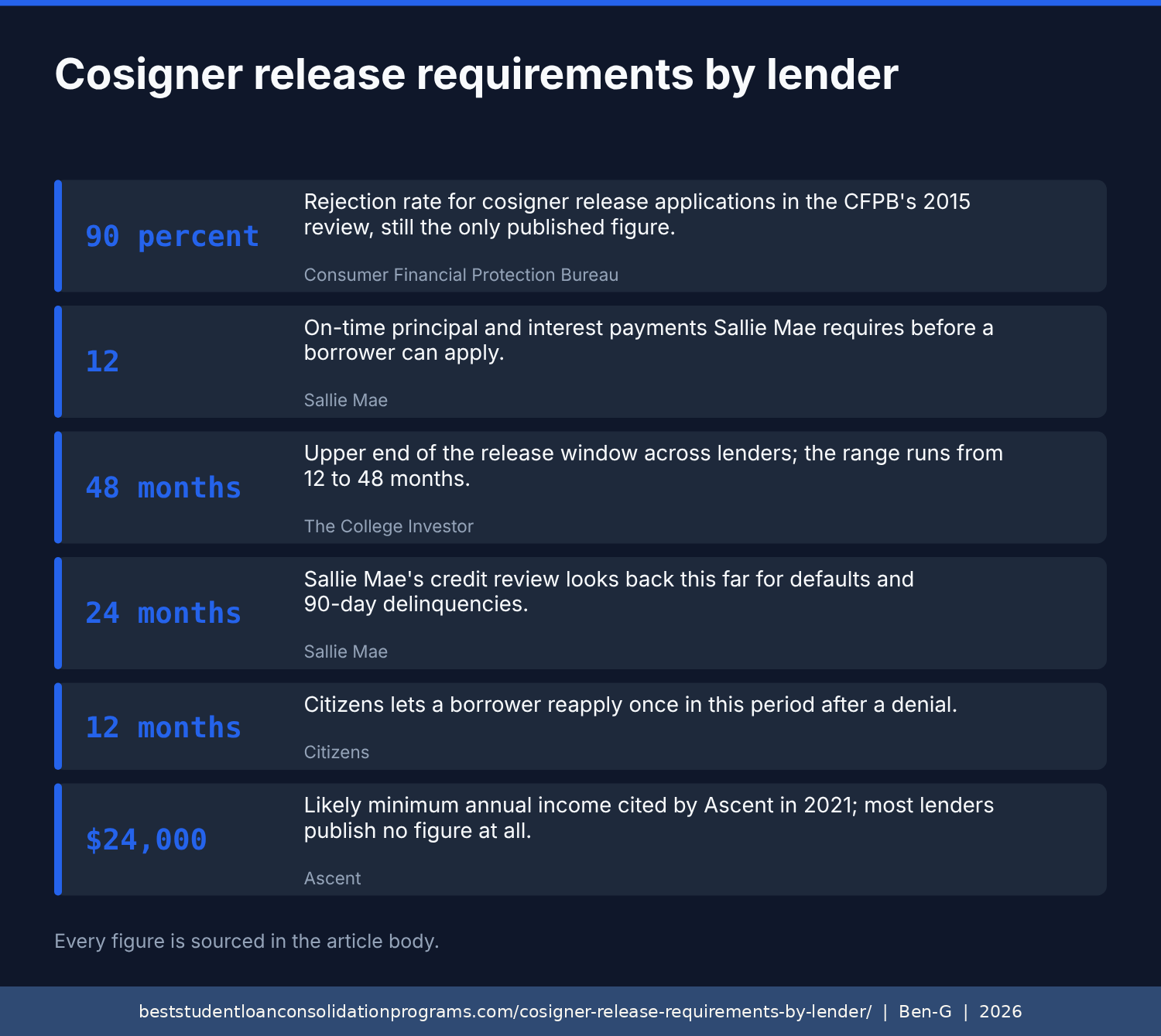
- → 90 percent Rejection rate for cosigner release applications in the CFPB's 2015 review, still the only published figure. (Consumer Financial Protection Bureau, 2015)
- → 12 On-time principal and interest payments Sallie Mae requires before a borrower can apply. (Sallie Mae, 2026)
- → 48 months Upper end of the release window across lenders; the range runs from 12 to 48 months. (The College Investor (secondary), 2026)
- → 24 months Sallie Mae's credit review looks back this far for defaults and 90-day delinquencies. (Sallie Mae, 2026)
- → 12 months Citizens accepts one release application every 12 months from the previous application date. (Citizens, 2026)
- → $24,000 Likely minimum annual income cited by Ascent in 2021; most lenders publish no figure at all. (Ascent, 2021)
Almost every private student loan comes with a promise attached: make your payments, and one day the parent or relative who cosigned can be taken off the loan. The promise is real, but the fine print decides whether it is ever kept. The one time a regulator asked lenders how often they said yes, the answer was that 90 percent of applicants were rejected (Consumer Financial Protection Bureau, 2015).
That number is from 2015, and it is still the only one. No lender publishes its approval rate, and no agency has repeated the exercise. What borrowers can check is the rulebook each lender applies, and those rulebooks differ far more than the marketing suggests. This page puts the published release terms side by side, taken from the lenders’ own pages wherever possible, lists the conditions that quietly disqualify applications, and sets out the route that remains when release is refused. It belongs with our other pieces on lender requirements.
A word on what release is, because the term is used loosely. A cosigner is fully liable for the debt, and the loan appears on that person’s credit report as their own. Release is the lender agreeing to let the cosigner go and rely on the borrower alone. Nothing else about the loan changes: the rate, the balance and the term all stay as they were. That is what separates it from refinancing, which replaces the loan with a new one.
1 How Often Is Cosigner Release Denied? 90 Percent in the Only Published Count
In 2015 the Consumer Financial Protection Bureau reported that, among borrowers who applied for cosigner release, 90 percent were rejected (Consumer Financial Protection Bureau, 2015). The figure came from lenders’ own responses. It has never been updated, so it shows how hard release was a decade ago, not what the rate is today.
| METRIC | VALUE | SOURCE |
|---|---|---|
| Cosigner release applicants rejected (2015) | 90 percent | Consumer Financial Protection Bureau |
| Private student loan complaints reviewed | 3,100 | Consumer Financial Protection Bureau |
| Rise in complaints over the prior year | 34 percent | Consumer Financial Protection Bureau |
| Year by which over 90 percent of new private loans were co-signed | 2011 | Consumer Financial Protection Bureau |
| Newer official denial rate | None published | Consumer Financial Protection Bureau |
The context of that finding matters as much as the headline. The Bureau was reviewing more than 3,100 private student loan complaints and found that borrowers had little information about release criteria, and that some lender policies permanently disqualified people who had prepaid or used forbearance. The Bureau did not report why applications failed, but it did find that borrowers had little information on the criteria.
Two things have changed since. Several lenders now print their release terms on public pages, which is why a comparison like the one below is possible at all. What has not changed is the absence of outcome data. Anyone who quotes a current approval rate is guessing. If you are weighing a cosigned loan today, assume release is possible but uncertain, and read our data on approval odds before counting on it.
It is also worth being clear about who is counted. The figure covers people who applied, which means borrowers who believed they met the terms. It says nothing about the much larger group who never apply because they do not know the option exists or assume they would fail. For a cosigner, that silence is the practical risk. At the lenders reviewed here, release is not automatic: release is granted only when the borrower asks, in writing, after the waiting period, and passes the review on that day.
2 How Many Payments Does Each Lender Require? 12 to 48 Months
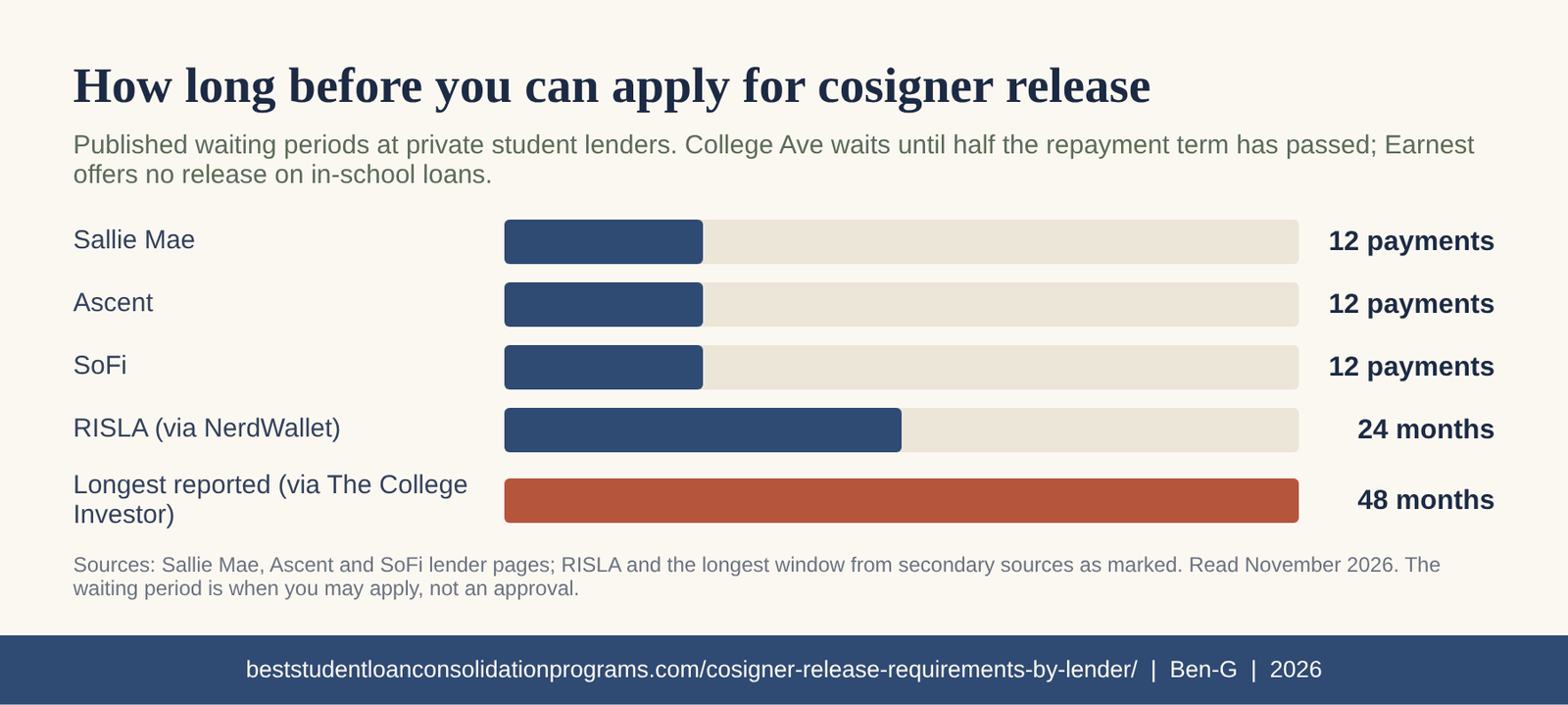
Sallie Mae asks for 12 on-time principal and interest payments (or for the borrower to have paid ahead) (Sallie Mae, 2026), Ascent for 12 consecutive payments (Ascent, 2026) and SoFi for 12 consecutive on-time full payments (SoFi (serviced by MOHELA), 2026). College Ave waits until half of the original repayment term has passed (College Ave, 2026); it also lists a 30-day or greater delinquency on any account in the last 12 months, and a bankruptcy, foreclosure or repossession in the last 24 months, as disqualifiers. NerdWallet puts RISLA at 24 months, and the reported range runs up to 48 months.
| METRIC | VALUE | SOURCE |
|---|---|---|
| Sallie Mae: on-time principal and interest payments | 12 | Sallie Mae |
| Ascent: consecutive on-time payments | 12 | Ascent |
| SoFi: consecutive on-time payments | 12 consecutive | SoFi (serviced by MOHELA) |
| College Ave | half of the original repayment term | College Ave |
| RISLA: time before release (via NerdWallet) | 24 months | NerdWallet (secondary) |
| Earnest (in-school loans) | No release; refinance only (via The College Investor) | The College Investor (secondary) |
| Longest window reported (via The College Investor) | 48 months | The College Investor (secondary) |
The payment count is the part lenders advertise, and it is the least informative part of the test. It tells you when you may apply, not whether you will be approved. A lender with a short window and a strict credit review can be harder to leave than one with a long window and a light one. Read the count as a waiting period and nothing more.
The College Ave rule deserves a second look because it is expressed differently. Tying release to half of the original repayment schedule means the wait depends on the term chosen at signing: a borrower on a long schedule waits years longer than one on a short schedule for the same loan. Borrowers comparing offers should ask for the release terms in writing before choosing a term, alongside the rate. Our lender notes on SoFi and Earnest cover how those two treat applicants more broadly.
Which payments count is the next trap. The clock generally starts only when full repayment begins, so years of small in-school payments may add nothing. A borrower who graduates, starts full payments and never misses one reaches the shortest windows about a year after full principal-and-interest repayment begins, often 18 months or more after leaving school.
3 What Disqualifies an Application? One Late Payment in 12 Months
At Sallie Mae, being 30 or more days past due on any loan it services in the last 12 months blocks release, as does a hardship forbearance or modified repayment plan in that period (Sallie Mae, 2026). Its credit review also looks back 24 months for defaults and 90-day delinquencies.
| METRIC | VALUE | SOURCE |
|---|---|---|
| Sallie Mae: days past due that block release (last 12 months) | 30 | Sallie Mae |
| Sallie Mae: look-back for default or 90-day delinquency | 24 months | Sallie Mae |
| Sallie Mae: hardship forbearance in last 12 months | Blocks release | Sallie Mae |
| Citizens: interest-only payments | Do not qualify | Citizens |
| Citizens: reapplication allowed | Once every 12 months | Citizens |
| Citizens: Student Loan for Parents | Release not available | Citizens |
These conditions explain most of the gap between the advertised window and the denial rate. A borrower can make every required payment and still be refused because of one bad month, a short forbearance taken during a job change, or a delinquency on a different loan entirely. The Sallie Mae test covers any loan the company services, not just the one in the application.
The forbearance rule can catch borrowers by surprise, because forbearance is what lenders offer when a borrower asks for help. At Sallie Mae, a hardship forbearance or modified repayment program in the previous 12 months blocks a release application, so ask your servicer how any hardship option affects release before you accept it. A missed payment does more damage than a forbearance, so do not skip help you need to protect a future release. Late payments carry their own cost beyond release, which we measure in our pieces on delinquency and credit scores.
Parent loans sit outside the system altogether. Where the parent is the borrower, there is no cosigner to release, and lenders such as Citizens say plainly that release is not available on those products.
4 What Income and Credit Do Lenders Want? Mostly Unpublished
Lenders require proof that the borrower can carry the loan alone, and most do not say what that means in numbers. Sallie Mae asks for proof of income and a satisfactory credit history (Sallie Mae, 2026). College Ave is the exception: documented annual income must be at least twice the balance of the outstanding loans (College Ave, 2026).
| METRIC | VALUE | SOURCE |
|---|---|---|
| College Ave: required annual income | at least twice the balance of the outstanding loans | College Ave |
| Ascent: likely minimum annual income (2021 guide) | $24,000 | Ascent |
| Ascent: credit history expected | At least two years | Ascent |
| Sallie Mae: income | Proof required, no figure published | Sallie Mae |
| Sallie Mae: credit | Satisfactory history, 24 months look-back | Sallie Mae |
| Typical lender wording | Sufficient income, satisfactory credit | The College Investor (secondary) |
This is the real test, and it is the one borrowers cannot prepare for precisely. The payment window is public. At most lenders the income and credit bar is discretionary, and the wording they use, sufficient and satisfactory, is not defined in numbers. College Ave’s rule shows how high a published bar can be: on a $40,000 balance it means $80,000 of documented income. Ascent’s 2021 guide mentioned a likely minimum of $24,000 a year (Ascent, 2021), a figure five years old and hedged, so treat it as a floor to be aware of, not a target that guarantees anything.
What can be said is that a release application is underwritten like a new loan in the borrower’s name alone. The same things that decide a refinance decide a release: income relative to the payment, a clean recent history, and a score that has had time to recover from student-era thin credit. We publish the thresholds refinance lenders disclose in our credit score to refinance data, and they are the best available proxy for what a release reviewer wants to see.
There are still steps that improve the odds without knowing the exact bar. Apply only when income is stable and documented, since lenders ask for proof and a new job with no pay history is hard to verify. Check your credit reports for errors before applying, because the review reads them as they stand. Keep every account current for at least a year beforehand. And ask the servicer for the release criteria in writing before you apply, so a refusal is not the first time you learn what the test was.
5 When Is Refinancing the Only Way Out? When Release Is Not Offered or Is Refused
Some loans cannot be released at all: Earnest does not offer release on in-school loans, so the cosigner leaves only through a refinance (The College Investor (secondary), 2026). With 92% of undergraduate private loans cosigned, per a MeasureOne report cited by Ascent, (Ascent, 2021), that route matters to most private borrowers.
| METRIC | VALUE | SOURCE |
|---|---|---|
| Undergraduate private loans with a cosigner (2021) | 92% (commonly cited; no primary source traceable) | Ascent |
| Earnest in-school loans | Refinance is the only removal route | The College Investor (secondary) |
| After a Citizens denial | Reapply once every 12 months | Citizens |
| Effect of refinancing on the cosigner | Old loan is paid off; liability ends | The College Investor (secondary) |
Refinancing does what release does and more: the old loan is paid off, so the cosigner’s liability ends and the account closes on their credit report. It also resets the rate, which can help or hurt. The catch is the one already described. The borrower must qualify alone, and a borrower who was just refused release on income or credit grounds will usually face the same answer from a refinance lender.
There is one difference worth using. A release is decided by the lender that already holds the loan and is decided by your current lender alone. A refinance is decided by lenders who want the business, and several can be approached at once through soft-credit rate checks. A borrower turned down for release can compare refinance offers through soft-pull rate checks before waiting out a reapplication period. What the application does to your score is covered in our refinancing and credit analysis, and the wider trade-offs are in the student loan refinancing section.
One caution applies to any private loan decision. Refinancing a private loan into another private loan does not cost federal benefits, but it can still cost you: the new loan may have different hardship, death-and-disability discharge or cosigner terms (SoFi, for example, says its refinanced loans are not eligible for cosigner release), and the application adds a hard inquiry. Compare those terms, not just the rate. Refinancing federal loans into a private loan permanently gives up federal options such as IBR, RAP, PSLF and federal discharges. Refinancing federal loans to remove a cosigner on a separate private loan is never necessary, and federal loans should be kept out of the transaction. More on that distinction is filed under student loan refinance.
For the cosigner, the choice between the two routes is not neutral. Release leaves the loan and its history in place and simply removes a name. Refinancing closes the account, which ends the liability at once and removes the monthly obligation from the cosigner’s own borrowing capacity. A parent planning a mortgage application, or approaching retirement, often cares more about that date than about the rate the borrower ends up paying. It is worth asking the cosigner which outcome they need and by when, and planning backward from that date.
Explore every figure in this article
Methodology
Lender terms were read on November 14, 2026 from the lenders’ own pages wherever those pages could be read: Sallie Mae, Citizens, Ascent’s cosigner release application, SoFi’s release page run by its servicer MOHELA, and College Ave’s help center. RISLA’s window and Earnest’s policy could not be found on their own pages, so they are cited from NerdWallet and The College Investor and marked as such in the tables; the 12 to 48 month range is The College Investor’s summary. Ascent’s 2021 guide blocks automated checks, so its two figures were read directly and are marked as secondary. The denial rate is from a June 2015 CFPB release and has not been updated. Terms can change without notice, and a borrower’s promissory note overrides anything here.
Frequently Asked Questions
How often is cosigner release approved?
Rarely, on the only evidence available. Lender data gathered by the Consumer Financial Protection Bureau showed 90 percent of borrowers who applied for cosigner release were rejected. That figure dates from 2015 and no regulator or lender has published a newer count, so treat it as a warning about odds, not a current measurement. (Consumer Financial Protection Bureau, 2015)
How many payments do you need before applying for cosigner release?
It depends on the lender. Sallie Mae requires 12 on-time principal and interest payments on each loan, and Ascent and SoFi ask for 12 consecutive full payments. College Ave waits until half of the original repayment term has passed, and across the market the reported wait runs from 12 to 48 months before an application is accepted. (Sallie Mae, 2026)
Do interest-only payments count toward cosigner release?
Usually not. Citizens states that borrowers may apply only after entering full principal and interest repayment and that interest-only payments do not qualify. Sallie Mae likewise counts on-time principal and interest payments. Payments made while in school on an interest-only plan generally do not start the clock. (Citizens, 2026)
Does forbearance reset cosigner release eligibility?
With Sallie Mae it blocks an application for a year. Its terms exclude borrowers who were enrolled in a hardship forbearance or modified repayment program in the last 12 months, or who were 30 or more days past due on any loan it services in that period. (Sallie Mae, 2026)
Which lenders do not offer cosigner release?
Earnest does not offer cosigner release on its in-school loans, so the cosigner can only be removed by refinancing. Citizens does not offer release on its Student Loan for Parents. Policies change, so confirm the terms in your own promissory note before relying on any list. (The College Investor (secondary), 2026)
What can you do if cosigner release is denied?
You can reapply or refinance. Citizens allows a new application once every 12 months from the previous one. The other route is refinancing the loan in your own name with a different lender, which removes the cosigner entirely but requires you to qualify alone on income and credit. (Citizens, 2026)
Sources & References
- Consumer Financial Protection Bureau. “CFPB Finds 90 Percent of Private Student Loan Borrowers Who Applied for Co-Signer Release Were Rejected.” consumerfinance.gov/about-us/newsroom/cfpb-finds-90-percent-of-private-student-l. Accessed 2026-11-14.
- Sallie Mae. “Cosigner release terms.” salliemae.com/landing/dm_cosigner. Accessed 2026-11-14.
- The College Investor. “Cosigner Release on Private Student Loans: The Truth.” thecollegeinvestor.com/79782/cosigner-release-on-private-student-loans-the-truth. Accessed 2026-11-14.
- NerdWallet. “Student Loans With Fastest Co-Signer Release.” nerdwallet.com/best/loans/student-loans/fastest-co-signer-release. Accessed 2026-11-14.
- Citizens. “What is a student loan cosigner?.” citizensbank.com/learning/student-loan-cosigner.aspx. Accessed 2026-11-14.
- Ascent. “How to Remove a Cosigner From a Student Loan.” ascentfunding.com/blog/remove-cosigner-from-student-loan/. Accessed 2026-11-14.
- Ascent. “Cosigner Release Application.” ascentfunding.com/Cosigner-Release-Application. Accessed 2026-11-14.
- SoFi (serviced by MOHELA). “Cosigner Release.” sofi.mohela.com/DL/resourceCenter/Brands/CosignerRelease.aspx. Accessed 2026-11-14.
- College Ave. “Can a cosigner be released from a loan?.” help.collegeave.com/hc/en-us/articles/5560603133079-Can-a-cosigner-be-released-f. Accessed 2026-11-14.
This article is general information for U.S. borrowers, not financial or legal advice. The author is not a lawyer. Lender terms change; confirm them with the lender and read your promissory note before acting. You remain responsible for your own decisions.
Last updated:

2 Comments
Comments are closed.